
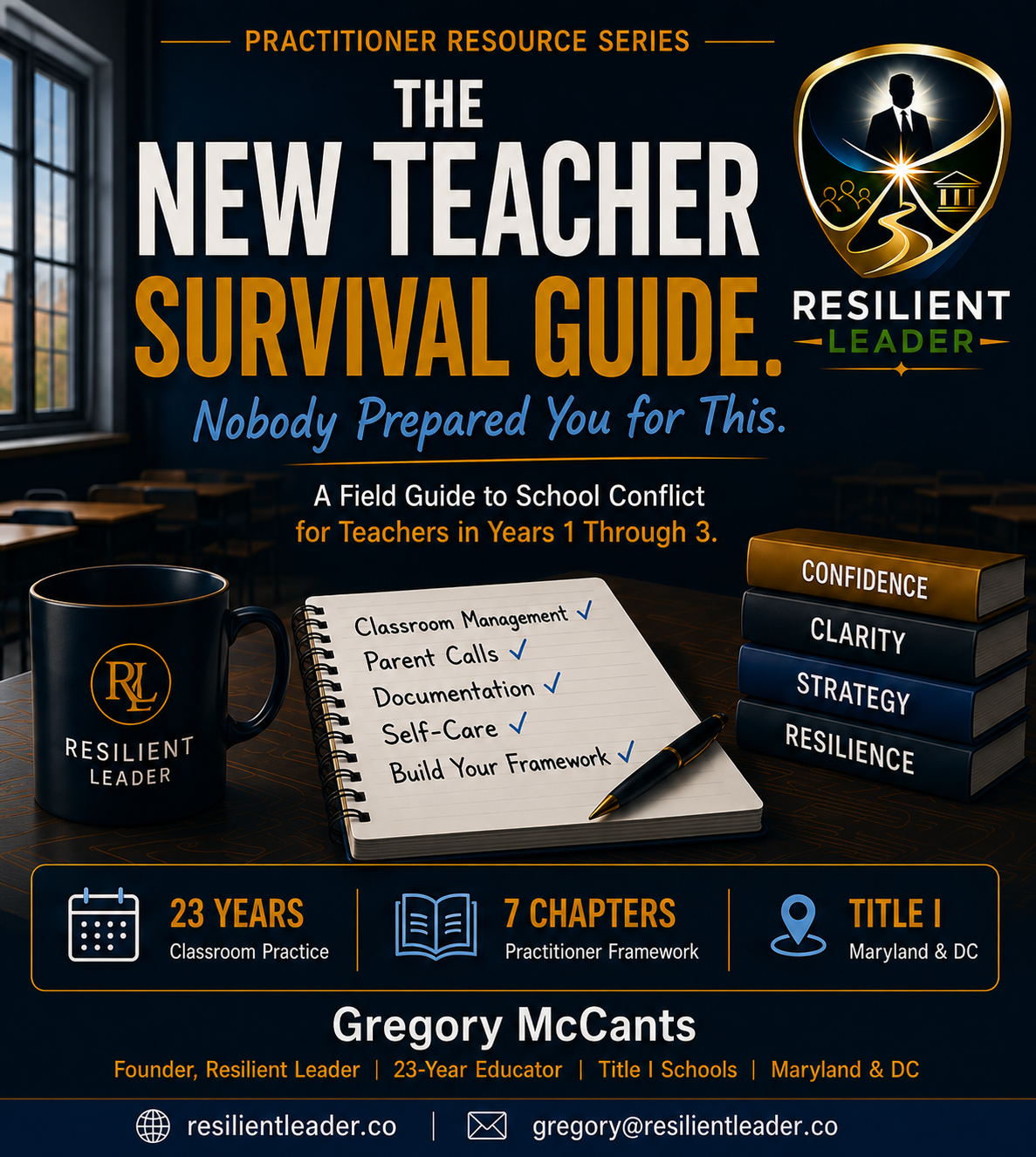


The New Teacher Survival Guide — A Field Guide to School Conflict for Teachers in Years 1 Through 3
Nobody told you the hardest part was the conflict. This guide is the chapter they left out.
You learned exactly how to write a flawless lesson plan in your university methods courses. You student-taught alongside a protective cooperating teacher who safely stepped in to handle the ugly behavioral blowups before they ever reached your desk. You passed your certification exams with flying colors, signed your contract, and were told you were completely ready for the room.
Then the school year started. And nobody told you what to do when a student looks you dead in the eye during third period and says something that makes the entire room go instantly quiet . Nobody prepared you for the toxic parent email that hits your inbox at nine in the evening, or the heavy cognitive load of writing a discipline referral when you are still physically shaking from a classroom confrontation.
The hardest part of public education isn’t delivering the content. It is surviving the conflict.
The national data maps out this preparation gap with brutal accuracy. A landmark McKinsey survey reveals that roughly one-third of teachers plan to abandon their positions, with outright quitting skyrocketing to account for 64% of all teacher exits. In states like North Carolina, green educators in their first three years are hollowing out and leaving at a rate of 15.1%—significantly higher than their veteran peers. Drop these identical early-career variables into a Title I environment, and the attrition rate instantly doubles.
Teachers aren't leaving in years one through three because they can't teach the standards. They leave because the emotional and relational cost of the unmitigated conflict completely overrides what their internal nervous system can hold.
The first mistake we make is believing that classroom behavior flips are personal failures. It is a lie that drives early-career talent into immediate isolation. Most classroom friction is a pure design problem, not a character defect.
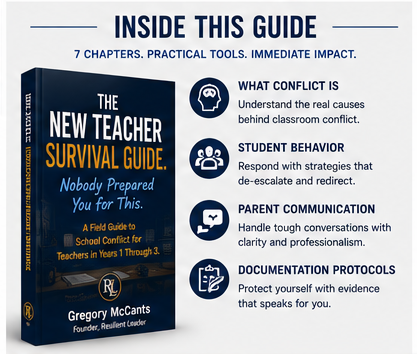
Written by a 23-year Title I school administrator, dean, and classroom teacher, The New Teacher Survival Guide provides the exact process infrastructure skipped by teacher preparation programs . It strips away abstract educational theories to give you plain-language frameworks, immediate script directives, and factual documentation models designed to protect your career under heavy pressure. Stop internalizing a broken system's operational gaps as personal incompetence. Reclaim your authority, protect your weekends, and build the internal practices required to stay in this profession for the long run.
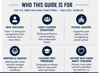
Who This Is For
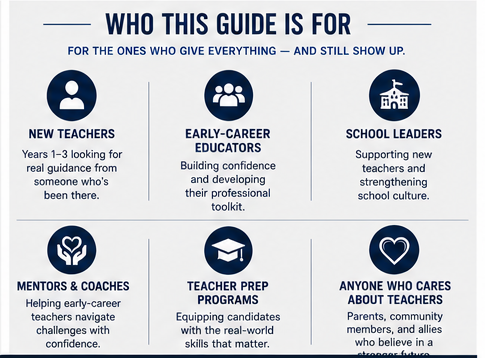
- Teachers in Years 1 Through 3 who are completely overwhelmed by boundary-testing students, adversarial parent calls, and the exhausting load of daily behavior tracking .
- Alternative Route & Transitioning Educators who entered the classroom trenches sideways mid-year without a structured, formal roadmap to manage building power dynamics.
- Instructional Mentors & Induction Coordinators looking for an objective, research-informed tactical framework to onboard early-career talent and prevent first-year burnout.
What You Receive
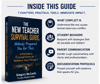
- 7-Chapter Practitioner Framework: A comprehensive navigational blueprint mapping the neurobiology of classroom triggers, relational equity metrics, and administrative request hierarchies.
- The Pre-Response Pause Blueprint: A practiced three-second tactical protocol combining specific physical maneuvers, verbal placeholders, and internal anchors to separate immediate physiological activation from professional decision-making.
- The 3 Categories of Classroom Conflict Diagnostic: An explicit self-check metric to quickly categorize incidents into Relational, Regulatory, or Structural breakdowns before executing a classroom response.
- The Early Parent Contact Phone Sequence: A highly effective four-step communication sequence designed to lower conversational temperatures, open with genuine specific observations, and secure home-to-school alignment.
- The Factual Language Referral Matrix ("Quick Swaps"): A tabular reference index detailing exactly how to purge emotional, conclusion-heavy labels like "defiant," "disrespectful," or "attitude problem" from official digital records and swap them for legally defensible, observation-forward statements.
- The End-of-Week Conflict Reflection Practice: A rapid 5-to-10 minute closing protocol utilizing three precise diagnostic questions to halt the accumulation of unprocessed emotional labor and prevent quiet attrition.
- The New Teacher Conflict Toolkit Script Bank: A ready-to-deploy collection of copy-and-paste verbal models, including Pushed-Back Redirections, After-Class Private Resets, Colleague Thought-Partner Outreach, and Visibility-Forward Administrator Requests.
What It Pairs With
To erect a bulletproof, automated shield across your entire instructional environment, this field guide links natively with:
- The ELA & Middle School Math AI Prompt Packs: For copying and pasting bracketed placeholder inputs straight into generative engines to instantly format UDL modifications, tier station arrays, and differentiated lessons.
- The Counselor’s Playbook: For aligning your daily classroom management loops with the broader restorative circle parameters and multi-dimensional mediation architectures utilized by your building's student services team.
- Veteran AP Field Manual: For pulling advanced upstream referral templates, escalation memos, and objective parent summary arrays that mirror the exact documentation layers required by building leadership.