
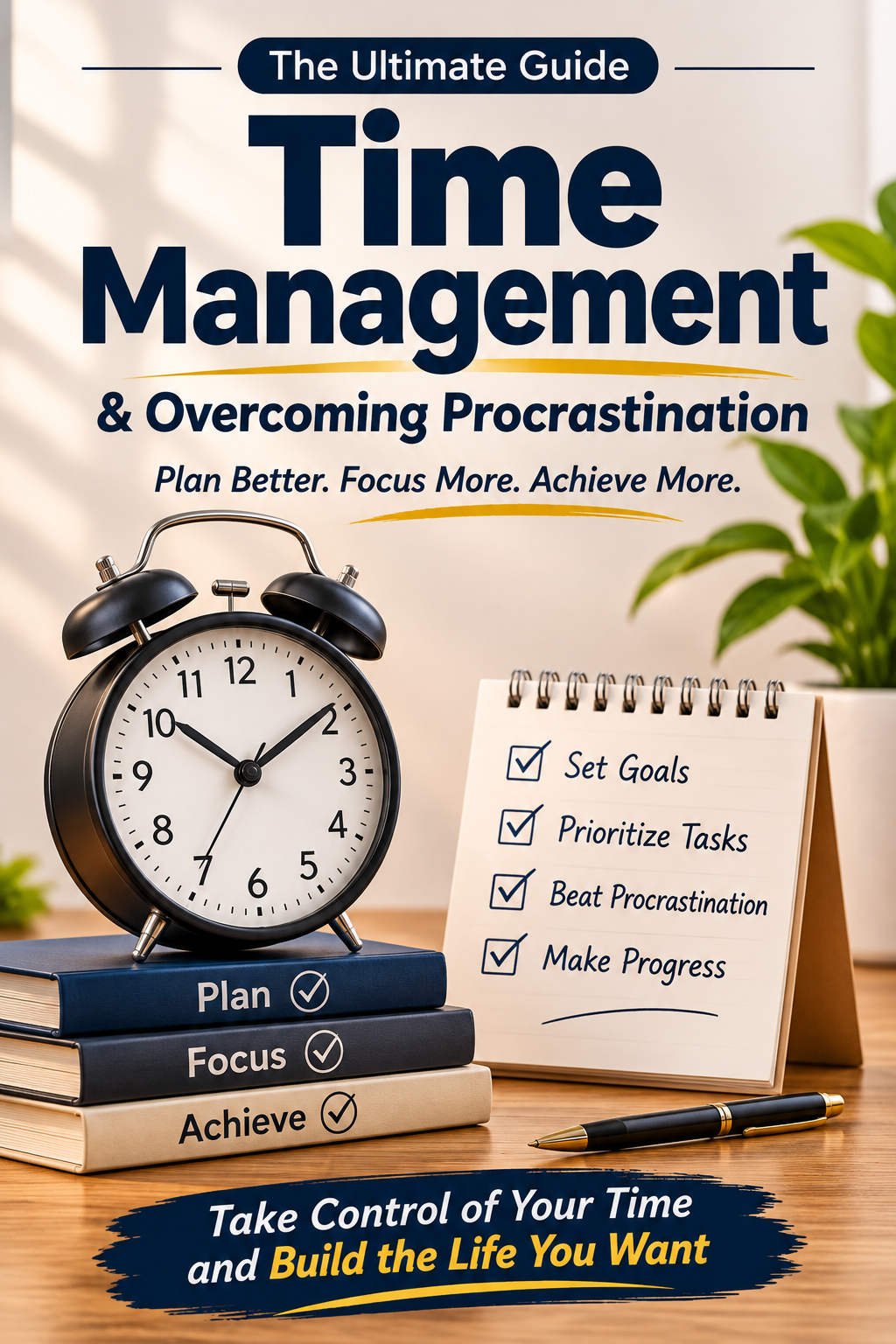
Time Management & Overcoming Procrastination
Content
A practical guide to organizing your time and breaking free from procrastination (Master Your Time), combining explanation, exercises, and tracking:
Why we procrastinate: procrastination is an emotion problem, not laziness (boredom, fear of doing it badly, feeling overwhelmed), plus the difference between procrastination and smart delay.
Knowing where your time goes: a three-day time audit, reading your results, and the Time Value Matrix (protect, manage, reduce, drop).
Setting priorities: from values to 90-day outcomes, the Urgent-Important Matrix, and the 1-3-5 rule (one big task, three medium, five small).
Realistic planning: a weekly planning ritual, time blocking, honest time estimates (adding a 25 to 50 percent buffer), and planning only about 60 percent of your day.
Beating procrastination in practice: shrinking the start, the five-minute rule, task breakdown, if-then plans, temptation bundling, reducing friction, and self-compassion.
Protecting deep focus: single-tasking, focus blocks (25 to 50 minutes with real breaks), managing energy rather than just time, and defending against distractions.
Handling interruptions: batching messages, saying no with ready-made phrases, delegating, meeting rules, and a library of reply templates.
Building sustainable systems: daily start and shutdown routines, a weekly review, simple tools, and handling setbacks.
30-day plan: a week for awareness and priorities, a week for planning and starting, a week for focus and protection, and a week for systems and sustaining.
Printable appendices: a baseline quiz, a daily plan template, a progress scorecard, FAQs, and a one-page summary.
Benefits
Clear priorities: you know what truly deserves your time instead of chasing urgent but unimportant things.
Easier starts: tools that make the first step so small the feeling of avoidance cannot stop you.
Deeper focus: better quality work, done faster and with fewer mistakes.
Plans that work: the guide anticipates interruptions and builds in buffers, so your plan survives ordinary days.
Less stress: less guilt and pressure from piled-up tasks, and a shutdown routine that helps your mind rest.
Healthy boundaries: saying no and delegating kindly and clearly without harming relationships.
Lasting habits: a simple system (a notebook, a calendar, and a task list) that needs no complicated apps, with measures to track your progress.