
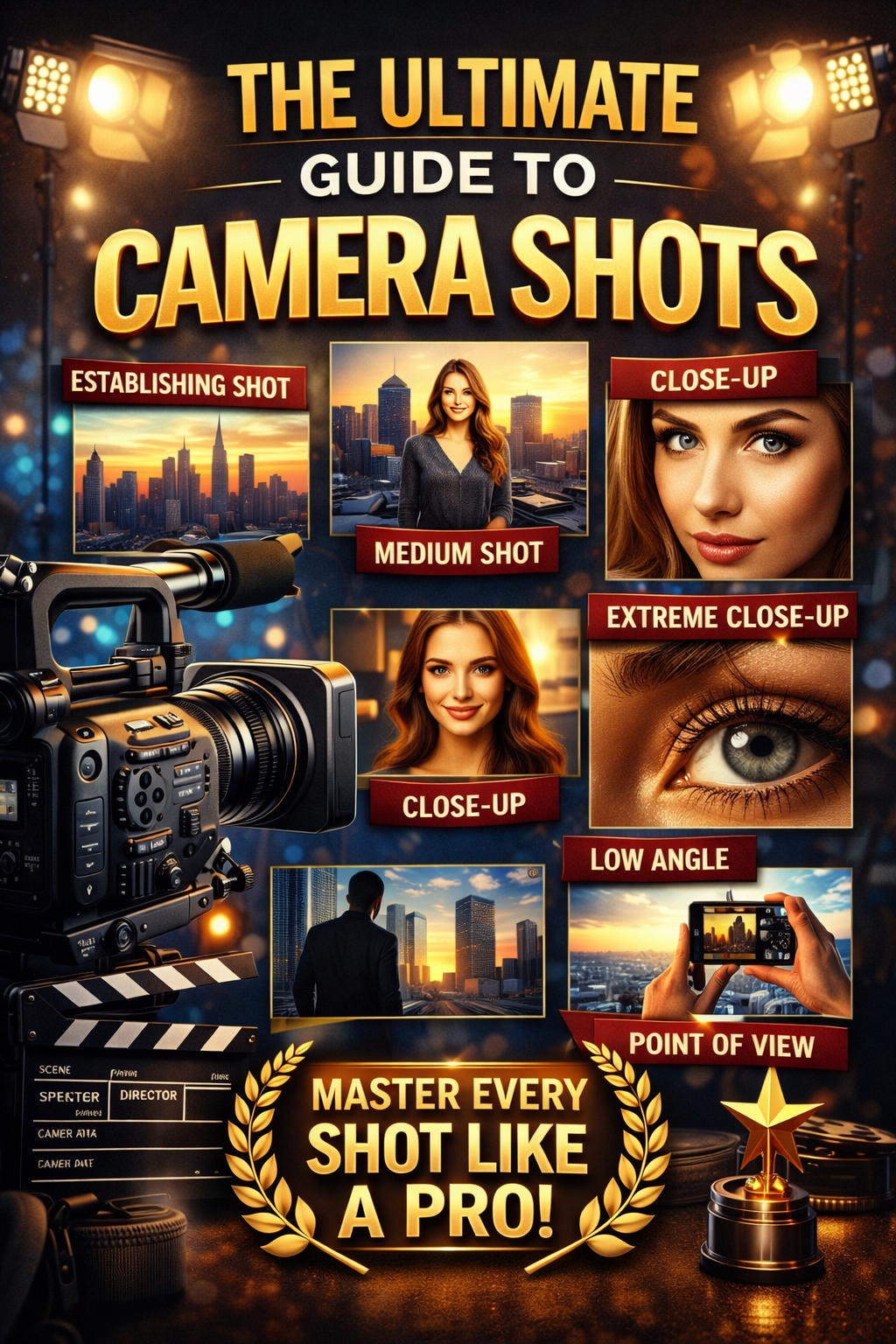
THE ACTOR'S ULTIMATE GUIDE TO CAMERA SHOT SIZES — MASTER SELF TAPE FRAMING, FILM AUDITIONS AND ON CAMERA ACTING FOR ACTORS IN KENYA AND WORLDWIDE
Master camera shot sizes for acting and self tapes with this practical PDF guide. Learn close ups, medium shots, wide shots, framing, eyeline and on camera techniques to improve auditions, build confidence and stand out in Kenya and worldwide.
When the camera changes everything
You deliver the scene perfectly. Your character is alive. Your emotions are real. Your preparation is solid.
Then you watch the recording back, too close, too far, too much movement, wrong framing.
The performance may be strong but the camera is not capturing it the way you intended.
In film and television, camera distance changes how the audience experiences you. A close-up can expose the smallest emotional shift. A medium shot can reveal your physical behaviour. A wide shot can make your relationship with the environment part of the story.
If you do not understand what the camera is doing, you are leaving part of your performance to chance.
Great acting is not only about the performance
Actors often focus heavily on lines, character, emotions and memorisation.
On camera acting adds another language: the camera.
Actors preparing self tapes and film auditions can struggle with:
. Choosing the wrong framing for a Self tape.
. Not understanding the difference between close-ups, medium shots and wide shots.
. Moving outside the camera's frame.
. Overacting because they do not understand how powerful the lens can be.
. Losing emotional detail because the framing is too distant.
. Becoming stiff because they are afraid of moving.
. Feeling uncertain about how camera shots affect performance.
Whether you are preparing for acting in Kenya, auditions in Nairobi, a film production in Lagos or Johannesburg or global casting opportunities, understanding camera shot sizes gives you another professional tool.
Turn camera knowledge into acting power
The Actor's Ultimate Guide to Camera Shots Sizes is a practical PDF designed to help actors understand how different camera framings affect performance.
Think of it as your camera language shortcut.
Instead of simply asking, "How should I act this scene?", you will begin asking smarter questions:
. What is the camera seeing?
. How much of my body is visible?
. How intimate should the performance feel?
. Where should my eyeline be?
. How does movement change within this shot?
. What does the framing communicate about the character?
This knowledge can help you make more precise choices for self tape auditions, film scenes, television performances and on camera acting.
Learn the language of the lens
Understanding shot sizes is an essential part of becoming a more camera aware actor.
The guide introduces concepts commonly encountered in professional film and television production, including the relationship between:
. Actor performance
. Camera distance
. Framing
. Eyeline
. Movement
. Emotional intensity
. Storytelling
These principles are relevant whether you are working toward productions in Hollywood, London, Nairobi, Mumbai, Toronto, Lagos, Johannesburg or other international markets.
You do not need to become a cinematographer. You simply need to understand enough about the camera to make better acting choices.
From camera uncertain to camera ready
Before:
. You are not sure how close or far the camera should be.
. Your self tapes sometimes feel visually awkward.
. You worry about moving outside the frame.
. You do not understand why different shots feel different.
. You focus so much on acting that you forget the camera is telling part of the story.
After:
. You understand common camera shot sizes.
. You become more aware of your framing.
. You make stronger self tape choices.
. You understand how camera distance affects performance.
. You can deliver smaller, more controlled performances when the lens is close.
. You approach film auditions with greater technical confidence.
The goal is not to make you perform bigger. It is to help you understand when the camera allows you to perform smaller, deeper and more truthfully.
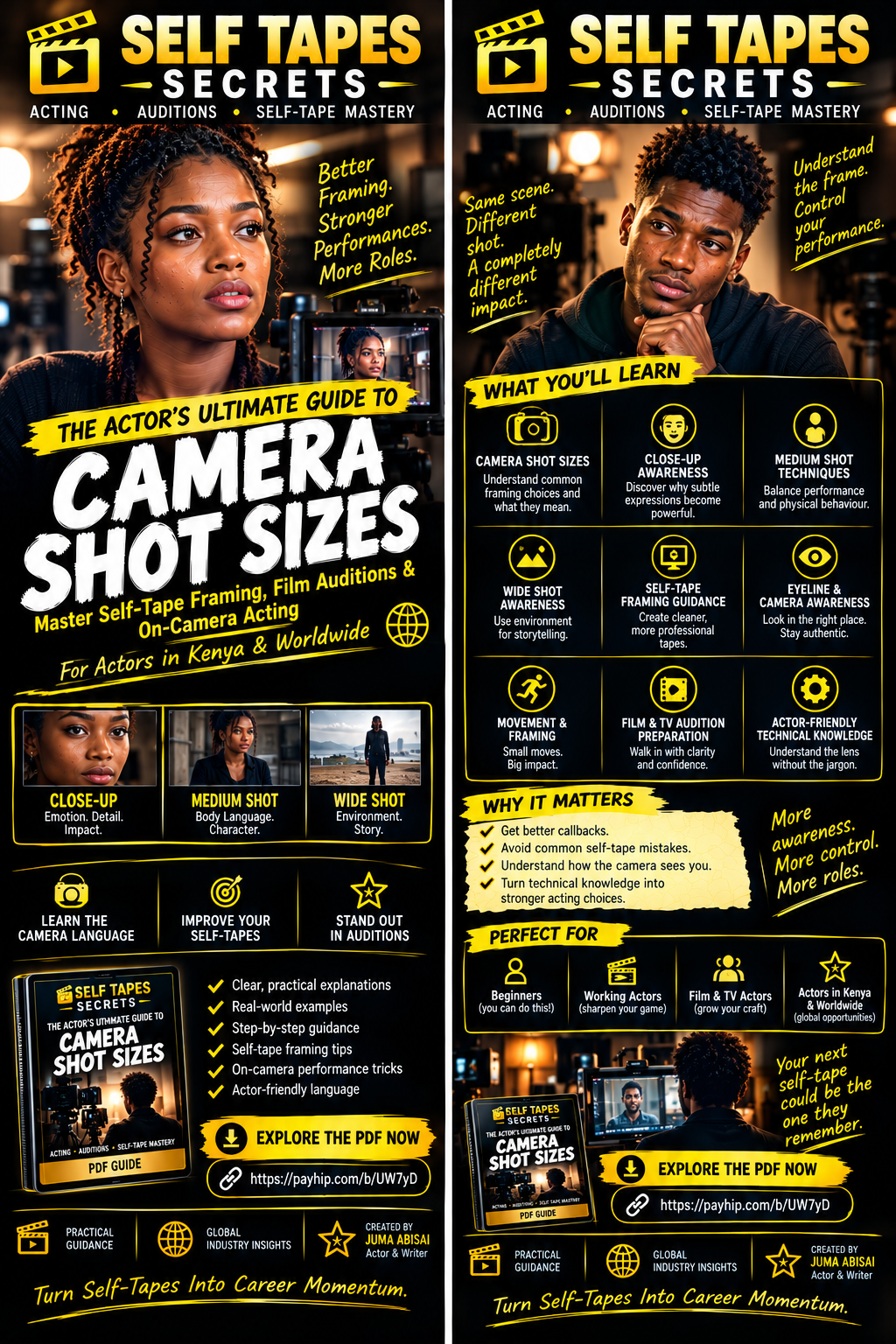
What is inside — Features + Benefits
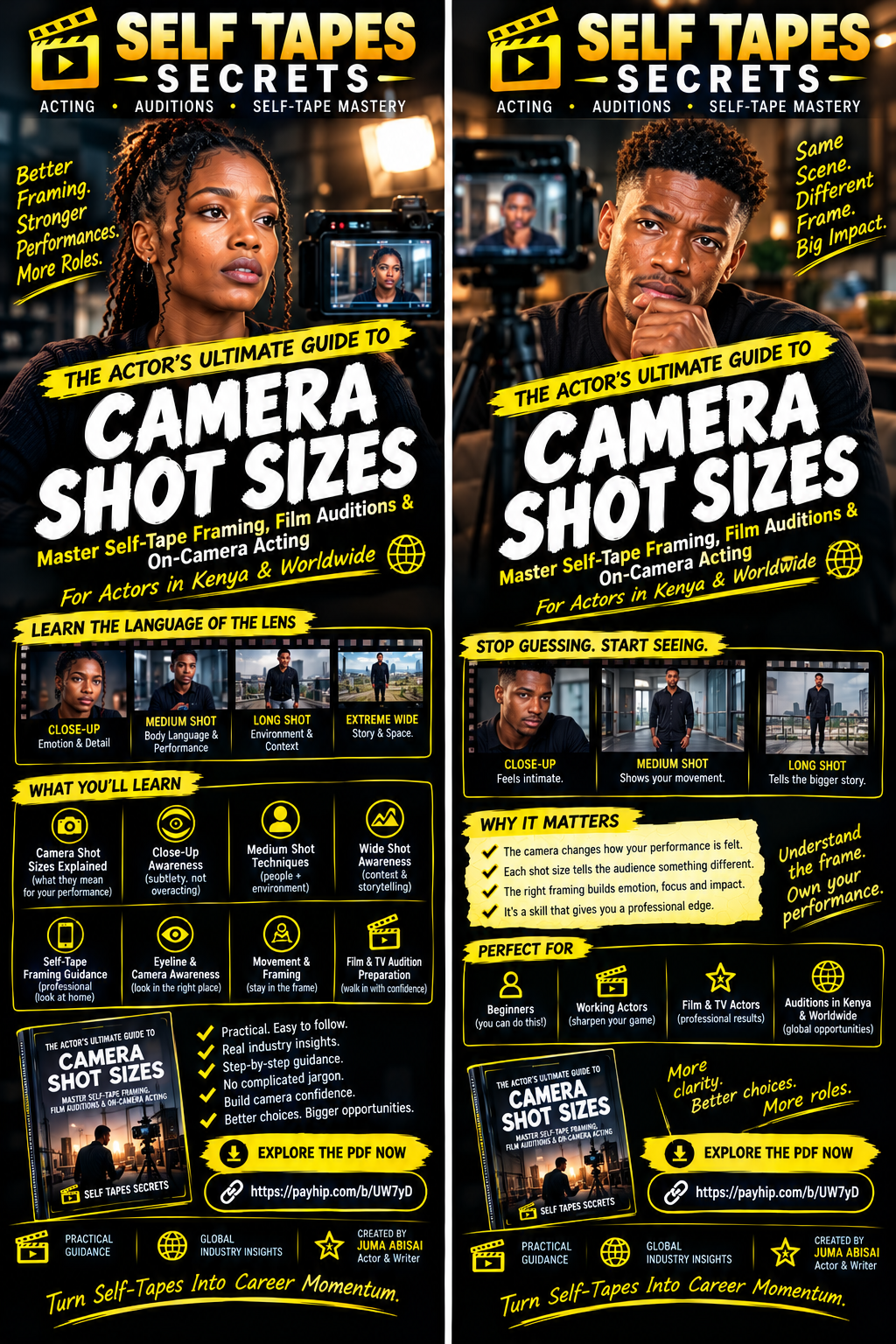
Camera shot sizes explained - Understand common framing choices and what they mean for actors.
Benefit: Build practical camera awareness for auditions and filming.
Close up performance awareness - Discover why subtle facial expressions and emotional shifts become powerful in tighter shots.
Benefit: Stop overacting and learn to trust the camera.
Medium shot techniques - Explore how the camera captures both performance and physical behaviour.
Benefit: Make your body language work with the frame instead of against it.
Wide shot awareness - Understand how distance and environment influence performance.
Benefit: Maintain believable physical storytelling even when the camera is farther away.
Self tape framing guidance - Apply shot size knowledge when recording auditions from home.
Benefit: Create cleaner, more professional looking self tapes.
Eyeline and camera awareness - Understand the importance of looking in the right place without appearing artificial.
Benefit: Strengthen your on camera authenticity.
Movement and framing - Learn why seemingly small movements can affect what the audience sees.
Benefit: Stay connected to the scene without fighting the frame.
Film &and television audition preparation - Use camera knowledge as part of your audition preparation process.
Benefit: Walk into auditions and self tapes with greater clarity and confidence.
Actor friendly technical knowledge Learn camera concepts without getting buried in complicated filmmaking terminology.
Benefit: Understand the lens while keeping your attention where it belongs, on the character.
Who is this guide for?
. Actors preparing for self tape auditions
. Beginners learning on camera acting
. Film and television actors
. Theatre actors transitioning to screen
. Actors attending auditions in Nairobi
. Actors developing their careers in Kenya
. Actors pursuing international casting
. Actors looking for practical self tape audition tips
. Actors who want to understand camera technique without studying cinematography
Whether you are taking your first audition or building a professional screen career, camera awareness can become another advantage in your toolkit.
This guide is designed around questions actors commonly ask when developing their screen skills:
. How do camera shot sizes affect acting?
. What shot size should actors use for self tapes?
. How can actors improve self tape auditions?
. How do you act for the camera?
. What is a close-up in acting?
. What is a medium shot in film?
. How can actors look more professional on camera?
. How can I improve my auditions fast?
. How can I stand out in auditions?
. What camera techniques should actors know?
Step nto the frame with confidence
The camera is not your enemy. It is your storytelling partner.
Learn how to understand the frame, control your performance and make smarter on camera choices.
Download The Actor's Ultimate Guide to Camera Shots Sizes and start becoming a more confident, camera ready actor one frame at a time.
Your next self tape could be more than a recording. It could be the moment someone remembers you.