
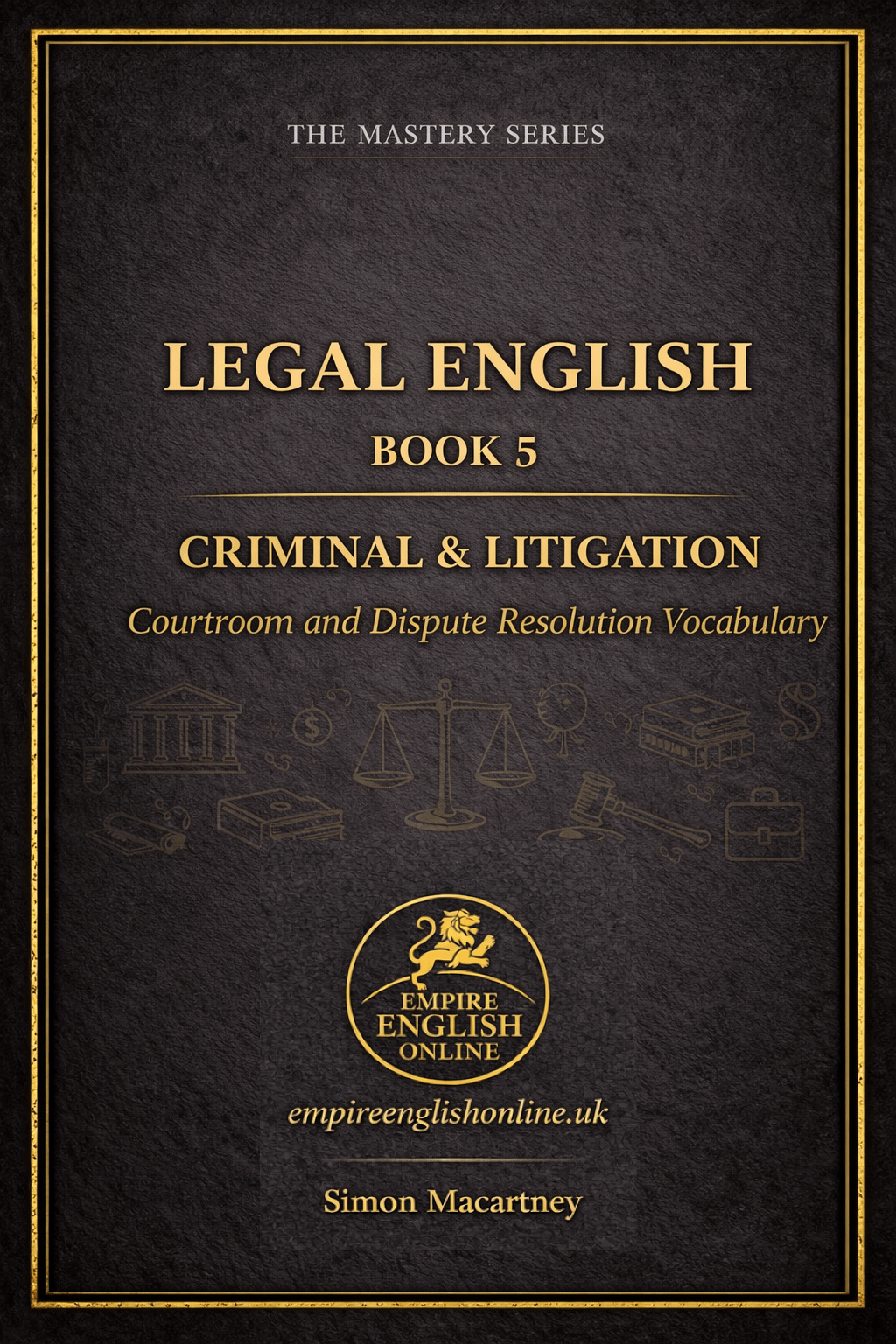
LEGAL ENGLISH: BOOK 5: Criminal & Litigation
The Language of the Courtroom
From arrest to appeal, plea to verdict. Master the vocabulary of criminal law, civil litigation, evidence, and dispute resolution. Essential for advocates and litigators.
WHAT'S INSIDE
Chapter 1: Criminal Law & Procedure
Arrest, bail, charge, indictment, plea, conviction, sentence, magistrates' court, Crown Court...
Chapter 2: Civil Litigation
Claimant, particulars of claim, defence, disclosure, summary judgment, injunction, costs...
Chapter 3: Evidence
Burden of proof, hearsay, cross-examination, admissibility, privilege, expert evidence...
Chapter 4: ADR & Arbitration
Mediation, arbitration, award, settlement, Tomlin order, New York Convention, LCIA...
Chapter 5: Courtroom Language & Etiquette
Your Honour, My Lord, learned friend, submissions, skeleton argument, dock, bench...
STRONG POINTS
✓ IPA Pronunciation — Command respect in court
✓ Dual Examples — Advocacy language + client explanations
✓ UK/US Differences — Claimant vs plaintiff, and more
✓ Common Mistakes — "Not guilty" not "innocent"
✓ Usage Notes — CPR and CrimPR references
✓ Plain English — Demystify court for clients
WHO NEEDS THIS
- Litigators and trial lawyers
- Criminal defence solicitors
- Barristers and advocates
- Prosecutors
- Court clerks and staff
- Arbitrators and mediators
- Paralegals in litigation
- Law students preparing for advocacy
SAMPLE ENTRY
burden of proof /ˈbɜːdən əv pruːf/ (noun phrase)
Definition: The obligation to prove a fact or facts in dispute to the required standard.
Formal: The burden of proof lies on the prosecution to prove each element of the offence beyond reasonable doubt.
Practical: The burden of proof is who has to prove what—in criminal cases, the prosecution must prove you're guilty, not the other way round.
Usage: Key collocations: discharge the burden, reverse the burden, legal burden, evidential burden. Criminal: beyond reasonable doubt. Civil: balance of probabilities.
UK vs US: UK: Burden of proof | US: Burden of proof (same concept, same standards)
Common mistake: ❌ "The defendant must prove his innocence" ✓ "The prosecution must prove guilt" (the burden rarely shifts to the defendant)
Empire English Online
Opening doors to the world through English