

Find your way through your story—and have fun doing it!
If you're anything like me, you may have started with a story you were excited about, only to reach a point where you weren't sure what should happen next.
Maybe you're halfway through and the story has lost its direction. Or you've finished a draft, but you can tell something isn't working and you don't know where the problem is.
Or maybe you're just getting started, with characters and ideas you love, but you're not sure how to turn them into a story that actually holds together.
I went through all of those things. I tried different methods, wrote more drafts than I want to admit, and spent years dealing with half-finished stories—all the while worried that I'd never become the writer I wanted to be.
Eventually, I created my own storytelling system. I combined things I had learned from other systems into a more flexible plan that helps me more easily find the path through a book. Now I know when I start a new book—or when I'm getting to the difficult middle of a novel—that I can use this series of maps to avoid getting stuck. No more banging my head against the wall trying to figure a story out!
Now I'm sharing that system with you, because telling stories shouldn't feel like trudging through a swamp. It should feel like discovering where the story wants to go.
Intro to Map to Storyland
This is the intro video included in the course where I describe what Map to Storyland is and why I developed it for myself and other writers. It's provided as a free preview for you here.
A System for Where You Are

Starting a New Story?
Use Map to Storyland to layout your story before you start, so you know where you're going. Writers can also use the system to test new ideas and find out which one is best to pursue!

Feeling Stuck?
If you’re halfway or two-thirds of the way through your story and suddenly you can tell things aren't working, you can map what you already have, find the places that are still foggy, and work forward from there.

Finished a Draft?
If you’ve finished a draft and something feels off or you know the impact is shallow, you can use the maps to look underneath the scenes and find the weak part of the story path.
A Flexible System That Works the Way You Write
There’s no single “right” way to use Map to Storyland.
If you’re learning story structure or starting a new book and want more guidance, you can work through the system from beginning to end. Each map builds on the one before it, with video training, examples, and Rescue Kits to help you understand what your story needs.
If you like to plot before you write, you can download the complete set of maps and use them to work out your story ahead of time. The video training is there whenever you want help with a particular part of the structure or run into something you’re not sure how to solve.
And if you’re more of a discovery writer (pantser), you can use Map to Storyland alongside your draft. Work with the part of the map you need, return to your manuscript, and come back when you’re ready to see farther down the road.
Map to Storyland can be a full story-building system, a plotting tool, or a guide you return to as your book develops.
You choose the route that works for you and your story.
What You Get in This System
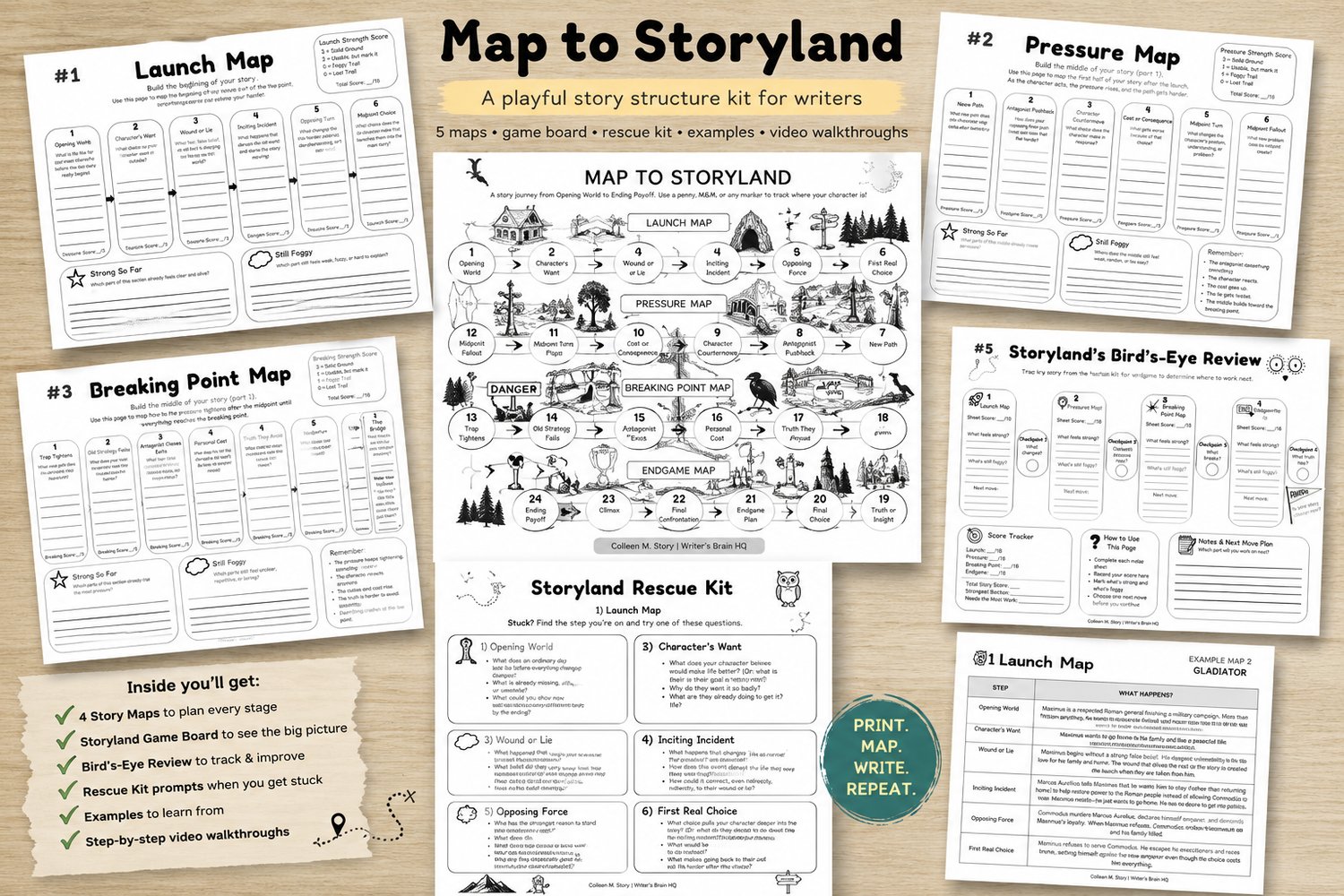
Map to Storyland gives you a complete visual system for seeing your story from beginning to end, along with step-by-step video teaching, prompts for when you get stuck, and examples that show you how the maps work inside actual stories.
The Launch Map
Build a beginning that gives the rest of your story somewhere to go. The Launch Map helps you establish the forces that will drive the story forward so you’re less likely to reach the middle and discover that you never gave yourself enough to build on.
The Pressure Map
Turn the first half of your middle into a chain of cause and effect instead of a collection of scenes. The Pressure Map helps you keep the story moving, strengthen the conflict, and make sure each development gives your character something new to deal with.
The Breaking Point Map
Take everything that has been building through the middle and tighten it until your character can no longer keep going the way they have been. The Breaking Point Map helps you deepen both the external conflict and the emotional pressure so the Low Point feels earned rather than dropped into the story because “this is where the Low Point goes.”
This map also includes The Bridge and Wider View, helping you create a believable transition from that lowest point into the change that makes the ending possible.
The Endgame Map
Build an ending that grows naturally out of the story you’ve already written (or planned out). The Endgame Map helps you connect your character’s internal journey with the final external conflict so the climax and ending feel like the payoff to the whole story, rather than a separate section you have to invent when you finally get there.
The Overall Map: Storyland Bird’s-Eye Review
Step back from the individual scenes and look at your story as a whole. This final Overall Map helps you see which sections are already working, where the path still gets foggy, and what deserves your attention before you spend hours revising the wrong thing.
The Map to Storyland Game Board!
This is the fun part! Put the entire story journey in front of you at once. The Game Board gives you a playful visual way to track where your character is, see how the major sections connect, and keep your progress visible as you write.
The Storyland Rescue Kit
When you reach a part of the map and your brain answers with a magnificent blank stare, this is where you go. 😄 Each of the four Rescue Kit pages gives you additional questions designed to jog your brain so you can get your story moving again.
Three Complete Story Examples
You’ll also see the entire Map to Storyland system applied to three very different stories.
Emma’s Story is an original example created for the course, so you can watch a story take shape across all four maps.
"Gladiator" shows how the maps work in a story driven by powerful external conflict, sacrifice, and a protagonist whose core values remain remarkably steady.
"Good Will Hunting" shows the system working in a deeply emotional character arc where the protagonist’s wounds and defenses shape nearly every major choice.
In the videos, I also bring in examples from "The Lion King" and "Star Wars." Seeing different stories mapped out makes one thing clear: this system isn’t about forcing every novel into the same formula. It helps you see the structure that makes sense for the story you’re telling.
Six Teaching Videos to Walk You Through the System
You won’t be handed a stack of maps and left to decipher them on your own. In the six teaching videos, I walk you through Map to Storyland and show you how to actually use it. I explain what to look for, why different parts of the story matter, how the sections connect, and what can go wrong when one part of the path isn’t doing enough work.
The goal is for you to understand why your story is working, where it may be losing its way, and what you can do next.
Most story-planning systems come with their own set of rules.
Put this here. Hit this beat now. Reach this point by the time you get 66 percent of the way through the story.
For some writers, that works really well, but it just didn't work for me. I tried Save the Cat, the 7-step story system, and many other reputable structures, but they just didn't work with my creative brain.
Through a lot of trial and error, I had to come up with a system that would help me tell a story in a way that felt intuitive, without requiring me to be more analytical than I naturally am.

I spent years trying to find a way to see the whole story.
I tried different approaches, and though I understood what they were teaching, I just couldn't find a way to apply them to my own way of writing. Or at least, not very well. I just ended up struggling even more.
I needed to be able to see my story, and that's what I was missing. How could I make MY story make sense?
I wanted enough structure to keep me from getting lost while still leaving room for the story to surprise me. And I wanted it to feel more fun and playful—like my creativity tends to be anyway—and a lot less like filling out tax forms or spreadsheets (which is how other structures often felt to me).
That became the beginning of Map to Storyland.
What if you could see where your story is going?
Imagine sitting down with your story and being able to see the path in front of you. I'm not talking about knowing every scene, chapter, or tiny detail, but rather knowing where your character is going and how your story is going to unfold.
That changes the experience of writing!
Instead of reopening the manuscript and wracking your brain trying to figure out what should come next (and failing?) imagine the story naturally asking for the next scene because of what happened before?
That's what started happening to me after I developed this system. Suddenly I could see more clearly where the story was going and it was SO much easier to figure out how I was going to get there. I could sit down and write and enjoy it instead of feeling stuck or like what I was creating wasn't going to work.
A Storytelling System You Can Use Again and Again
Map to Storyland isn’t just for the book you’re working on today. Use it to find your way through this story, then come back to the maps, Rescue Kits, and training whenever you start a new book or lose the path in one you’re already writing.
When you purchase: Payhip will ask you to create a customer account so you can log back in anytime and access your Map to Storyland videos, maps, and other materials. It only takes a moment, and everything will be waiting for you inside your course area.

Plotter? Pantser?
Whether you plan your story out completely before you start (plotter) or let it unfold as you go (pantser), this system will work for you!
For plotters, confusion often sets in because they can see all the details, but not the big picture. This system helps them get a bird's-eye view of what the story needs so they can get moving again.
Pantsers (or discovery writers) can fill out the entire mapping system while still enjoying the magic of discovery—or they can fill out just part of it, write for a while, and return when needed to make sure the plot is unfolding as it should.
You get to decide how much you want to know. The system isn’t here to lock you into a box. It will help you ask better questions about the story you’re already trying to tell.
You don’t have to figure out the whole book today.
What is my midpoint?
What is my climax?
Does my antagonist have enough agency?
What happens in Act Three?
Should I change the subplot?
Why isn’t the character arc working?
Often, we try to solve the entire novel at once, which quickly leads to overwhelm or procrastination.
Map to Storyland allows you an easier approach.
Where are you now?
Then:
What does the story need from here?
You can always zoom out and look at the whole journey, but you can also put your finger on one place on the map and work from there. That makes a very large project (like a book!) feel workable again.
So what exactly is Map to Storyland?
Map to Storyland is a guided story-mapping system built around five visual maps that follow the movement of a story from its opening through its ending, along with a story game board (!) that lets you pull everything together and see the complete journey.
You’ll work through:
- The Launch Map, which helps you set up the beginning of the story in such a way that the rest of the story is much easier to write!
- The Pressure Map focuses on what matters as you move into the middle of the story—raising the pressure in a way that fits your characters.
- The Breaking Point Map helps you tighten the second half of the middle, taking you through each exciting turn until your character reaches the dreaded low point.
- The Endgame Map carries the story through the character’s final choice, the climax, and the final image.
- The Overall Map gives you a place to bring what you discovered in the other four maps into one place where you can get a bird's-eye view of the entire path.
- Then the Storyland Game Board taps into the magic of play to help you track your progress and follow your character from beginning to end.

Who is Map to Storyland for?
- The writer sitting on a promising idea and wondering whether there’s enough story there.
- The writer who started with momentum and hit that strange middle-of-the-book bog where everything feels wrong.
- The writer with a finished draft who can feel that something isn’t holding together, or that the impact is weak.
- The experienced writer who already knows how to write a novel and would simply like the next one to involve less circling, less backtracking, and fewer afternoons spent glaring at Chapter 23.
- The writer who has tried other structure systems and keeps thinking: I understand the system. But it's not helping me with my book.

Who probably won’t love it?
If you want a system that tells you exactly what scene to write at every point in the book, Map to Storyland probably isn’t going to give you enough rules.
- It won’t write your plot for you.
- It won’t hand you a predetermined list of beats and tell you to make your story fit them.
You’ll still be making creative decisions.
In fact, that’s the whole point.
Map to Storyland gives you a way to make those decisions with a clearer view of the story around them.
FAQs
-
No. You can start there, but you can also bring in a half-finished or completed draft. If you’re already writing, map what you know first. The unanswered parts can show you where your story may need more attention.
-
You don’t have to map the entire story ahead of time. Use as much of the map as you need. You can work one section, leave unanswered spaces open, or return to the map only when you get stuck. It's very flexible.
-
This system will not give you every scene, beat, or minute turning point. Instead, it helps you rise above the details and see the main path of your story. It's especially helpful for plotters who are stuck! You can work through the entire thing before drafting if you like, but you can also use the maps to see where your current draft may be struggling.
-
Yes. In fact, this is one of my favorite ways to use it. Start mapping each idea and see what begins to develop. You may discover that one of your ideas has much more story hiding inside it than the others.
-
That’s fine. Map to Storyland isn’t meant to replace everything you already know. You can use it alongside three-act structure, beat sheets, or other planning tools. The maps help you examine whether the underlying story path itself is working.
-
It will definitely help you figure that out. The maps ask questions about your character, opposition, choices, pressure, consequences, change, and ending. There's also a "Rescue Kit" included that provides additional prompts to help you get clear on the story you want to tell.
-
Yes. Knowing how to write doesn’t mean every new story politely arrives with road signs installed! Sometimes experienced writers get stuck because they can see too many possibilities. The maps give you a way to evaluate those possibilities against the story you’re actually building.
A Storytelling System You Can Use Again and Again
Map to Storyland isn’t just for the book you’re working on today. Use it to find your way through this story, then come back to the maps, Rescue Kits, and training whenever you start a new book or lose the path in one you’re already writing.
When you purchase: Payhip will ask you to create a customer account so you can log back in anytime and access your Map to Storyland videos, maps, and other materials. It only takes a moment, and everything will be waiting for you inside your course area.