
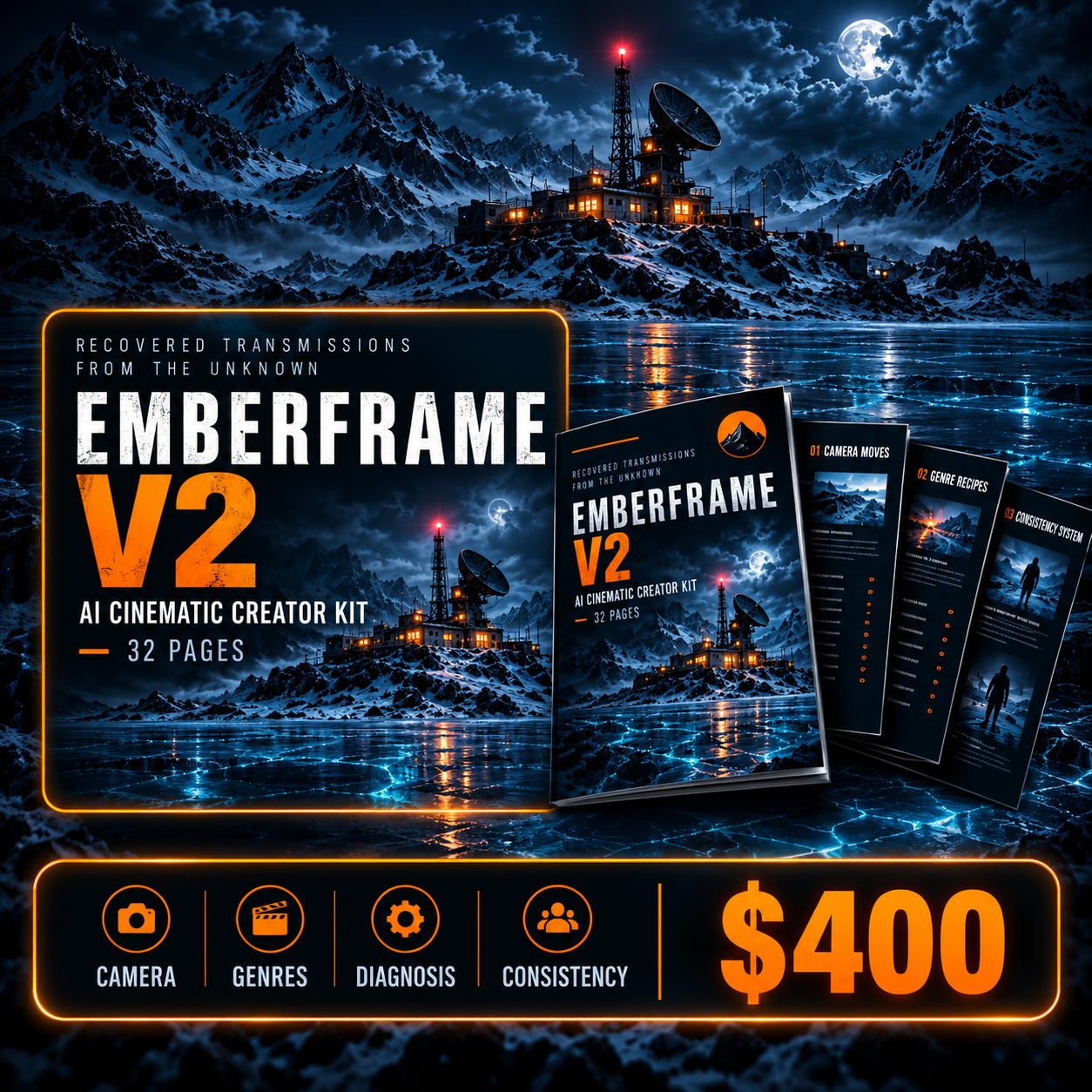
EMBERFRAME V2 — AI Cinemati2
EMBERFRAME V2
THE AI CINEMATIC PRODUCTION SYSTEM
STOP PROMPTING. START DIRECTING.
Most AI video creators don't have a creativity problem.
They have a control problem.
You've tried longer prompts. More cinematic adjectives. More camera words. More negative prompts. More detail.
Yet the result still feels artificial.
The lighting doesn't behave naturally. Motion feels weightless. Depth feels flat. Characters drift between shots. Camera movement doesn't match the scene. And every new generation becomes another round of guessing.
EMBERFRAME V2 changes the workflow.
This isn't a collection of random prompts.
It is a structured AI Cinematic Direction System designed to help creators make deliberate decisions before generating a shot.
Instead of asking:
“What else should I add to my prompt?”
You learn to ask:
“Which visual variable is actually causing the problem?”
THE EMBERFRAME METHOD
10 CONTROLLED VARIABLES
Every cinematic shot is built around a controlled visual system:
SUBJECT → ACTION → CAMERA → LENS → LIGHTING → ENVIRONMENT → ATMOSPHERE → MOTION → COMPOSITION → COLOR
Each variable has a job.
Each decision affects the final image.
Instead of generating hundreds of variations and hoping one works, you build the shot intentionally.
The objective:
Fewer generations.
Better decisions.
More predictable results.
01 — CINEMATIC CAMERA SYSTEM
Master a library of 50+ camera movements organized by creative intent.
Including:
• Push-ins
• Pull-backs
• Tracking shots
• Orbits
• Crane movements
• Reveal movements
• Establishing shots
• Rack-focus combinations
• Parallax movements
• Subject-following movements
• And more
But EMBERFRAME doesn't stop at naming camera movements.
You learn why a movement works, when to use it, and how to construct it inside an AI video prompt.
02 — LENS LANGUAGE
A camera move alone doesn't create cinematic imagery.
The lens changes the visual language.
Learn how focal length influences:
• Perspective
• Compression
• Depth of field
• Subject separation
• Spatial relationships
• Background behavior
• Perceived scale
Understand why the same camera movement can produce completely different results depending on the lens.
03 — CINEMATIC LIGHTING SYSTEM
Stop writing:
“cinematic lighting.”
Start designing the light.
Learn how to construct scenes using:
• Key light
• Side light
• Rim light
• Practical sources
• Motivated lighting
• Hard and soft light
• Controlled contrast
• Atmospheric depth
• Shadow direction
• Light interaction with environments
The goal isn't to make every shot look “cinematic.”
The goal is to make the lighting intentional.
04 — THE MICRO-MOTION RULE
One of the biggest reasons AI video feels artificial:
Nothing behaves like the real world.
EMBERFRAME introduces a practical motion principle:
Even a static shot should contain life.
A curtain moves.
A character breathes.
Steam drifts.
Water ripples.
Fabric reacts to wind.
A practical light flickers.
Dust moves through the atmosphere.
These micro-events create physical continuity and make a generated scene feel less synthetic.
05 — THE FAILURE DIAGNOSIS SYSTEM
THIS IS WHERE EMBERFRAME V2 BECOMES A SYSTEM.
When a generation fails, don't rewrite everything.
Diagnose it.
Ask:
Is the problem composition?
Camera?
Lens?
Lighting?
Motion?
Depth?
Physics?
Consistency?
Then correct the variable responsible for the failure.
EMBERFRAME'S CORE PRINCIPLE:
Don't add more adjectives. Diagnose the broken variable.
This turns prompting from trial-and-error into an iterative creative process.
06 — CHARACTER LOCK SYSTEM
Character consistency is one of the hardest problems in multi-scene AI production.
EMBERFRAME V2 includes a structured Character Lock System for creating reusable character definitions.
Learn how to define:
• Facial characteristics
• Body proportions
• Clothing
• Physical attributes
• Color relationships
• Negative constraints
• Reference-frame anchors
• Scene-specific variations
Then reuse the character architecture across different scenes, cameras and lighting conditions.
The goal:
Same character.
Different shot.
Different environment.
Consistent identity.
07 — SOUND & FOLEY DIRECTION
A cinematic scene isn't only visual.
Sound creates physical presence.
Learn practical principles for:
• Foley
• Environmental sound
• Silence
• Micro sound cues
• Timing
• Impact sounds
• Atmospheric layers
• Sound-to-action relationships
Because a visual can look convincing—
but the right sound can make it feel real.
08 — GENRE RECIPE SYSTEM
Instead of starting from zero every time, use structured cinematic recipes.
Each recipe combines:
CAMERA
LENS
LIGHTING
MOTION
SOUND
COLOR
ATMOSPHERE
Use the structure as your creative foundation.
Then replace the subject and action.
This allows you to move faster without producing generic-looking results.
09 — PLATFORM-AWARE WORKFLOW
AI video models don't always interpret instructions identically.
EMBERFRAME V2 includes a practical 2026 comparison framework covering:
Kling 3.0
Runway Gen-4.5
Veo 3.1
Pika 2.5
Seedance 2.0
Understand where each platform fits into a cinematic workflow and how prompting behavior can differ between tools.
This section is treated as a 2026 workflow snapshot, not a permanent specification sheet.
10 — COLOR & VISUAL CONTINUITY
Color isn't decoration.
It controls:
• Mood
• Emotional tone
• Visual hierarchy
• Scene continuity
• Character separation
• Environmental identity
Learn how to build intentional color relationships instead of randomly adding color keywords.
THE CASE STUDY SYSTEM
12 CINEMATIC BEFORE → AFTER CASE STUDIES
See the system applied to real creative problems.
Each case study follows:
BEFORE
What went wrong.
DIAGNOSIS
Which variable caused the problem.
REASONING
Why the correction works.
AFTER
The redesigned cinematic construction.
You don't just receive the final prompt.
You learn how to think through the shot.
THE PROMPT ARCHITECTURE
Included are ready-to-use fill-in-the-blank frameworks for:
CHARACTER MOMENT
Build intimate character-driven shots.
PRODUCT / OBJECT HERO
Create controlled cinematic product imagery.
ESTABLISHING ENVIRONMENT
Build atmospheric worlds and locations.
The structure does the heavy lifting.
You supply the creative decision.
THE 7-DAY CINEMATIC TRAINING SYSTEM
EMBERFRAME isn't designed to be read once and forgotten.
The included 7-Day Practice System turns the framework into a repeatable workflow.
Each day focuses on a different cinematic control:
Day 1 — Composition
Day 2 — Camera
Day 3 — Lens
Day 4 — Lighting
Day 5 — Motion
Day 6 — Character Consistency
Day 7 — Full Cinematic Shot Construction
By the end, you're not simply collecting prompts.
You're building a cinematic decision-making process.
QUICK REFERENCE SYSTEM
When you need speed, use the condensed reference system.
Includes:
• One-page Core Formula
• Camera reference
• Lens reference
• Lighting reference
• Motion reference
• Character Lock reference
• Diagnostic checklist
• Cinematic glossary
Designed to stay beside your AI video workflow.
WHAT YOU'RE ACTUALLY BUYING
EMBERFRAME V2 isn't valuable because it contains 32 pages.
It's valuable because it gives you a repeatable production methodology.
You're not buying:
❌ Random prompt collections
❌ Endless adjective lists
❌ Generic “cinematic” formulas
❌ Copy-paste tricks
❌ Theory without application
You're buying:
✓ A shot construction framework
✓ A cinematic diagnosis system
✓ Camera and lens control
✓ Lighting methodology
✓ Motion design principles
✓ Character consistency architecture
✓ Sound-design principles
✓ Genre frameworks
✓ Platform-aware workflow
✓ Real before/after analysis
✓ A structured practice system
WHO THIS IS FOR
EMBERFRAME V2 is built for creators who want to move beyond basic AI prompting.
Ideal for:
• AI filmmakers
• Cinematic content creators
• Faceless channel creators
• Visual storytellers
• AI advertising creators
• Product-video creators
• AI character creators
• Small creative studios
• Solo filmmakers
• Content creators building cinematic brands
Especially creators who are tired of generating the same shot repeatedly—
and want to understand why it failed.
THE EMBERFRAME CREATOR RULE
DON'T GENERATE MORE.
DIRECT BETTER.
Every frame should feel like a decision.
Not a guess.
Not another random generation.
Not another pile of adjectives.
A decision.
EMBERFRAME V2
THE AI CINEMATIC PRODUCTION SYSTEM
BUILD FEWER SHOTS.
CONTROL THEM BETTER.
MAKE EVERY FRAME FEEL INTENTIONAL.