



Neuropsychology of Attachment
Your attachment style is not your destiny.
But you cannot change what you cannot see.
You keep ending up in the same patterns. Different person. Same dynamic. Same ache.
That is not bad luck. That is neuroscience.
From the moment you are born, your brain is being wired by your early relationships — building a blueprint for how close to let people get, how much you can trust, and how your nervous system responds when love feels threatened. That blueprint runs on autopilot. Until you make it conscious.
"Most people know something is off in how they relate. What they don't have is a map — of where the pattern came from, why the nervous system responds the way it does, and what to actually do about it." — Dr. Maartje
The science of why you love the way you love
This is not a personality quiz. It is a clinical-grade neuropsychological framework — written in plain language, grounded in research, and designed to actually change something.
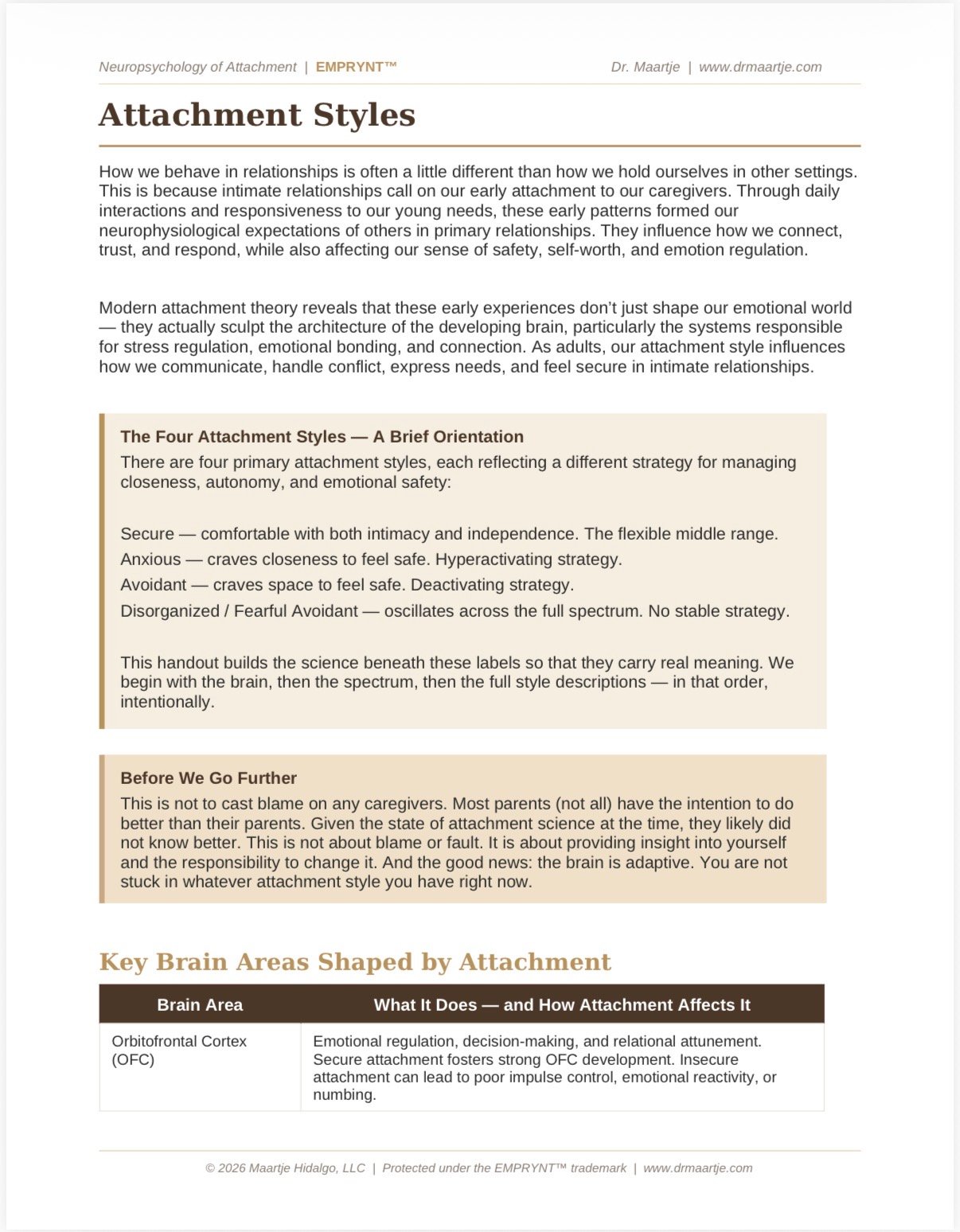
The attached brain — which brain areas are shaped by early attachment, and exactly how that shapes your adult patterns. The amygdala, the orbitofrontal cortex, the insula — not as abstract anatomy, but as the machinery running your relationships.
The attachment spectrum — anxious and avoidant as two poles of a continuum, with secure as a flexible range in the middle. Not a fixed type, but a set of capacities anyone can build.
The glass metaphor — why the anxious nervous system craves closeness to feel safe, and the avoidant nervous system craves space. What happens when they meet in the same relationship. And what each needs to learn to meet the other.
Secure attachment qualities — a concrete, specific picture of what secure attachment actually looks and feels like, in yourself and in how you show up for others. The north star, not just the diagnosis.
Regulation by style — targeted emotion regulation tools for anxious and avoidant patterns. How to give space without interpreting it as abandonment. How to read the other person's glass before you pour. How to empty yours so you can actually hold space for someone else.
Four clinical exercises — each with a detailed explanation of which brain areas they activate and how they begin to rewire the attachment pattern at a neurological level. The science doesn't just explain the exercises. It's the reason they work.
What's inside
- The neuropsychology of attachment — how the amygdala, OFC, insula, ACC, and HPA axis are shaped by early caregiving and what that means for your adult relationships
- The attachment spectrum — anxious vs. avoidant as a horizontal continuum, with the fearful avoidant bouncing across the full range
- The glass metaphor — the emotional capacity difference between anxious and avoidant, and how to honor both
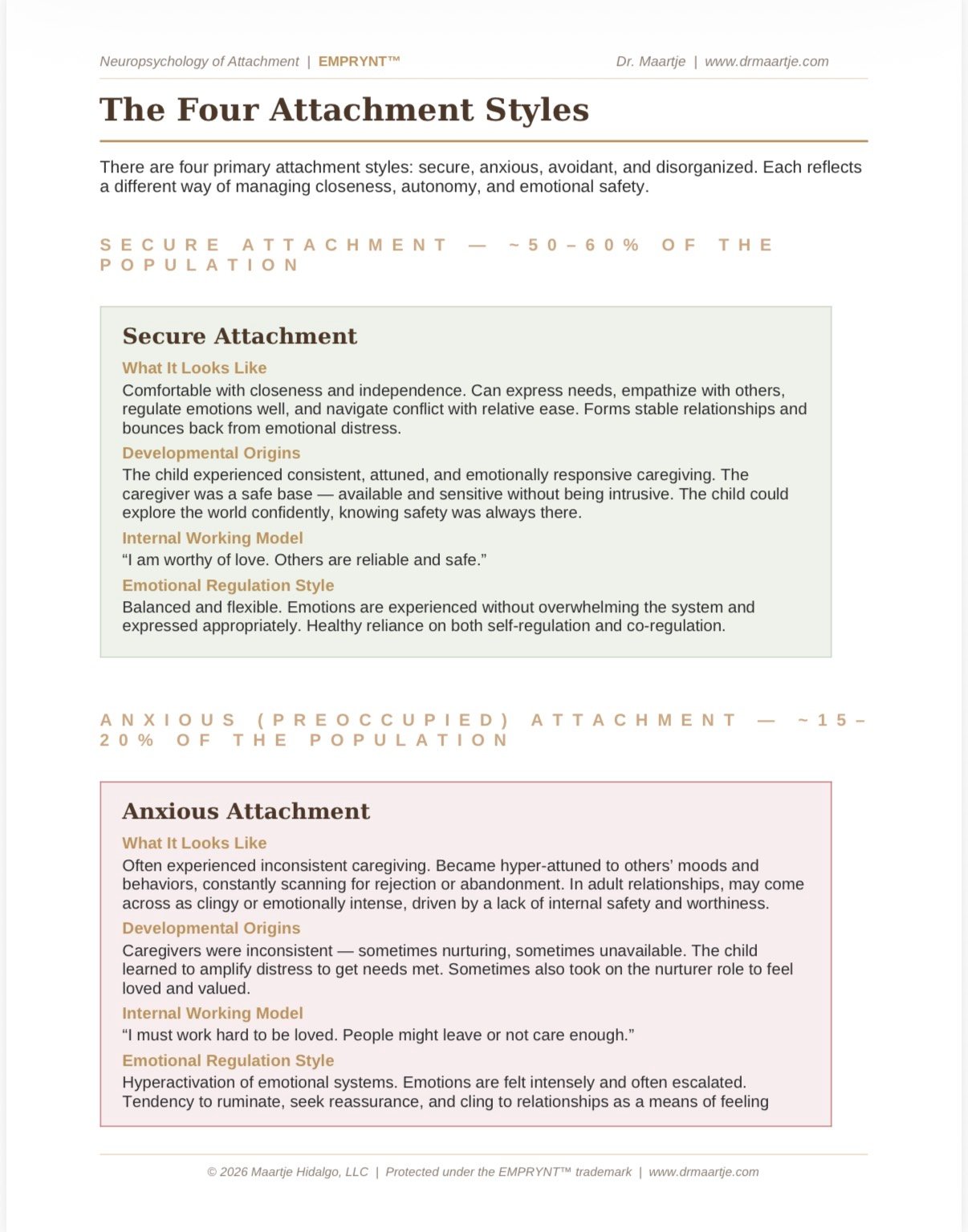
- All four attachment styles — developmental origins, internal working models, and regulation strategies for each
- A 14-quality secure attachment self-assessment — rated across two dimensions: in yourself and with others
- Emotion regulation tools specific to your style
- A cycle-tracking exercise that takes you from trigger all the way down to underlying need
- An 18-item attachment style quiz with scoring and guidance on mixed results
- Writing space throughout for reflection
This workbook is for you if —
- You keep attracting the same dynamic in relationships, even when the person is completely different.
- You oscillate between craving closeness and pushing people away — and you don't fully understand why.
- You've read about attachment styles online but want something with real science and practical tools behind it.
- You're in a relationship where one of you pursues and one withdraws — and neither of you can stop.
- You're doing the work on yourself and want to understand what's actually happening in your brain, not just your behavior.
- You're ready to stop blaming the other person and start understanding your own nervous system's role in the pattern.
This workbook is grounded in peer-reviewed research — not wellness trends. Every framework is sourced. Every exercise connects back to a specific brain mechanism. Because understanding why something works is half of why it works.
© 2026 Maartje Hidalgo, LLC | Protected under the EMPRYNT™ trademark ·