

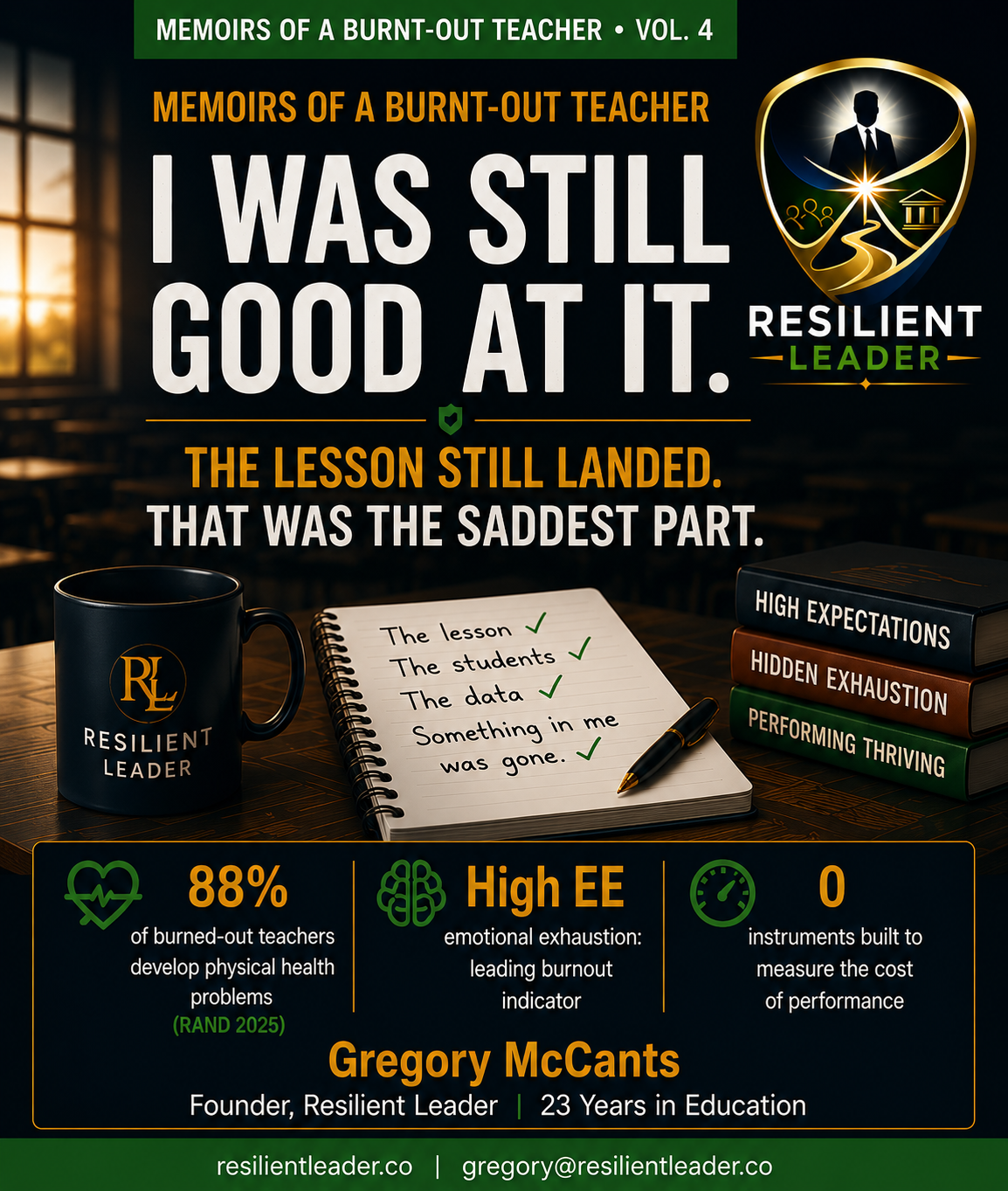



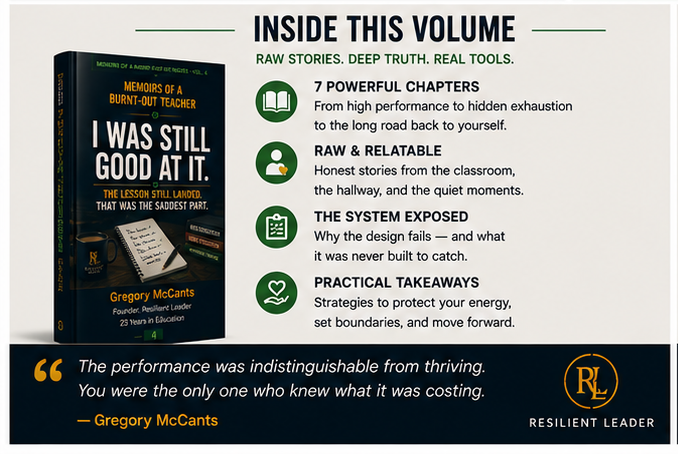





Memoirs of a Burnt-Out Teacher Vol. 4 — I Was Still Good at It. That Was the Saddest Part: Hiding Biological Depletion Behind Professional Competence
The performance was indistinguishable from thriving. You were the only one who knew what it was costing.
This is the part of the educational career arc that nobody warns you about. The initial idealism has faded, and the quiet resignation has already settled into your body, yet your lessons still land flawlessly. Your student data looks excellent. Your classroom transitions are exceptionally tight, your routines are clean, and your efficiency is higher than it has ever been.
You haven't stopped being competent; if anything, you’ve actually gotten better. You have stripped your daily operations down to a hyper-polished science and run them on pure autopilot. The machinery of your classroom runs beautifully because you spent years engineering a system that doesn't actually require your authentic human presence to operate.
And that is the most terrifying part of all. Because your extreme competence gives the school district absolutely zero signal that anything is wrong.
The district walkthrough rubrics look at your room and check every single box for standards alignment and student engagement. The system logs a perfect, satisfactory score and moves on. It possesses completely zero mechanisms to distinguish between a teacher who is genuinely thriving and a veteran professional who has simply learned to perform thriving at a level indistinguishable from the real thing. It isn't a support system; it’s an observation ledger. And observation without the capacity to measure human draw-down is just clinical documentation.
The physical and biological bill for this design gap is stark. Research shows that when educators internalize chronic emotional exhaustion and depersonalization, a staggering 88 percent develop severe physical health crises—including hypertension, anxiety, and chronic inflammation. The biological cost extends directly to your students. A landmark 2025 longitudinal study tracking 1,120 students confirmed a stress-contagion model: in classrooms where teachers suffer from high emotional exhaustion, students' physical cortisol levels are measurably higher, driving downstream learning difficulties and mental health struggles.
Written by a 23-year Title I teacher and assistant principal, this fourth volume exposes the adequacy trap that closes around high-performing educators. Stop letting your professionalism act as a camouflage for an extraction environment that is running your gauge on empty. Read the data, spot the hidden costs, and start shifting from exhausting performance back to protective structural design.
Who This Is For
- Highly Capable Veteran Teachers who feel intense exhaustion but continue to output flawless, satisfactory evaluation scores through sheer muscle memory and discipline.
- Educators Carrying the "Sunday Weather" who have completely normalized low-grade dread and are rationing their remaining care to survive the school year.
- School Principals & District Personnel who want to understand why their most dependable, top-tier staff members suddenly quit despite having zero visible classroom red flags.
What You Receive
- The Autopilot & Muscle Memory Analysis: An in-depth operational look at how elite educators construct procedural classroom environments that run independently of their emotional presence.
- The Stress-Contagion Data Profile: A direct breakdown of the 2025 longitudinal study linking unmitigated teacher exhaustion directly to elevated student stress cortisol spikes and learning dropouts.
- The "Sunday Weather" Diagnostic: A reflective conceptual lens to help you evaluate hidden, internalized dread that has been misdiagnosed as standard professional routine.
- The Relational Cost and Rationed Care Matrix: A sharp evaluation of how depersonalization systematically forces open dialogue to close at the bell, transforming student interaction into pure management.
What It Pairs With
To convert the systemic revelations of this text into automated process boundaries that protect your time and energy, this book pairs natively with:
- Memoirs of a Burnt-Out Teacher Vol. 5 (I Did Not Choose This. And Then I Did.): For stepping backward into the origin arc to analyze the exact moment the system gained unearned access to your dedication.
- The Invisible Load: For translating this volume's clinical burnout arguments into actionable, personal workload inventories and structural request templates.
- The Item Analysis Practitioner's Guide: For installing a disciplined, fast student data-grading loop that cuts out hours of exhausting, non-replenishing lesson planning pressure.