
70s Strings
70s Strings (VST3, CLAP, AUv2, M4L)
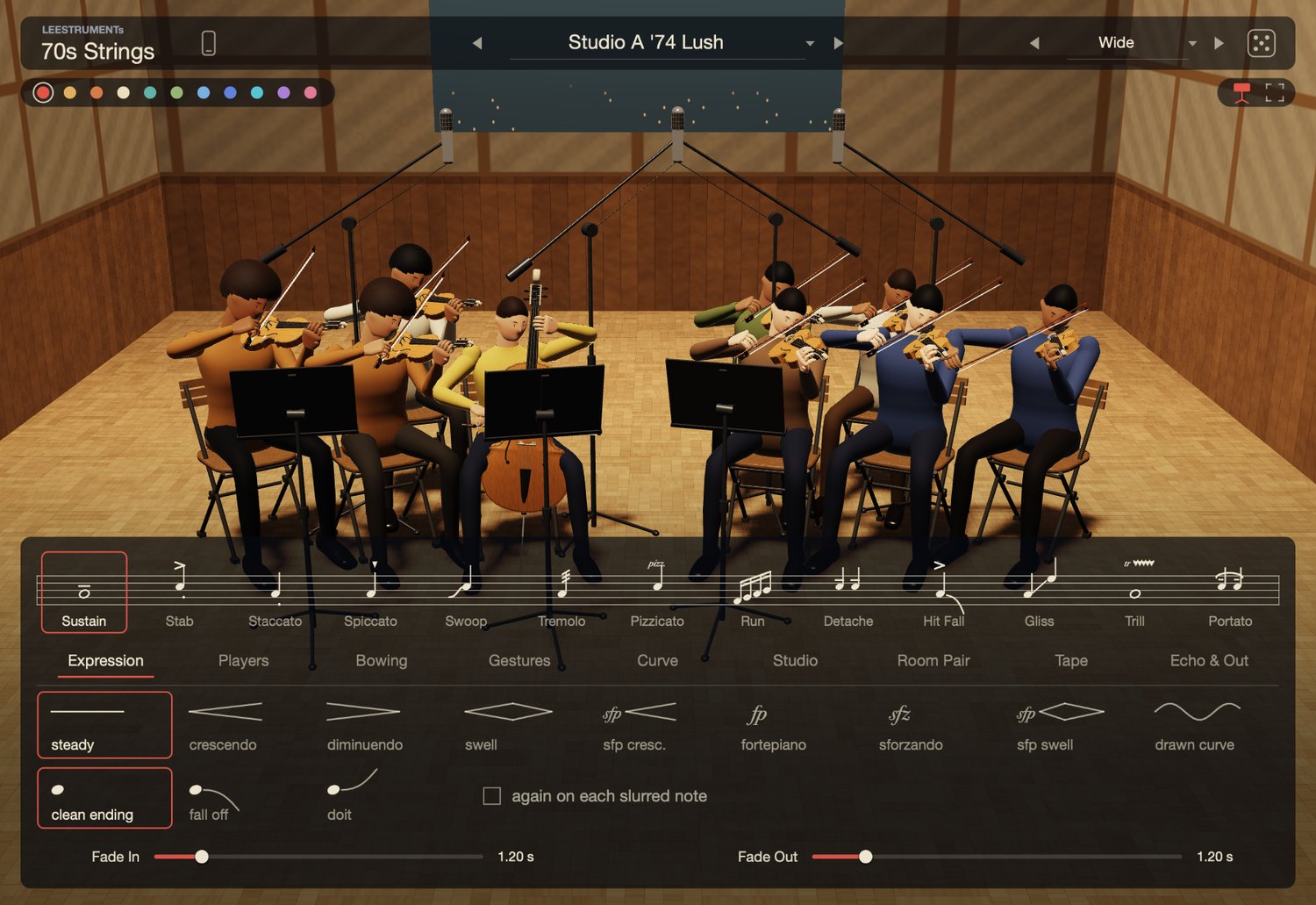
70s Strings is a virtual instrument that plays a 1970s Philadelphia soul and disco string section with physical modelling. Nothing is sampled: every violin, viola and cello is a bowed string on its own modelled instrument body, played by its own player and recorded in a modelled studio.
Each player bows a string through a friction model (stick and slip under the rosin), the string drives a bridge coupled to a modal body, and the body radiates into the room. The players have their own intonation, vibrato, reaction time, bow arm and bow changes, so a held chord breathes and moves like a section.
The section is the Philadelphia 6-2-1: six violins, two violas and one cello, enlargeable to 16-6-6. It plays once, doubled as the Philadelphia overdubs were, or Light Doubled: one played take and a second take recorded from it, which gives the doubled sound for about a quarter less CPU. The players sit in one of eleven modelled spaces, from a 1970s Philadelphia studio to a church, and are heard through four spot microphones and an optional room pair. The section is recorded on multitrack tape with noise reduction, levelled by an optical leveller and sent to an echo chamber or a steel echo plate. Fourteen studio setups load documented kinds of 1970s sessions at once.
Play chords and the arranger voices them the Philly way: melody in the first violins, violas inside and the cello under the harmony, with the arrangers' added octaves switchable on or off. Choose from thirteen articulations on the panel or by keyswitch, write dynamics over the notes (crescendo, swell, sfp, sfz or a curve you draw) and add falls or doits on release. On screen the section sits in the studio and bows what you play.
Highlights:
- Physically modelled bowed strings and instrument bodies, no samples
- 6-2-1 section up to 16-6-6, Single, Light Doubled or Doubled takes
- Philly, Chord, Solo, Mono and Philly (Last) voicings with added octaves on or off
- 13 articulations, from sustain, stab and staccato to tremolo, pizzicato, runs and hit falls
- Written dynamics and a drawn dynamic curve, falls and doits
- 11 modelled spaces, 16 microphone models, multitrack tape, optical levelling, echo chamber and plate
- Animated players in the studio, seating you can drag; MPE pressure, bend and bow position
- 23 factory sessions and 14 studio setups
Formats:
VST3 / CLAP / AUv2 / M4L
Compatibility:
macOS 12 or later
Windows 11 or later
For problems, questions, or feature requests:
leestrument@gmail.com