



The Pacing Guide Has Never Met Your Kids
Every K-12 teacher knows what a Tuesday morning feels like when your diagnostic instincts collide with a district calendar.
You look out at a room of confused faces during third period and realize your students haven’t mastered the foundational concept. Cognitive science says you need to stop, clear the working memory bottleneck, and provide a low-stakes retrieval pause. But somewhere in a central district office, a calendar built in July dictates that today is Day 47, and you are supposed to be moving on to the next unit.
So you are forced to make an impossible choice: keep moving to satisfy a document written for a hypothetical classroom, or make the correct professional call to reteach, knowing that the system will record your deliberate diagnostic decision as an unexcused "delay" .
The problem isn't your pedagogy. The problem is that the instruments built to score your classroom were never designed with a human brain in mind.
When a school treats standard coverage as the sole metric of success, it relies on two flawed tools: a rigid pacing guide and a superficial walkthrough rubric. The Pacing Guide Has Never Met Your Kids completely dismantles this compliance-driven operational dynamic. Grounded in 23 years of front-line classroom and administrative experience across high-intensity Title I settings, this guide provides a sharp, research-backed framework that validates a teacher's real-time read of the room. Learn how to reclaim authority over the pace of your instruction, evaluate the tools doing the scoring, and bridge the massive design gap between administrative standardization and cognitive reality.
Stop hiding deliberate professional decisions as accidental errors . Learn how to name your clinical expertise with institutional seriousness, protect your instructional depth, and run a structural audit on the instruments themselves.
Who This Is For
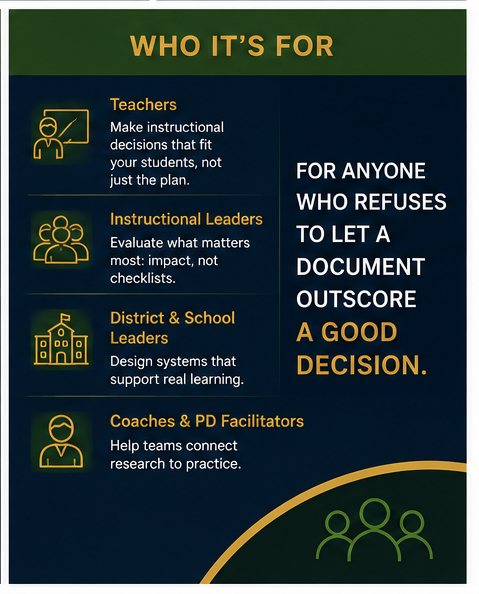
- Classroom Teachers who are trapped between calendar clocks and cognitive clocks, needing a robust, research-backed vocabulary to defend their real-time instructional adjustments.
- Principals, Assistant Principals, & Deans who carry walkthrough clipboards and want to train themselves to see deep, quiet cognitive processing instead of just superficial visible motion.
- Instructional Coaches & Curriculum Specialists looking to challenge rigid district-level tracking silos and install low-friction methods for teachers to log clinical decisions as valid diagnostic data.
What You Receive
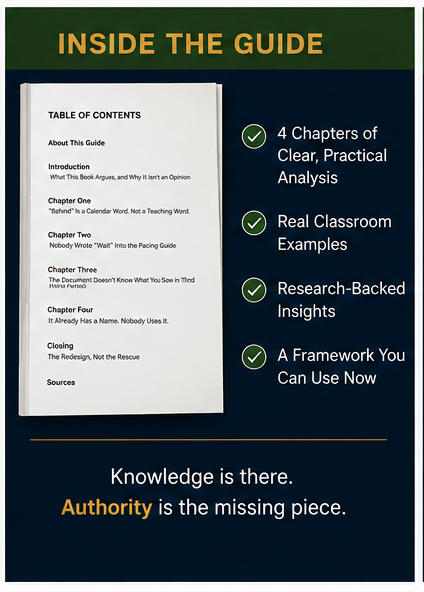
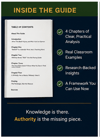
The Pacing Guide Diagnostic Framework: A comprehensive, 4-chapter operational guide cross-referencing 13 distinct cognitive science and educational research sources:
- Chapter One: "Behind" Is a Calendar Word. Not a Teaching Word. – Unpacking the toxic focus on days elapsed versus true mastery, and how pacing pressure concentrates most heavily in classrooms that can least afford the loss.
- Chapter Two: Nobody Wrote "Wait" Into the Pacing Guide – Deconstructing how 5-to-15-minute walkthrough rubrics accidentally penalize the exact time, quiet, and cognitive friction required for durable retrieval practice.
- Chapter Three: The Document Doesn't Know What You Saw in Third Period – Establishing why an undocumented expert decision looks identical to a sloppy delay on paper, and the critical need for low-friction logging systems.
- Chapter Four: It Already Has a Name. Nobody Uses It. – Introducing the verified academic construct of Professional Vision (Noticing + Knowledge-Based Reasoning) and how to protect this ultimate marker of veteran expertise.
- The Closing Design Blueprints: Practical guidelines to shift your campus lens from rescuing compliance metrics to actively redesigning the institutional evaluation instruments themselves.
What It Pairs With
To construct an absolute shield against performative compliance, administrative friction, and institutional memory loss, this guide links directly with:
- The Audit Nobody Runs: For moving past standard teacher walkthroughs and evaluating the actual, unmapped workflow and schedule constraints choking your building.
- The Universal AI Prompt Pack (Bundle 04): For instantly constructing tiered, UDL-aligned assignments and 5E lesson maps that honor working memory limits without lowering your instructional bar.
- The Veteran AP Field Manual: For mapping your real-time classroom "noticing" into a legally rigorous, fact-based documentation standard that administrators are forced to accept as data.