




Artificial Intelligence: Reinforcement Learning in Python
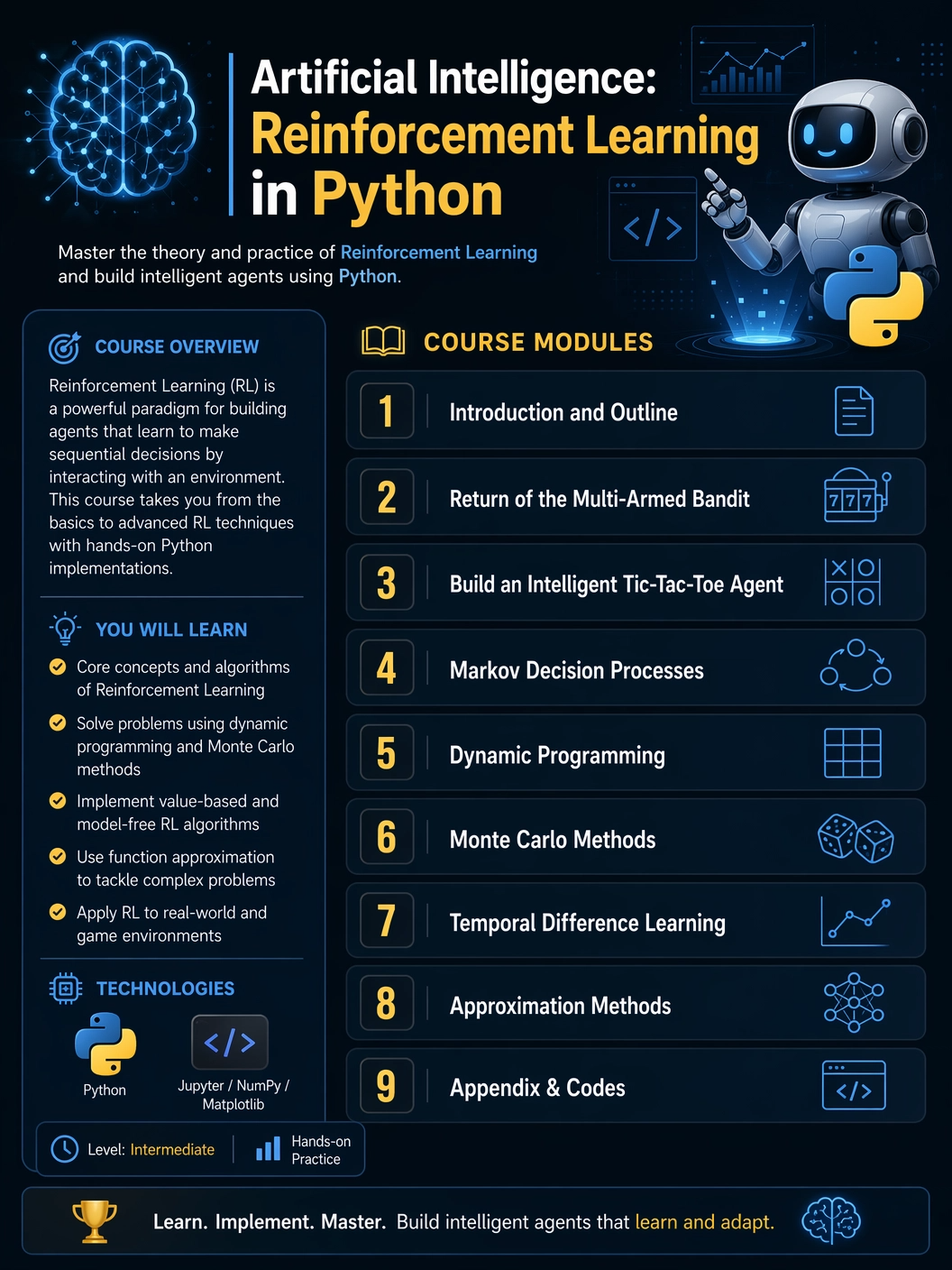
This comprehensive course provides a deep dive into Reinforcement Learning (RL), a powerful paradigm within Artificial Intelligence that enables agents to learn optimal behaviors through interaction with an environment. From foundational concepts to advanced algorithms, this course is designed to equip learners with the theoretical understanding and practical skills necessary to build intelligent agents capable of making sequential decisions. Through hands-on Python implementations, you will master the core principles of RL and apply them to solve real-world problems and develop sophisticated AI systems.
What You Will Learn
Upon successful completion of this course, you will be able to:
•Understand Core Concepts: Grasp the fundamental principles and algorithms of Reinforcement Learning, including states, actions, rewards, policies, and value functions.
•Solve Complex Problems: Apply dynamic programming and Monte Carlo methods to solve various RL problems, understanding their strengths and limitations.
•Implement Advanced Algorithms: Develop and implement value-based and model-free Reinforcement Learning algorithms.
•Tackle Real-World Challenges: Utilize function approximation techniques to handle large state spaces and complex problems effectively.
•Build Intelligent Agents: Apply Reinforcement Learning to create intelligent agents for real-world scenarios and game environments, such as building a Tic-Tac-Toe agent.
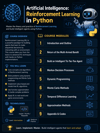
Course Modules
This course is structured into the following modules, progressively building your expertise in Reinforcement Learning:
1.Introduction and Outline: An overview of Artificial Intelligence and the role of Reinforcement Learning. This module sets the stage for the course, introducing key terminology and the learning roadmap.
2.Return of the Multi-Armed Bandit: Explore the classic Multi-Armed Bandit problem, understanding exploration-exploitation trade-offs and fundamental decision-making strategies.
3.Build an Intelligent Tic-Tac-Toe Agent: A practical module where you will apply RL concepts to develop an intelligent agent capable of playing and learning to master Tic-Tac-Toe.
4.Markov Decision Processes: Delve into the mathematical framework of Reinforcement Learning, understanding Markov Decision Processes (MDPs) and their significance.
5.Dynamic Programming: Learn how to solve MDPs using dynamic programming techniques, including policy iteration and value iteration.
6.Monte Carlo Methods: Discover Monte Carlo methods for estimating value functions and policies without a complete model of the environment.
7.Temporal Difference Learning: Explore Temporal Difference (TD) learning, including Q-learning and SARSA, which combine ideas from Monte Carlo and dynamic programming.
8.Approximation Methods: Address the challenges of large state spaces by learning about function approximation techniques, such as neural networks, in Reinforcement Learning.
9.Appendix & Codes: Supplementary materials, additional resources, and all Python code implementations used throughout the course for hands-on practice and further exploration.
Technologies Used
This course emphasizes practical application using Python and its powerful libraries, including:
•Python: The primary programming language for all implementations.
•Jupyter Notebooks: For interactive coding and experimentation.
•NumPy: For numerical operations and array manipulation.
•Matplotlib: For data visualization and plotting results.
Target Audience
This course is ideal for:
•Data scientists, machine learning engineers, and AI enthusiasts looking to specialize in Reinforcement Learning.
•Developers interested in building intelligent agents and autonomous systems.
•Students and researchers seeking a practical and theoretical understanding of RL.
Prerequisites: A solid understanding of Python programming, basic linear algebra, and probability is recommended.
Level: Intermediate | Hands-on Practice
Learn. Implement. Master. Build intelligent agents that learn and adapt.