


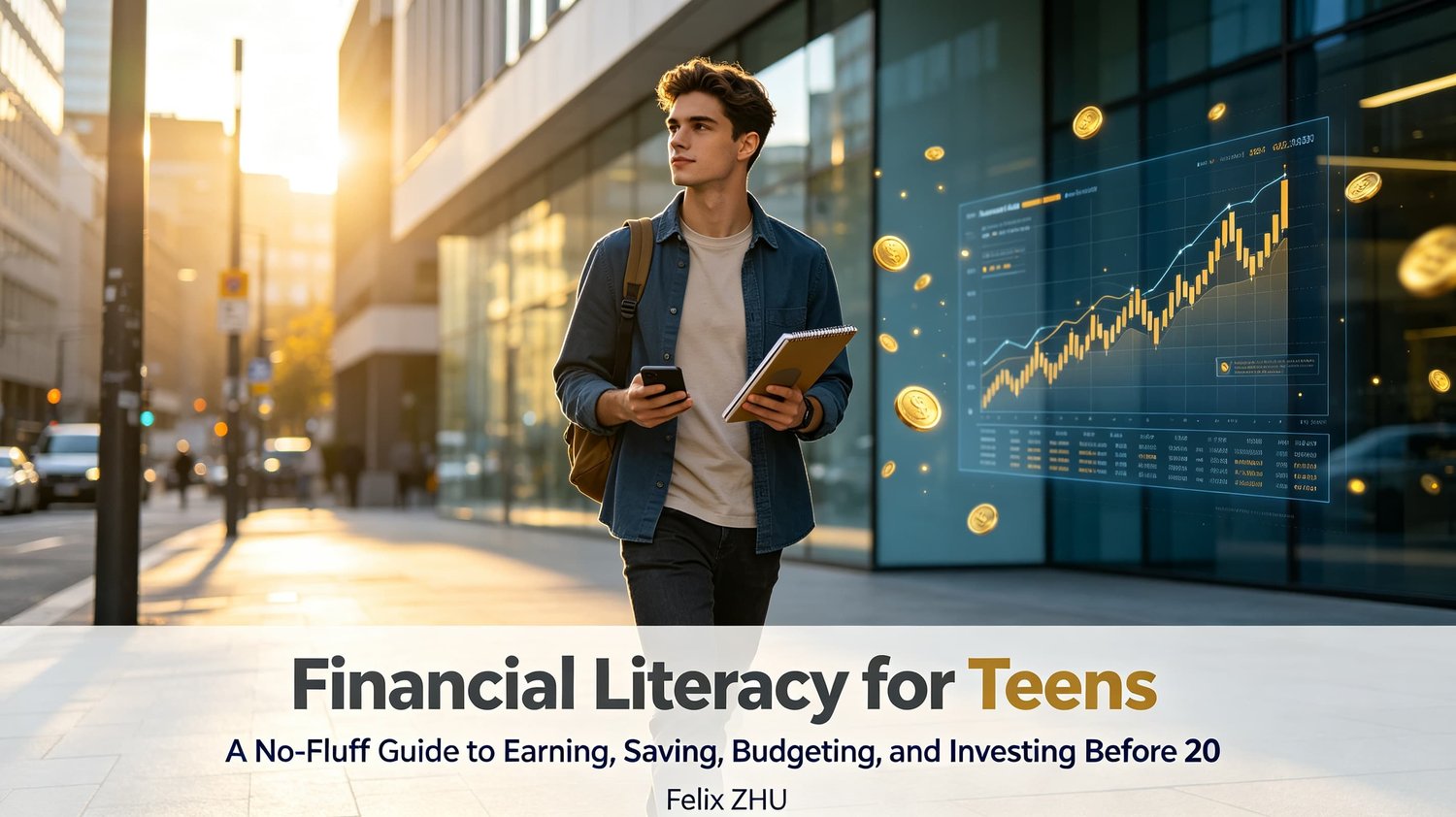







Financial Literacy for Teens: Money Skills Schools Don't Teach
Give teenagers the money skills they need before they leave home — budgeting, saving, credit, debt, and investing basics.
Financial Literacy for Teens is written in plain language with real examples, interactive exercises, and a no-judgment approach. The perfect gift for high school and college students.
Covers: Budgeting, saving strategies, credit scores, avoiding debt, intro to investing, and financial traps to avoid.
Instant EPUB download. No DRM.
Most money advice for teenagers falls into two traps: adults telling you to "just save your allowance" like $10 a week changes anything, or finance bros screaming about index funds without explaining what an index fund actually is. Meanwhile, your math teacher makes you balance a fake checkbook like it is 1987. None of it connects to your actual life.
This is what actually changes the game.
Inside this guide, you get a complete 10-chapter system covering the exact money skills school refuses to teach:
Chapter 1 — Money Mindset: The Builder vs. Consumer framework that determines whether you stay broke or build wealth for life.
Chapter 2 — Earning: Three tiers of income from classic teen jobs to freelancing on Fiverr to building a real service business, with real pricing tables and client-getting scripts.
Chapter 3 — Budgeting: The 3-bucket system (Needs, Future, Freedom) that sets up in 10 minutes and requires zero spreadsheets.
Chapter 4 — Banking 101: How to choose fee-free accounts, avoid overdraft traps, and understand what banks actually do with your money.
Chapter 5 — Saving: The automation stack that moves money before you can spend it, plus the $5 challenge that starts your emergency fund this week.
Chapter 6 — Credit: The 5 non-negotiable rules for building a 700+ score before you turn 20.
Chapter 7 — Investing: Step-by-step guide to opening a custodial Roth IRA and buying your first index fund with as little as $10.
Chapter 8 — Taxes: Exactly how to file your first return, what to do with a W-2 vs. 1099, and why you must set aside 25–30% of side hustle income immediately.
Chapter 9 — Side Hustles: The skill audit, pricing framework, and customer-finding playbook for turning what you already know into real income.
Chapter 10 — Your Money Roadmap: Age-specific action plans for 14–15, 16–17, and 18+ with exact milestones and weekly missions.
Product highlights include actionable banking and tax roadmaps for first-time earners. Core features include a first-paycheck survival guide with automatic savings setup. Key takeaways include a maintenance-free budgeting framework built for real teen life. Story core centers on contemporary teen earning realities beyond babysitting and lawn mowing. Key takeaways include a phase-based money roadmap from first bank account to first investment.
Who this is for:
- Teens aged 14–18 who want real money skills before adulthood
- High schoolers working their first job and confused by pay stubs and taxes
- Parents looking for a practical, non-patronizing finance resource for their teenager
- Young adults aged 18–20 who need to catch up fast on credit, investing, and taxes
What you gain long-term:
- A checking account that does not bleed fees, a savings account that actually earns interest, and an investment account that compounds for decades
- The confidence to negotiate pay, price services, and file taxes without panic
- A credit score above 700 by age 20, opening doors to apartments, car loans, and future mortgages
- A marketable skill that generates $20+/hour before you graduate
FAQ:
Q: Do I need any prior money knowledge?
A: Zero. This guide assumes you have never seen a pay stub, opened a bank account, or heard of a Roth IRA. Every term is explained in plain language.
Q: Are there worksheets or templates included?
A: This is a comprehensive digital ebook. You get the complete 10-chapter system with step-by-step instructions, pricing tables, and platform recommendations. Print the chapters you want to reference repeatedly.
Q: What format is this delivered in?
A: You receive a high-quality PDF ebook compatible with any device—phone, tablet, laptop, or e-reader. Instant delivery after purchase.
Q: Can parents use this to teach younger teens?
A: Yes. The "A Note for Parents & Guardians" section includes specific guidance on opening custodial accounts, letting teens make small mistakes, and modeling good financial behavior.
Q: Is this applicable outside the United States?
A: The banking, credit, and tax sections focus on U.S. systems. However, the mindset, budgeting, earning, and investing principles translate to any market economy.