





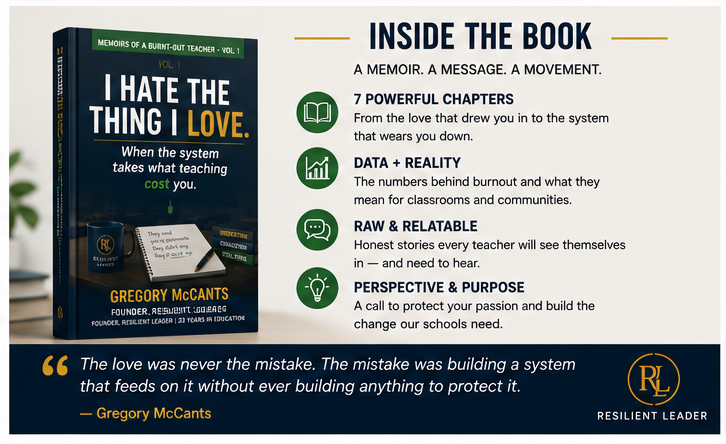





Memoirs of a Burnt-Out Teacher Vol. 1 — I Hate the Thing I Love: When the System Takes What Teaching Cost You
The love was never the mistake. The mistake was building a system that feeds on it without ever building anything to protect it.
Let's stop calling it standard professional fatigue. What teachers are experiencing in school buildings isn't just burnout, it is quiet, unacknowledged grief. It is the profound grief of watching the massive canyon widen between your creative instructional imagination and a cold, rigid institutional reality.
The district recruitment models are highly intentional. They hire educators at their absolute peak of idealism, capturing them when the belief that a classroom can transform a life is completely intact and unchallenged. The system hands you an impossible operational structure, relies on your love as an unlimited, self-replenishing fuel source, and then steps back to let the institution run on your uncompensated overextension . By the time the massive biological cost becomes clear, your commitment to the kids is already locked in. That isn't naivety. That is the design.
The raw data exposes the devastation of this framework: 53% of K-12 teachers report chronic burnout, 62% operate under frequent, job-related stress, and the average educator logs 49 hours a week; 10 full hours entirely above contract limits . This human extraction bleeds public education to the tune of $2.2 billion annually in constant teacher turnover and replacement costs.
When you finally break, the wellness industry swoops in with generic boundary-setting worksheets and mandatory mindfulness sessions. Making the individual teacher responsible for systemic breakdown is a cheap shield for the institution. It is far less expensive to force you to manage your relationship with systemic harm than to actually pay to redesign the toxic environment.
Written by a 23-year Title I classroom teacher, dean, and assistant principal, this first volume of a landmark eight-part memoir series shatters the self-care myth. It names the architectural flaws of public education precisely, helping you separate a personal self-management problem from a severe infrastructure defect . Your exhaustion isn't a character flaw. It is institutional data the system was never designed to collect. Stop adapting to an impossible design and start legacy-building the process infrastructure required to survive it.
Who This Is For
- Classroom Teachers who are currently showing up physically every morning while something quieter has already started to withdraw to protect what little energy remains.
- Educators in Year Three to Five who feel intense guilt because the professional distance they tried to build over the summer completely dissolves by the third week of September.
- School Administrators & Deans wanting to read the unvarnished, institutional data regarding why their strongest veteran talent keeps quietly walking out the door.
What You Get
- The Master Narrative Framework: An 8-page personal and analytical opening manifesto mapping the structural mechanisms that exploit professional dedication.
- The Self-Management vs. Infrastructure Diagnostic: A core conceptual lens to help you stop internalizing systemic failures as personal character defects.
- The "Third Week of September" Analysis: A visceral breakdown of the relational moments the observation rubrics cannot measure, detailing the real biological cost of letting the love back past the perimeter.
- Longitudinal Turnover Data Profiles: Contextualized national research metrics verifying the massive fiscal and human toll extracted by defensive district operations.
What It Pairs With
To begin constructing the automated process shields needed to offset your daily administrative load, this memoir volume links directly with:
- Memoirs of a Burnt-Out Teacher Vol. 2 (I Did Not Quit. I Just Stopped Bringing the Best Part of Me): For tracking the incremental, quiet withdrawal of presence when the environment remains un-redesigned.
- The Invisible Load: For expanding this text's systemic burnout diagnostic into a full series of worksheets and structural next-step action planners.
- The Item Analysis Practitioner's Guide: For taking the emotional clarity of this text and anchoring it to a disciplined, time-reclaiming student data grading framework.