







Store Reset Master Manual 2026 - The Complete Financial and Operational Framework For South African Franchise Supermarket Owners
A store reset is not a renovation. It is the most financially dangerous event in the life of a franchise supermarket business.
Most South African franchise owners discover this too late — six weeks into construction, with a contractor on site, a bank covenant in breach, service departments offline, and a cash buffer that ran out three weeks ago.
This manual exists so that never happens to you.
Written by Walter Da Cruz — founder of RIDBS, with 46 years in South African FMCG and retail, and CEO roles at Action DIY, Best Buy C&C and Bower BUILD — the Store Reset Master Manual 2026 is the only reset framework built specifically for the South African franchise supermarket environment.
It does not recycle international retail theory. It does not offer generic business advice. Every model, every threshold, every risk provision, and every negotiation framework inside this manual has been calibrated to the realities of trading as a Pick n Pay, SPAR, or Shoprite/Checkers franchisee in South Africa in 2026.
THE NUMBERS MOST OWNERS NEVER SEE BEFORE THEY START
The average SA franchise supermarket enters a reset with a pre-reset gross profit of 17 to 20 percent and total operational costs of 16 to 19 percent. That produces an EBITDA of approximately one percent — R400,000 on a R40 million store.
You are funding an R8 million reset on a R400,000 earnings base.
Your annual debt service on that reset facility is R1,279,000. Your pre-reset DSCR — your debt service coverage ratio — is 0.31×. Your bank's minimum covenant threshold is 1.2×. You are in breach before the first wall comes down.
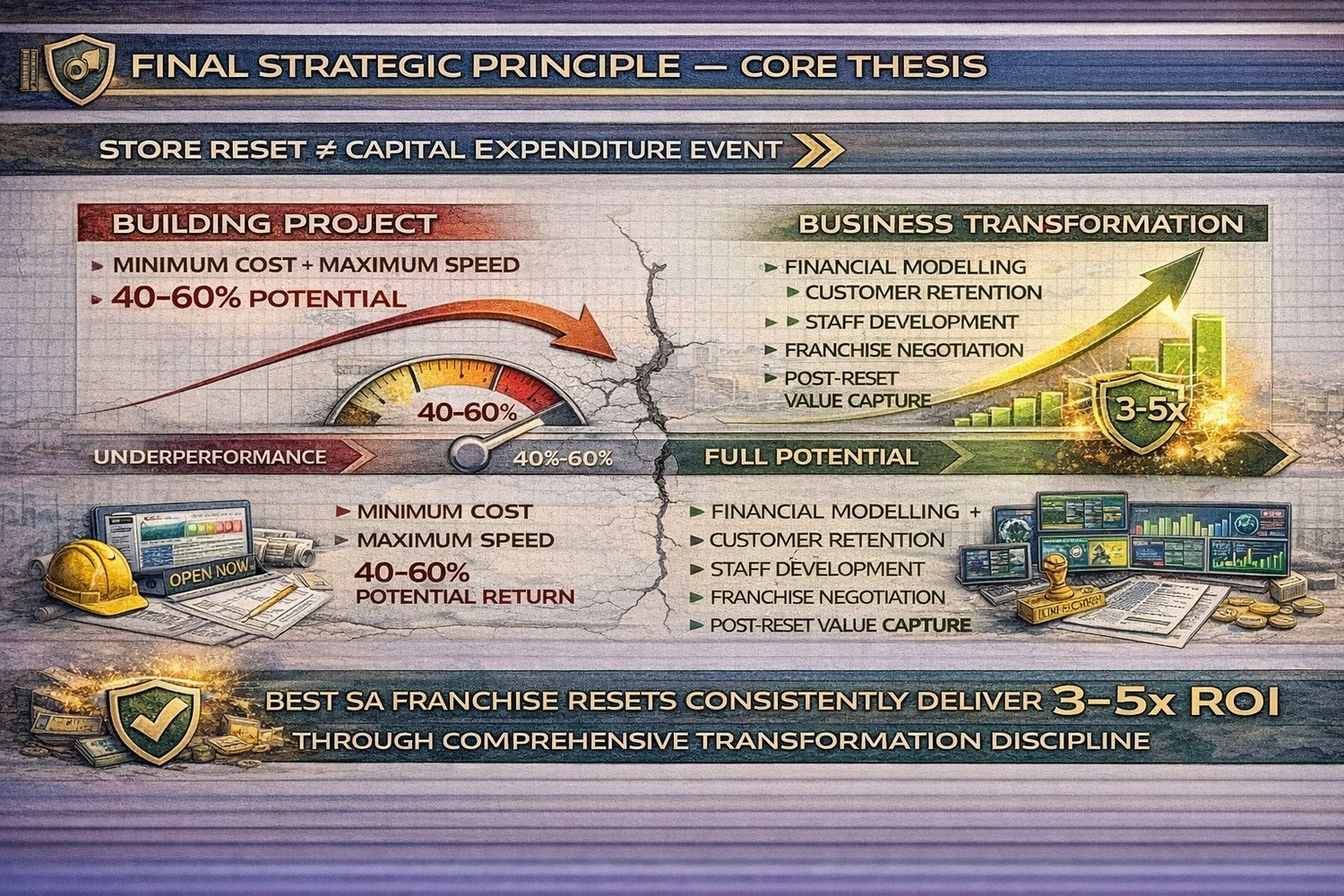
Then construction starts. You planned for 15 percent revenue disruption because that is what every contractor tells you to expect. The actual figure, based on real SA franchise reset data, is 40 percent. Some stores hit 60 percent. Your deli closes. Your butchery closes. Your bakery closes. These are your three highest-margin departments, gone for six to ten weeks, while your fixed costs continue at R1.1 million per month.
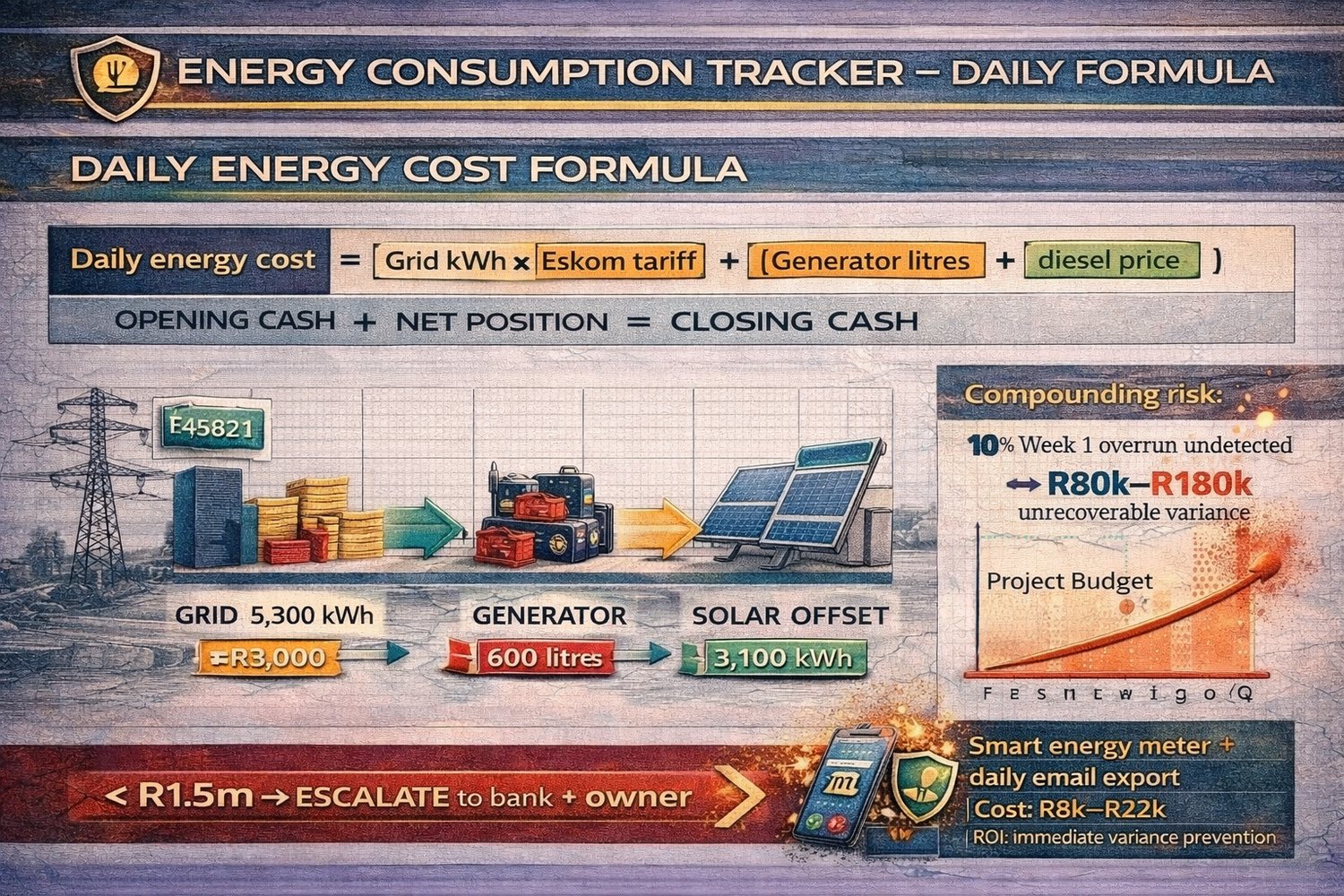
Then Stage 6 load shedding hits. Mid-construction. Eight hours a day. Diesel at R23 a litre. Your generator runs. Your refrigeration falters. Your municipal inspector doesn't arrive for six weeks because that is simply how the SA building compliance environment operates. Your programme slips. Your contractor triggers a delay clause. Your buffer runs out.
And nobody told you any of this was coming.
This manual tells you. All of it. In advance. With the models, frameworks, and decision tools to make sure you are prepared for every single one of these scenarios before you commit a single rand.
WHAT IS INSIDE
Section 1 — The Go/No-Go Decision Matrix Eight financial drivers. Scored and weighted against SA franchise benchmarks. EBITDA margin, gross profit percentage, DSCR, working capital cover, shrinkage, energy cost, and sales density — each with a GO, CONDITIONAL, and NO-GO threshold calibrated to the real SA environment. A total score below 5 out of 16 means the reset should not proceed until specific fundamentals are addressed. This section also covers competitive pressure modifiers — what happens when a Checkers Sixty60-enabled store opens within 2.5km of your trading zone — and the strategic positioning framework for choosing between an offensive, defensive, compliance, or infrastructure reset.
Section 2 — Capital Structure, Debt Modelling & Financial Dashboard The section most owners need most and have access to least. Full DSCR modelling at 25%, 40%, and 60% revenue disruption. Capital reserve structure showing why the minimum liquidity buffer for an R8 million reset is R7.3 million before construction commences. The 8-week pre-reset working capital compression protocol — a step-by-step cash release programme that can free up R1.25 million to R3.1 million before you break ground. Covenant holiday frameworks. Bank presentation templates. And the post-reset EBITDA uplift summary showing exactly how gross profit moves from 18.5% to 22% and operational costs move from 17.5% to 17%, section by section, rand by rand.
Section 3 — Revenue Interruption Economics The real disruption curves that SA franchise resets produce, not the optimistic projections contractors put in their proposals. Customer migration probability models showing the 8 to 22 percent basket value loss when a competitor opens nearby. Recovery timelines at Month 1, Month 3, Month 6, and Month 12. And the full SASSA grant cycle trading impact analysis — why missing a single grant payment weekend during construction can cost more than five full days of normal trading.
Section 4 — Service Department Profit Re-Engineering Your deli, bakery, butchery, and fish counter are simultaneously your highest-margin departments and your highest-risk reset components. This section gives each department its own IRR calculation — deli at 28 to 32 percent, bakery at 28 to 38 percent, butchery at 38 percent, fish at 31 percent — alongside the exact capex requirements, staffing models, health compliance checklists, shrinkage reduction targets, and the specific failure modes that destroy value in each department when the reset is executed poorly. The butchery section alone — including Halaal certification management, cold chain compliance, and the skilled labour retention challenge — is worth the download.
Section 5 — Energy Investment NPV Modelling South Africa is not a normal retail operating environment. A generator-only strategy at Stage 6, eight hours a day, 220 days a year, costs between R480,000 and R2.88 million annually. This section gives you the full net present value model for solar PV, battery storage, generator, LED lighting, and full hybrid configurations — with payback periods, maintenance reserve requirements, and the Section 12B tax incentive calculation that delivers a 125% first-year deduction on qualifying renewable energy assets. On a R2 million solar and battery installation, that is R675,000 in tax savings in year one. Section 12L energy efficiency incentives — worth R0.95 per kWh saved — are also fully modelled.
Section 6 — Layout-Driven Shrinkage Reduction & EBITDA Bridge How your physical store design decisions directly drive your financial outcomes. The full EBITDA bridge from pre-reset R400,000 at 1.0% margin to post-reset R1.2 million net — showing the exact contribution of service department GP improvement, shrinkage reduction from 2.8% to 1.5%, merchandising and space productivity uplift, energy cost reduction, and labour productivity improvement. Every line item. Every rand.
Section 7 — Franchise Negotiation Frameworks Pick n Pay. SPAR. Shoprite/Checkers. Each group has different co-funding structures, different fee holiday policies, different planogram compliance requirements, and different consequences for non-compliance. This section covers co-funding application timelines — why you must apply 9 to 12 months before your reset start date, not 6 weeks before — co-funding percentages available on qualifying capex, franchise fee holiday negotiation, advertising levy obligations, preferred supplier pricing through group procurement, and the gondola end rate structures that drive R5,000 to R15,000 per position per month in post-reset supplier income.
Section 8 — SA Systemic Risk Quantification This is the section no international retail manual will ever include — because no international retail environment looks like South Africa's. Load shedding annual exposure: R480,000 to R2.88 million. Water disruption annual exposure: R80,000 to R280,000. Security cost escalation in high-risk areas: R180,000 to R720,000. Labour relations and CCMA exposure: R40,000 to R250,000. Municipal inspection delay exposure: R80,000 to R250,000 per month of delay. SASSA grant cycle trading impact: quantified month by month. Total SA systemic risk provision for a medium suburban store: R560,000 — separate from your capex contingency, because both are required.
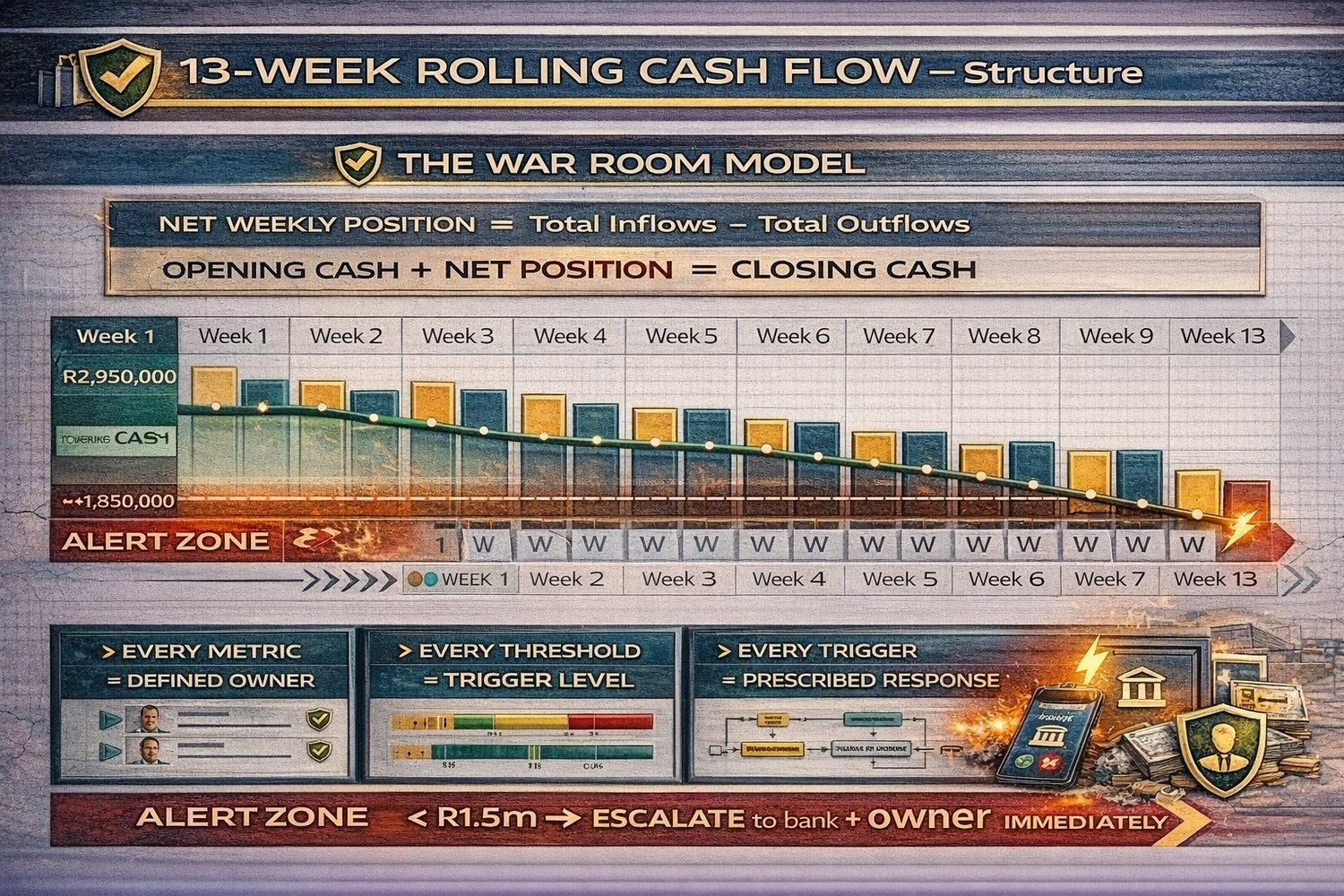
Section 9 — Weekly War Room Dashboard & 13-Week Cash Flow Templates The operational control framework for the construction period. Weekly KPI thresholds with GREEN, AMBER, and RED triggers for sales, cash position, capex committed, construction progress, temperature compliance, staff attendance, shrinkage, energy cost, and gross profit. The 13-week rolling cash flow template. The Monday morning War Room agenda. And the escalation protocol that tells you exactly when to call your bank, your contractor, and your franchisor development manager.
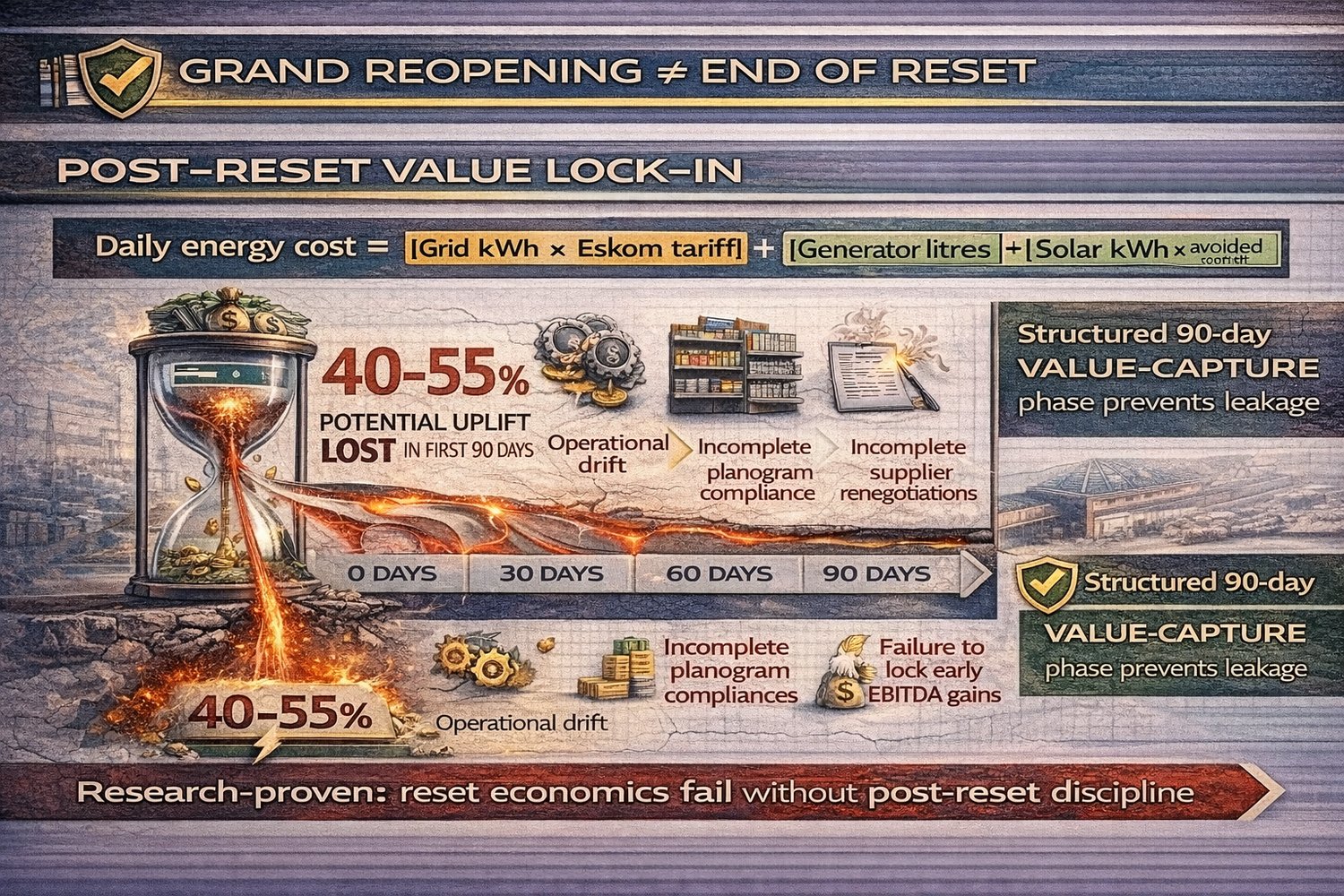
Section 10 — 90-Day Stabilisation, Supplier Renegotiation & Refinancing Strategy The post-reset phase where 40 to 55 percent of reset value is typically lost through operational drift. The Days 1 to 14 stabilisation protocol. The Days 31 to 60 supplier renegotiation sprint — with gondola end rate negotiation targets, rebate uplift benchmarks of 0.5 to 1.5 percentage points above pre-reset rates, and a minimum R120,000 additional annual rebate target. The Days 61 to 90 performance anchoring framework. And the refinancing trigger assessment — when a DSCR above 1.8× and EBITDA improvement of 2 percentage points justifies approaching your bank for a rate reduction from prime plus 2% to prime plus 1.5%.
WHO THIS MANUAL IS FOR
This manual is written for the owner-operator of a Pick n Pay, SPAR, or Shoprite/Checkers franchise supermarket in South Africa who falls into one of four categories.
You have a reset coming up in the next 12 to 36 months and you want to approach it with the financial rigour and operational discipline that gives you the best possible outcome.
You are currently in discussions with your bank about reset funding and you need to walk into that meeting with models, scenarios, and a covenant holiday framework that demonstrates financial maturity.
You are trying to decide right now whether your store can actually afford a reset — and you need an objective scoring framework that gives you an honest answer rather than a contractor's optimistic projection.
Or you have already started a reset and something has gone wrong — the costs are running over, the disruption is worse than expected, the cash is thinning — and you need a structured recovery framework immediately.
In all four cases, this manual is your next step.
THIS MANUAL IS A MUST BEFORE STARTING ANY NEW PROJECT
There is no paywall. No subscription. No upsell hidden inside.
Walter Da Cruz and RIDBS have made this manual available because the SA franchise retail community needs it, and because an informed owner makes better decisions — for their business, their family, their staff, and the customers who depend on their store being there next year and the year after that.
Download it. Read it before your next meeting with your bank. Share it with your chartered accountant. Take it to your franchise development manager. Give it to every franchise owner you know who has a reset on the horizon.
GET THE COMPLETE CHECKLIST SUITE — FREE after Purchase
The manual references a complete Excel checklist suite containing 15 operational templates covering every phase of the reset lifecycle — from the pre-reset Go/No-Go assessment through to the annual review cycle.
These templates are available free of charge to any franchise owner who requests them directly.
To receive the full checklist suite, simply send an email to info@ridbs.co.za with the subject line:
"Send RESET CHECKLISTS"
You will receive the complete Excel workbook by return — 15 tabs, fully formatted, with dropdown status fields, progress tracking formulas, and owner/date fields ready to complete.
Templates included are the Go/No-Go scoring matrix, financial readiness benchmarks, 8-week working capital compression tracker, franchisor co-funding application checklist, construction readiness gate, weekly War Room KPI dashboard, monthly checklists for during and after the reset, service department sign-off templates for deli, bakery, butchery and fish, energy commissioning checklist, grand reopening compliance gate, 90-day stabilisation tracker, post-reset monthly performance review, top-20 supplier renegotiation tracker, SA systemic risk and insurance checklist, and annual review cycle.
No charge. No obligation. Just send the email.
Don't Miss Out—Unlock Epic Deals & Bundles Now!
To see all our other offers and bundles, check the links below:
🎯 Start with the free checklist
📚 Explore all RIDBS supermarket bundles