



Coin Identification and Coin Counting Workstation Activity Cards
On Sale
$3.99
$3.99
coin counting and comparison resource using ten-frames is an excellent hands-on, visual tool for teaching money concepts in a developmentally appropriate way—especially for younger learners or students who benefit from visual math supports.
Here’s a clear summary of what’s included and how to make the most of it:
✅ What’s Inside:
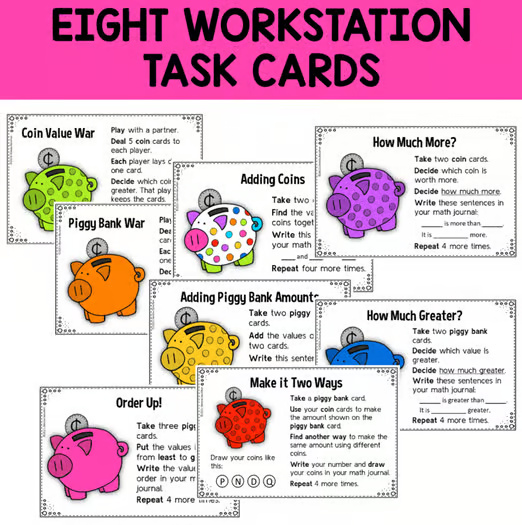
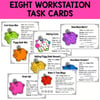
🔢 8 Low-Prep Workstation Tasks (Use the Same Card Set!)
- Coin Value War – Compare coin cards and determine the greater value.
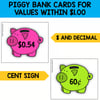
- Piggy Bank War – Compare total values on piggy bank cards.
- Adding Coins – Combine values of two or more coin cards.
- Adding Piggy Bank Amounts – Add two piggy bank cards together.
- How Much More? – Find the difference between two amounts.
- How Much Greater? – Another variation on subtraction and comparison.
- Make It Two Ways – Show two different combinations of coins to match the same amount.
- Order Up – Put coin or piggy bank cards in ascending or descending order.
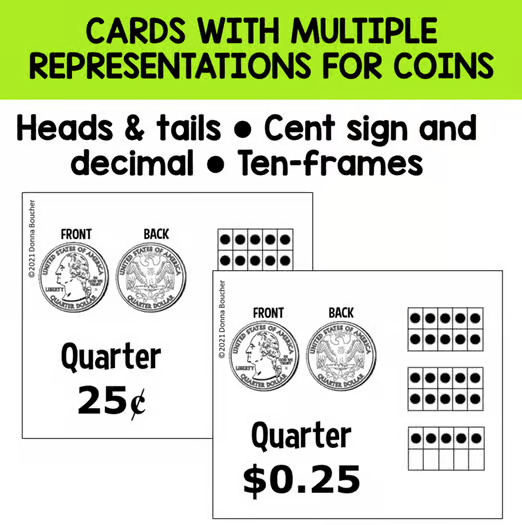
💰 Coin Identification Cards
- Front/back coin images
- Value with cent sign and decimal (e.g., 25¢ / $0.25)
- Ten-frame representations to reinforce grouping and counting by 5s/10s
- 2 quarters, 6 dimes, 8 nickels, 14 pennies
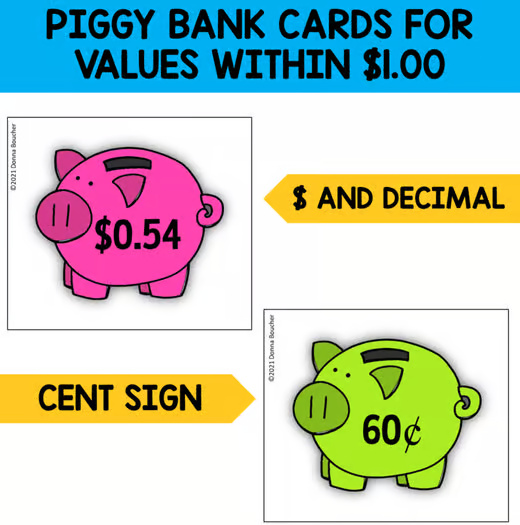
🐷 Piggy Bank Cards
- 18 pre-made cards (color + B&W) with values up to $1
- 12 blank cards to create custom amounts
- Each card displays values with ¢ and $ formats
💡 Why This Resource Works:
- Ten-frames help bridge concrete and abstract thinking: Students “see” the value of coins, making it easier to compare and add them.
- Repetition without boredom: Eight different games/activities keep students engaged while reinforcing the same skill set.
- Differentiation made easy: Use fewer or simpler coin combinations for beginners; add quarters and complex amounts for more advanced students.
- Flexible use: Great for centers, partner work, early finishers, or guided groups.
👌 Teacher Tips:
- Laminate the cards for durability and reusability.
- Use real or plastic coins alongside the cards for tactile learners.
- Send home blank piggy bank cards for students to create their own combinations as homework or a home connection task.