
Step 2 — Education Excelling in the Learning Process
Personalising education through understanding the individual blueprint, the Social Brain and integrated human capability.
Every child has a unique way of perceiving, processing, communicating, connecting and learning.
Step 2 — Education helps parents, carers, educators and support professionals look beyond standardised expectations and consider what each child’s behaviour, communication and learning preferences may be revealing.
Building on the foundations established in Step 1 — Prevention, this course shifts the focus from understanding the adult’s blueprint to understanding the child’s developing blueprint.
Learners explore how the child’s innate preferences interact with relationships, experiences and learning environments—and how compatible conditions can strengthen emotional safety, participation, motivation and developmental capacity.
Understanding creates connection.
Connection creates safety.
Safety creates learning.
Learning creates capability.
Capability creates possibility.

How this course fits within the NEXIE Method
Step 2 — Education is the second pillar of PEDICure:
- Prevention — understand what the adult brings.
- Education — understand the child and how they learn.
- Detection — investigate what is influencing the presenting experience.
- Intervention — use aligned processes to strengthen capacity.
- Correction — integrate the learning into an individual plan.
Education does not simply mean providing information.
Within NEXIE, Education means developing enough understanding of ourselves and the other person that we do not mistake our own lens, expectations or learning preferences for theirs.
Choose a pricing plan
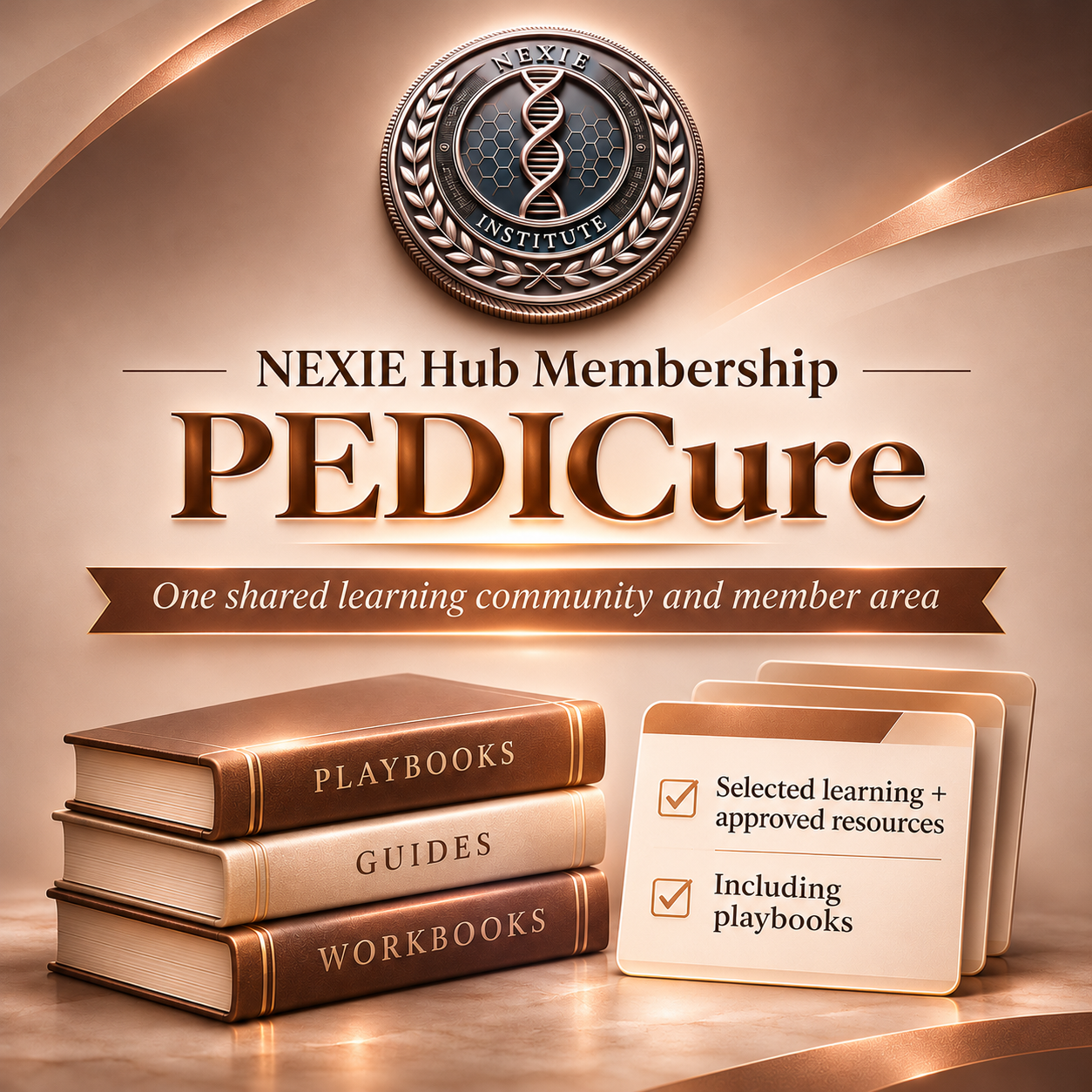
NEXIE PEDICure Hub Membership
A$49
per month
AUD $49/month. Includes the five NEXIE PEDICure learning steps—Prevention, Education, Detection, Intervention and Correction—ten guided Entry and Exit application lessons, the existing PEDICure and URE Application Playbooks (P01–P05, U01, Start Here and working records), and access to the shared NEXIE Hub. Build a practical five-step learning portfolio through LEARN IT → WAGOLL → BUILD IT → REVIEW. One selected pathway; subscription renews monthly until cancelled. Some advanced source content remains subject to final review.
Course curriculum
Module 1 — Your Perception Is Your Reality
Explore how perception influences learning, communication and relationships. Meet the Social Brain framework and consider how your own lens may differ from the child’s experience.
Key question: How does this child naturally perceive and engage with the world?
Module 2 — Creating Emotional Safety
Examine the conditions that support belonging, trust, regulation and participation. Explore respectful engagement, listening, validation, empathy and the developmental effects of fear and stress.
Key question: What does emotional safety look and feel like for this child?
Module 3 — Discovering the Child’s Learning Strengths
Recognise natural strengths, processing preferences, interests, intelligences and motivational drivers. Consider how strengths can become entry points for learning and development.
Key question: What strengths can we notice, nurture and build upon?
Module 4 — Complementing Strengths Through the Core Quality Quadrant
Explore how a strength may become overused, how frustration may reveal a polarity and how complementary qualities can support greater integration.
Key question: What additional qualities or capacities could support this child’s development?
Module 5 — Communicating to Connect
Explore how communication needs differ across individual blueprints. Consider language, timing, tone, interaction, listening and engagement strategies that help a child receive and respond.
Key question: How can we communicate in a way this child can best understand and receive?
Module 6 — Values, Motivation and Meaning
Examine the relationship between values, emotional needs, motivation, purpose and participation. Explore why a child may engage deeply with one experience while withdrawing from another.
Key question: What matters to this child, and what helps learning feel meaningful?
Module 7 — Creative Conflict Resolution
Reframe conflict as communication and an opportunity for developmental learning. Explore perspective-taking, reflection, emotional intelligence, appreciative inquiry and collaborative problem-solving.
Key question: What is this challenge communicating, and what can everyone learn from it?
Module 8 — From Frustration to Fascination
Bring the learning together by identifying strengths, bottlenecks, missing or developing capacities and opportunities for integration across Action, Mind and Relational development.
Key question: What can this frustration teach us about the child’s pathway to becoming?
-

Who this course is for
Step 2 — Education is designed for:
- parents, carers and family members;
- early childhood educators;
- teachers and education-support workers;
- home educators;
- youth and disability-support workers;
- practitioners working within their existing professional scope;
- trainers and educational providers;
- Future Neuropreneurs exploring an education-focused pathway;
- schools, early childhood services and community organisations.
No previous professional experience is required for personal or family learning.
Professional application must remain within the learner’s existing role, qualifications, competence and organisational responsibilities.
-

What you will explore
Through Step 2 — Education, you will explore:
- how children may experience the world differently from the adults around them;
- the interaction between the child’s innate blueprint and their epigenetic experience;
- Action, Mind and Relational processing;
- the six Social Brain pathways;
- learning, communication and relationship preferences;
- emotional needs, values, motivations and stress responses;
- the importance of emotional, relational, physical and learning safety;
- brain-compatible and neuro-compatible learning environments;
- behaviour as communication;
- strengths, bottlenecks and developing capacities;
- the Core Quality Quadrant;
- the Six Cs of Capability;
- Action Smart, Mind Smart, Heart Smart and Life Smart development;
- emergent curriculum and interest-led learning;
- how adults can adapt communication, expectations and environments without trying to change the child’s identity.
-

Resources included
The Step 2 — Education learning collection includes:
- eight learner guides;
- eight teaching and story presentations;
- eight reflection guides;
- the Step 2 Education Workbook;
- the Social Brain Compatible Learning reference guide;
- the Designing Learning Environments That Fit the Child publication;
- the Raising a Child to Be Learned and Good publication;
- Epigenetics reflection resources;
- Emotional Blueprint activities;
- Emotional Networks activities;
- Social Brain and learning-preference reflections;
- Core Quality Quadrant activities;
- communication and emotional-safety tools;
- learning-environment reflection activities;
- capability-development and pathway-planning resources.
Resources are supplied for the access and purpose stated with the product. Purchasing the course does not transfer ownership of the NEXIE Method or provide unrestricted reproduction, facilitation or commercial-delivery rights.
-

What you will develop
By completing Step 2 — Education, you will be better able to:
- recognise that children may perceive and process the same experience differently;
- observe learning and behaviour with greater curiosity;
- identify possible strengths, preferences and developmental needs;
- distinguish your own lens from the child’s lens;
- create safer and more compatible learning conditions;
- personalise communication and engagement;
- use interests and strengths to support participation;
- recognise how stress and environmental mismatch may affect learning;
- support Action Smart, Mind Smart, Heart Smart and Life Smart development;
- identify an appropriate next step without rushing to judgement or intervention.
-

Educational and professional scope
This course provides education, guided reflection and developmental learning.
It does not independently provide:
- diagnosis or clinical treatment;
- medical, psychological or crisis advice;
- a completed SYMBEB Blueprint assessment or individual report;
- authority to administer protected NEXIE assessments;
- professional registration;
- a nationally recognised qualification;
- permission to reproduce or distribute protected resources;
- permission to commercially deliver a NEXIE Productised Service.
Where a completed Blueprint assessment, individual report or professional application process is required, this is accessed through the appropriate authorised NEXIE pathway.
Nationally recognised training is delivered and assessed by the relevant approved partner RTO.
The NEXIE educational principle.
Every child has a unique blueprint. Every child has strengths. Every child has potential. Education becomes more effective when we understand the child before attempting to teach, correct or intervene. Brain + Relationships + Environment = Development One Core Method. Every Context. Every Stage of Life.