
Comminution & Classification — Standalone Unit Calculators
Comminution & Classification Calculator
A standalone Excel workbook of formula-driven sizing and mass-balance calculators for the four core unit operations in a comminution circuit: ball milling, crushing, screening, and hydrocyclone classification — plus three mass-splitting utilities for linking units into a simple circuit.
Unlike a flowsheet simulator, there's no macro engine running in the background — every result is a visible, auditable Excel formula. You can trace any number back to the equation that produced it, change an input, and watch the whole sheet recalculate.
What's inside (9 sheets):
Ball Mill (Bond) Bond (1952) specific energy equation. Quick power draw and reduction-ratio estimates from F80/P80/Wi
Crusher (Bond + t10) Bond energy + single-point JKMRC-style breakage index. Fast planning-level crusher sizing
Crusher (Whiten Matrix) Full classification + breakage matrix, solved by forward substitution. Size-by-size product PSD prediction, accounting for in-chamber re-crushing
Screen (Partition Curve) Plitt/Whiten-form reduced efficiency curve with bypass. Oversize/undersize split and screen efficiency
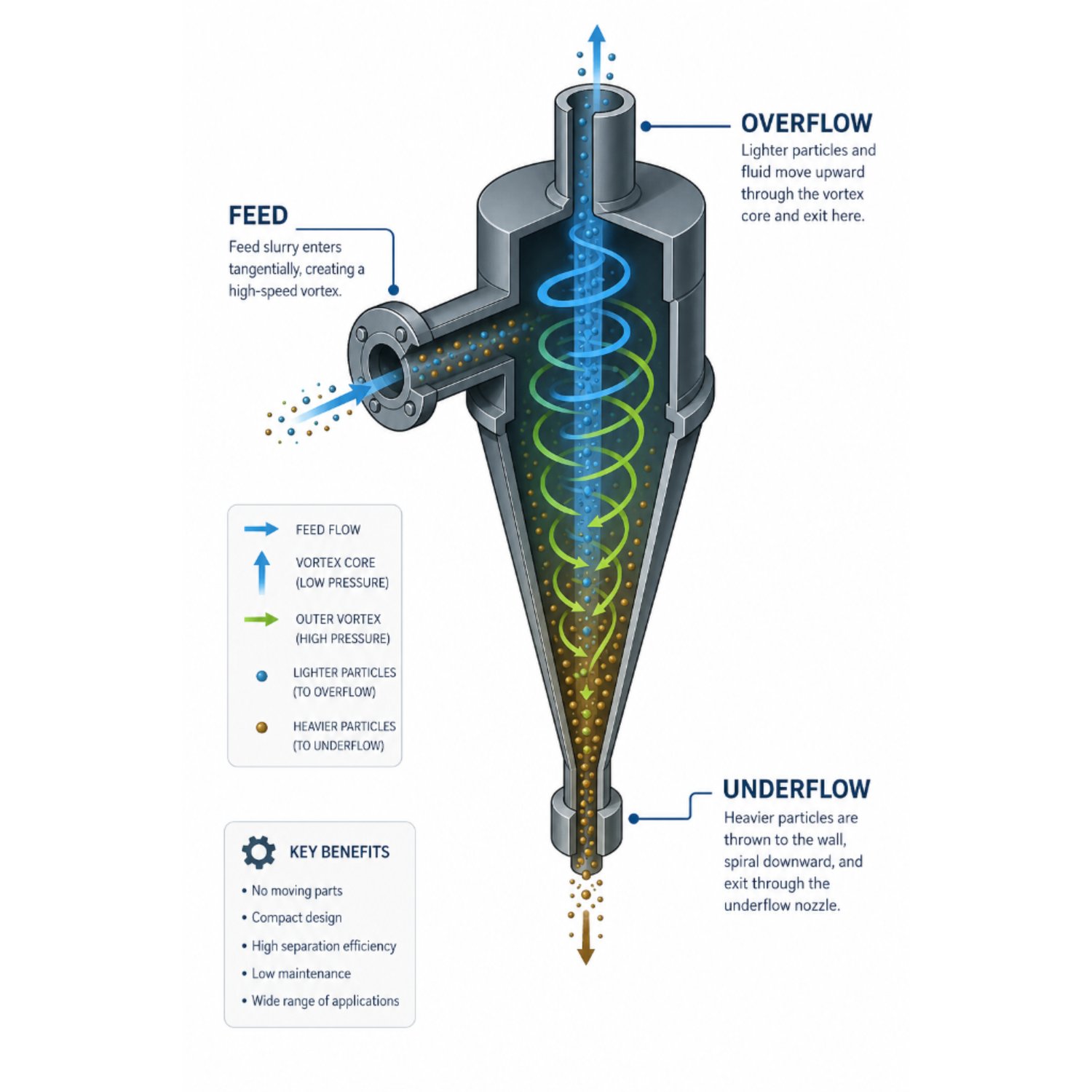
Hydrocyclone (Plitt) Same efficiency curve form, with a known/measured d50c. Overflow/underflow split and classification efficiency
Bulk Splitter Fraction-based mass split, dividing a stream without changing its PSD
Mass Distributor Target-tonnage mass split. Matching downstream equipment capacity
Component Splitter User-set split fraction per size class. Empirically-measured (sampled) splits
Design philosophy: every model uses an established, citable equation rather than a black-box fit — Bond's law, Rosin-Rammler PSD generation, the Broadbent-Callcott breakage function, and the Plitt/Whiten reduced efficiency curve. Where a model genuinely needs site- or ore-specific data (breakage parameters, cut sizes), the sheet says so plainly rather than presenting a placeholder as fact.
Downloaders are eligible for a 30% discount on the book: Comminution and Classification A Practitioner's Handbook