
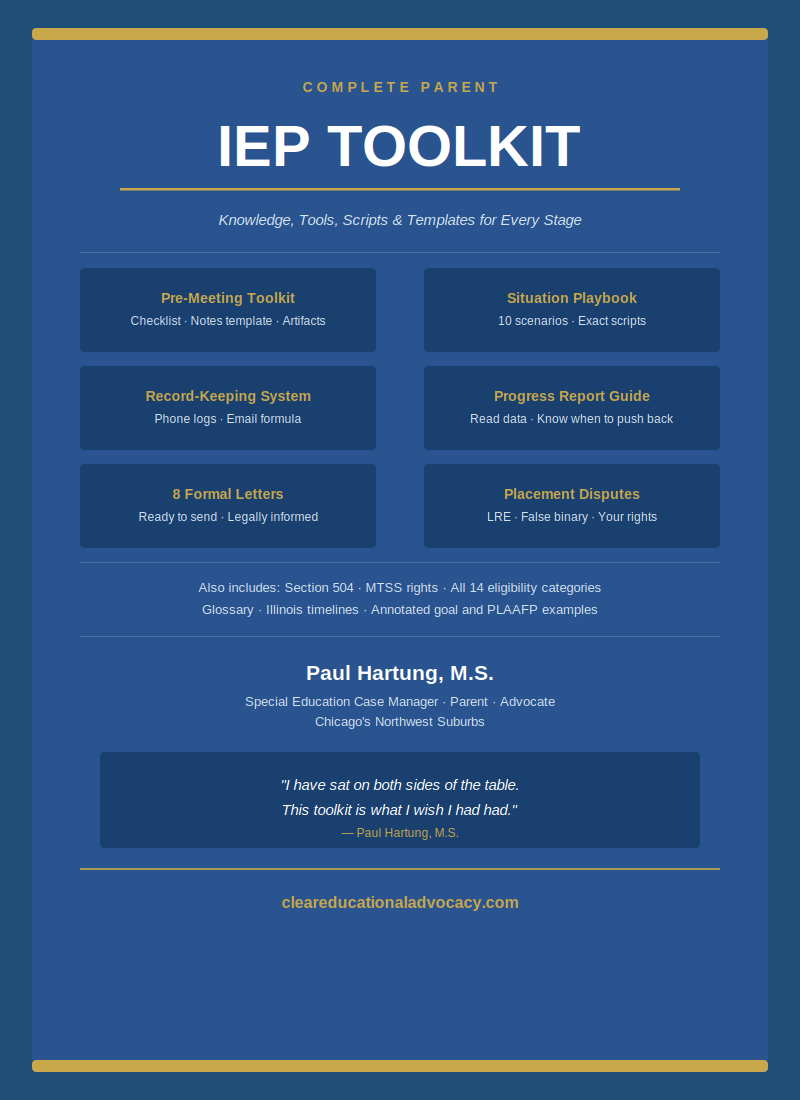
Parent Complete IEP Toolkit
Most parents enter the IEP process just informed enough to show up — but not enough to push back.
IEP meetings move fast. The language is technical. The professionals across the table have done this hundreds of times. You may be doing it for the first. When you don’t know what to ask for, the cost is paid by your child — in missed services, vague goals, and a plan that looks complete on paper but produces little in practice.
The Complete Parent IEP Toolkit changes that. Built by a special education case manager who is also the parent of two children with IEPs and 504 plans — and who has attended IEP meetings as an advocate for other families — this toolkit gives you the knowledge, tools, scripts, and templates to participate fully at every stage of the process.
What Makes This Different:
Most IEP books tell you what your rights are. This toolkit tells you how to use them. There is a difference between knowing you can request an IEE and knowing exactly what to say at the meeting, what the school must do within 5 days, and what to do if they don’t respond. This toolkit covers the second kind.
What’s Inside:
The Full Knowledge Foundation
- What an IEP is and what it legally must contain
- Your full parent rights under IDEA and Illinois law
- MTSS explained — and your right to request evaluation at any point during it
- How to read evaluations, present levels, goals, and progress reports
- Section 504 vs. IEP — including 5 common myths and the OCR complaint process
- All 14 disability eligibility categories in plain language
- Transition planning, age of majority, and adult services
- When and how to dispute a decision — with 4 real scenarios including the false binary placement
The Pre-Meeting Toolkit
- Complete meeting preparation checklist — every document to gather and review
- Artifacts list — what to bring that shifts a meeting from reactive to productive
- Pre-meeting notes template — a fillable page to organize concerns and questions before every meeting
The Record-Keeping System
- The 24-hour documentation rule and what to document after every interaction
- Phone call log template — dated, timed, and legally defensible
- The follow-up email formula — confirm what was discussed, create a paper trail, stay collaborative
- Digital folder organization guide — find anything in 30 seconds during a meeting
The Progress Report Guide
- How to tell the difference between real data and a checkbox
- The compliance vs. independence distinction — the most important concept in progress monitoring
- Strong vs. weak progress report examples, annotated side by side
- Questions to ask by goal domain: reading, writing, math, executive functioning, behavior
The Situation Playbook
Exact language for 10 of the most common difficult moments in IEP meetings:
- “The school says my child is doing fine — but I’m not seeing it at home”
- “I disagree with the goal they’ve proposed”
- “I think accommodations aren’t being consistently offered”
- “The school wants to reduce my child’s services”
- “I received the draft IEP the night before the meeting”
- “My child is facing suspension and I don’t know my rights”
Each scenario includes what you might hear, exactly what to say, why it works, and what to do next.
8 Sample Formal Letters
Ready to customize and send, with legal grounding, customization notes, and sending guidance:
- Requesting an initial evaluation
- Requesting an IEE at public expense
- Requesting school records
- Requesting an IEP meeting
- Requesting Prior Written Notice
- Documenting a concern in writing
- Requesting a change of placement
- Requesting mediation
About the Author:
Paul Hartung, M.S. is a special education case manager and team lead with more than a decade of experience in Chicago’s northwest suburbs. He holds a B.S. in Special Education from Illinois State University, an M.S. in Curriculum and Instruction from the American College of Education, and a Director of Special Education Endorsement from National Louis University.
He is the parent of two children who receive special education services. One was found eligible for a learning disability in writing after a two-evaluation process. The other has ADHD and holds a 504 plan. He has also attended IEP meetings as an advocate for other families — reviewing records, preparing parents for what would happen in the room, translating jargon in real time, and helping families hold the line on what their children were entitled to.
This toolkit was written from both sides of the table. It is what he wishes had existed when his family needed it.
Who This Is For:
- Parents new to the IEP process who want to be genuinely prepared, not just informed
- Families who have had IEPs for years but feel like they’re always reacting rather than leading
- Parents who have been told “we don’t have that program” or “your child doesn’t qualify” and want to know what to say next
- Anyone who wants to walk into the next meeting knowing exactly what to ask for — and what to do if the answer is no
The families I have supported didn’t need to become experts in special education law. They needed to be prepared enough to participate fully, informed enough to ask the right questions, and supported enough to hold the line when it mattered. That is what this toolkit is for.
Each license covers one purchaser.