
Special Populations Quick Reference
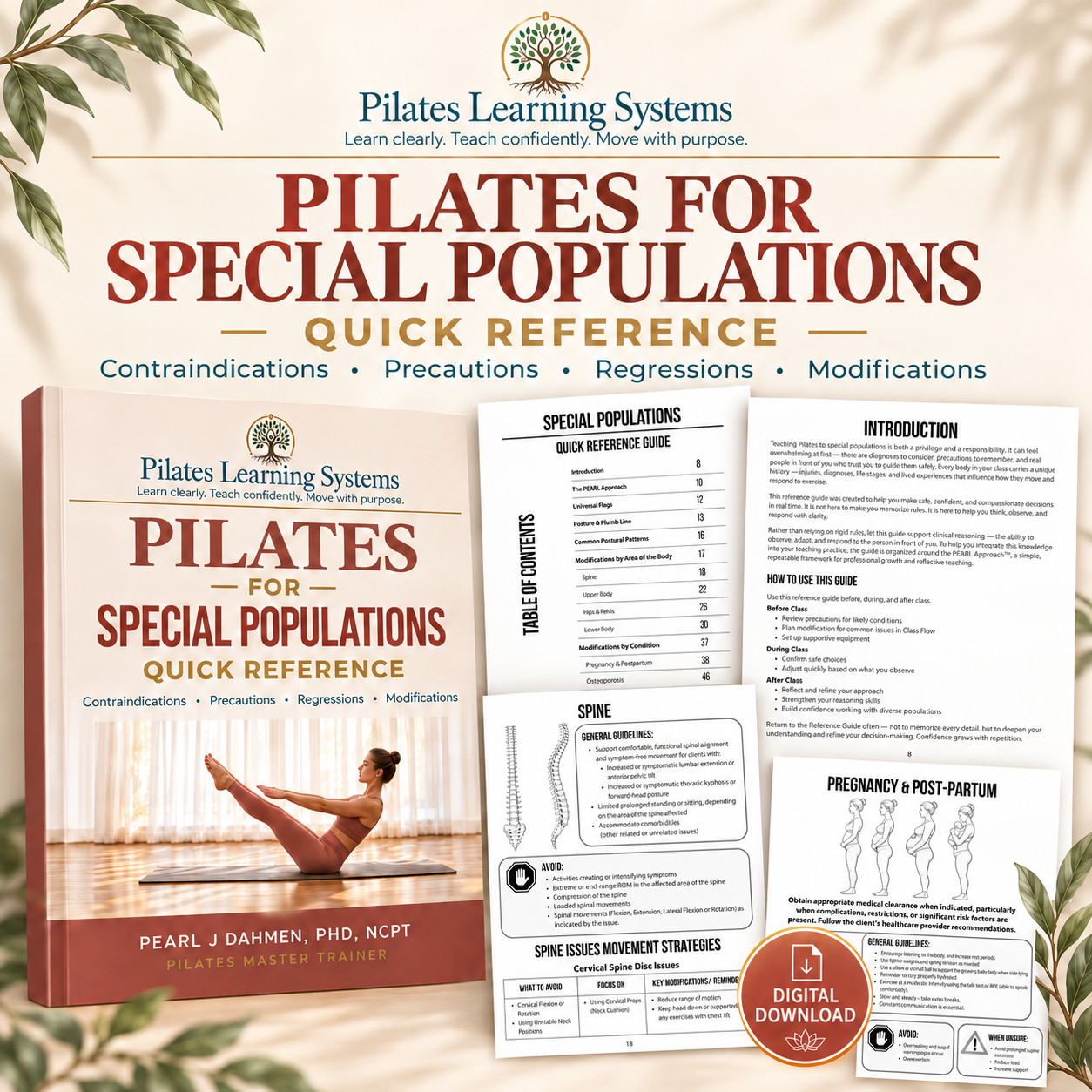
Pilates for Special Populations — Quick Reference
Contraindications • Precautions • Regressions • Modifications
Teaching Pilates to special populations requires more than knowing exercises. It requires knowing what to observe, when to modify, when to reduce demand, and when to stop and refer.
The Pilates for Special Populations Quick Reference is a practical digital resource designed to help Pilates instructors and instructors in training make safer, more thoughtful movement decisions when working with clients whose conditions, diagnoses, life stages, or movement limitations may require additional consideration.
Rather than asking you to memorize rigid rules, the guide is designed to support observation, clinical reasoning, modification, and confident decision-making before, during, and after a Pilates session.
Inside the Guide
The guide brings together essential reference information for working with special populations, including:
- The PEARL Approach™ for organizing observation and decision-making
- Universal warning signs and safety considerations
- Posture and plumb-line concepts
- Common postural patterns
- Modifications organized by area of the body
- Condition-specific precautions and teaching considerations
- Contraindications and movements to avoid
- Regressions and ways to reduce movement demand
- Supportive positioning and equipment considerations
- Practical reminders for deciding when to modify, pause, or refer
Modify by Area of the Body
Dedicated reference sections help you think through movement considerations for:
- Spine
- Upper Body
- Hips & Pelvis
- Lower Body
These sections focus on maintaining comfortable, functional movement while identifying situations in which range of motion, load, position, or exercise choice may need to change.
The goal is not simply to ask, “Can this client do the exercise?”
Instead, the guide encourages you to consider:
What should I avoid?
What should I focus on?
What modification would make this movement more appropriate?
Condition-Specific Reference
The guide also includes condition and life-stage sections, including topics such as:
- Pregnancy & Post-Partum
- Osteoporosis
- Additional special-population considerations requiring changes to movement, load, support, or exercise selection.
Each section is organized to make important information easier to locate when planning or reviewing a session.
Universal Red Flags
A dedicated Universal Red Flags reference reinforces an important principle:
Pause • Assess • Modify • Refer
The guide helps instructors recognize when continuing an exercise may not be appropriate and provides a simple decision framework for reducing intensity, simplifying movement, increasing support, or stopping when safety is uncertain.
Designed for Real Teaching
Use the guide:
Before class
Review likely precautions, plan modifications, and prepare supportive equipment.
During class
Confirm safe choices, observe the client’s response, and adjust movement as needed.
After class
Reflect on what worked, refine your approach, and strengthen your decision-making for future sessions.
This makes the guide useful not only for studying special populations, but also as a working reference for class planning, practice teaching, observation, and instructor development.
Designed For
This resource is especially useful for:
- Pilates instructors in training
- Newly certified instructors
- Comprehensive Pilates teachers
- Instructors reviewing special-population considerations
- Teachers preparing private or group sessions
- Instructors who want a concise reference to supplement comprehensive teacher training
Digital Download
You will receive the Pilates for Special Populations Quick Reference as a downloadable PDF.
The interior is designed in a clean black-and-white reference format, making it practical for on-screen study or personal printing.
Save it to your computer or tablet, keep it available while planning sessions, or print selected pages for your instructor reference binder.
Important Scope Reminder
This guide is an educational reference for Pilates instructors. It is not intended to diagnose medical conditions or replace advice from a qualified healthcare professional.
Use the information with known diagnoses, client-reported restrictions, your professional scope of practice, and healthcare-provider guidance when appropriate.
Safety first. Progress second. Confidence follows.
Learn clearly. Teach confidently. Move with purpose.