

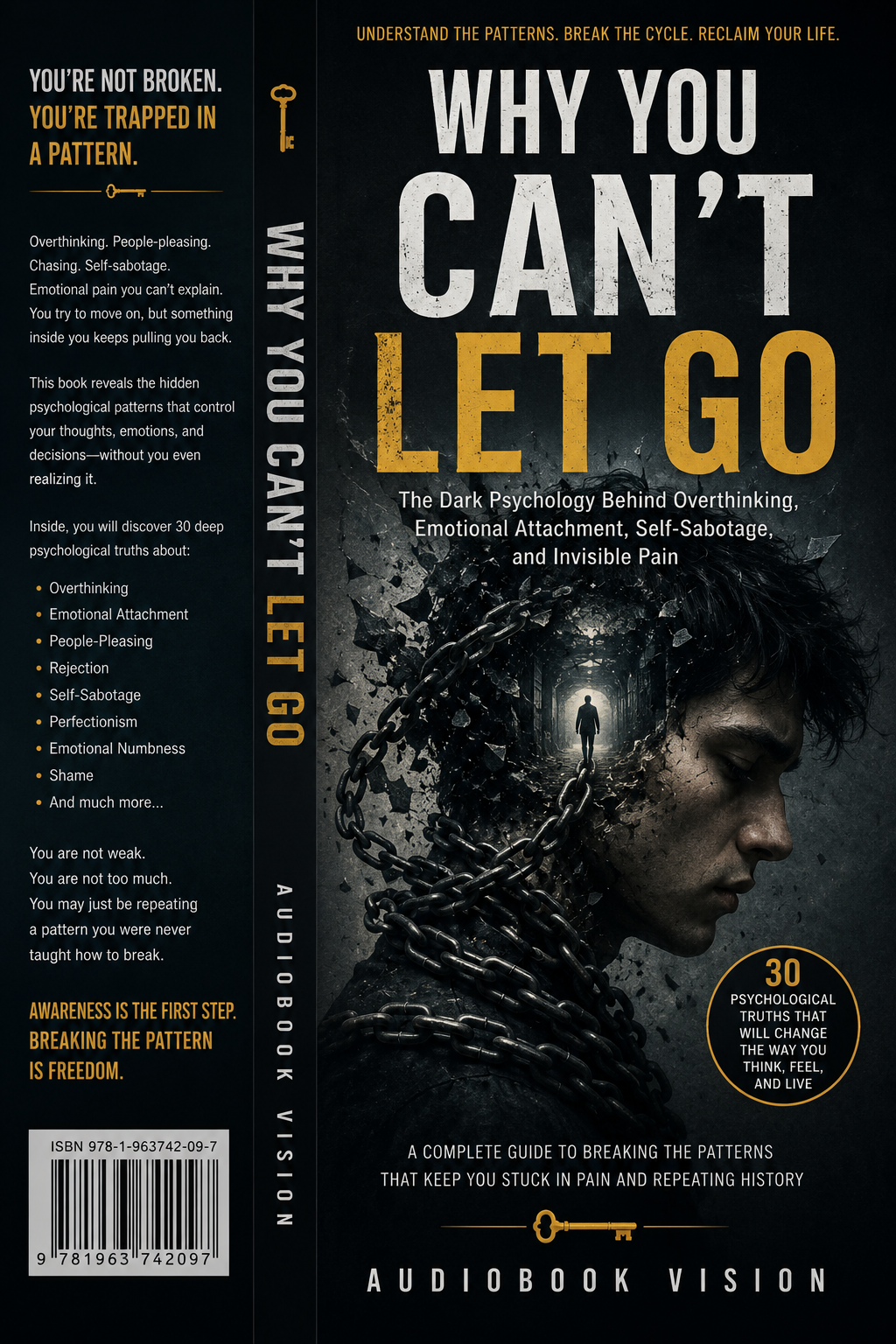
WHY YOU CAN’T LET GO The Dark Psychology Behind Overthinking, Emotional Attachment, Self-Sabotage, and Invisible Pain
WHY YOU CAN’T LET GO
The Dark Psychology Behind Overthinking, Emotional Attachment, Self-Sabotage, and Invisible Pain
Why do you keep thinking about the past when you desperately want to move forward?
Why do you replay conversations that ended years ago? Why do you become attached to people who pull away? Why do you overthink simple decisions, seek approval, sabotage your own progress, or feel emotionally empty when everything appears to be fine?
Maybe the problem isn't that you are weak.
Maybe you are trapped in a psychological pattern you were never taught to recognize.
WHY YOU CAN’T LET GO takes you beneath the surface of everyday thoughts and behaviors to explore the hidden psychological patterns that influence your relationships, decisions, emotions, and sense of self.
Inside these pages, you will discover why:
- Your mind keeps replaying painful memories.
- Overthinking can become a cycle that feels impossible to escape.
- You search for closure long after a relationship has ended.
- Rejection can feel like a judgment on your entire identity.
- You chase people who keep pulling away.
- Attention can be mistaken for love.
- People-pleasing can hide a fear of rejection.
- You sabotage things just when they begin to work.
- Perfectionism can become a sophisticated form of avoidance.
- You continue choosing familiar pain over unfamiliar freedom.
- You become emotionally numb after being hurt.
- Shame can quietly control your decisions.
- You struggle to forgive yourself for things that happened years ago.
- You feel as though everyone else is moving forward while you remain behind.
But understanding the problem is only the beginning.
This book is designed to help you recognize the pattern, understand what keeps it alive, and begin breaking it.
Each chapter moves beyond explanation into practical reflection and action, helping you separate facts from the stories your mind creates, recognize emotional triggers, identify hidden needs, interrupt automatic reactions, and develop healthier responses.
You will not be told simply to “think positive” or “move on.”
Instead, you will be invited to look directly at the psychological mechanisms that keep certain thoughts, emotions, and behaviors repeating.
Because sometimes the thing you cannot let go of isn't a person.
It is the meaning you gave them.
Sometimes it isn't the past.
It is the identity you built around what happened.
And sometimes the real battle isn't against another person, a mistake, or a memory.
It is the pattern inside your own mind.
If you have ever felt trapped in your thoughts, unable to move forward, dependent on someone's attention, afraid of rejection, or frustrated because you understand what you should do but still cannot seem to do it—
this book was written for you.
You are not broken.
You are carrying a pattern.
And patterns can change.