






Restorative Conference Facilitator Guide: The Complete Framework for Hard Conversations
Preparation prevents escalation. Design produces resolution. The conference outcome is decided before anyone sits down.
Think about the standard restorative circle format that most school districts push out through generic training manuals. A major behavioral crisis explodes in a classroom, a meeting is hastily scheduled, and a group of exhausted adults sits in a circle with a dysregulated student. Everyone takes turns venting their frustration, the student is prompted to give a rehearsed apology, a behavior agreement is signed, and the file is marked resolved.
We call that a restorative performance. It satisfies a central office compliance check, but it leaves the underlying environmental conditions entirely untouched.
Because there was no deliberate system holding the frame before the doors even opened, the meeting automatically defaults to raw emotion and defensiveness. The teacher feels isolated and undermined, the parent enters in a defense posture built from historic institutional friction, and the student retreats behind a script of guarded behavior. Within three weeks, the exact same behavioral disruption recycles, and the building leadership wonders why the restorative program "didn't work."
It failed because a circle format is not a magic solution. It is an advanced facilitation task that requires rigid process infrastructure.
The longitudinal numbers back this up clearly. A landmark study by the Learning Policy Institute tracking restorative practice exposure across 485 California middle schools confirmed that while restorative frameworks significantly boost academic achievement and drive down suspension rates, particularly for Black and Latino youth, the ultimate success models hinge entirely on implementation quality. And implementation quality lives or dies based on facilitator preparation.
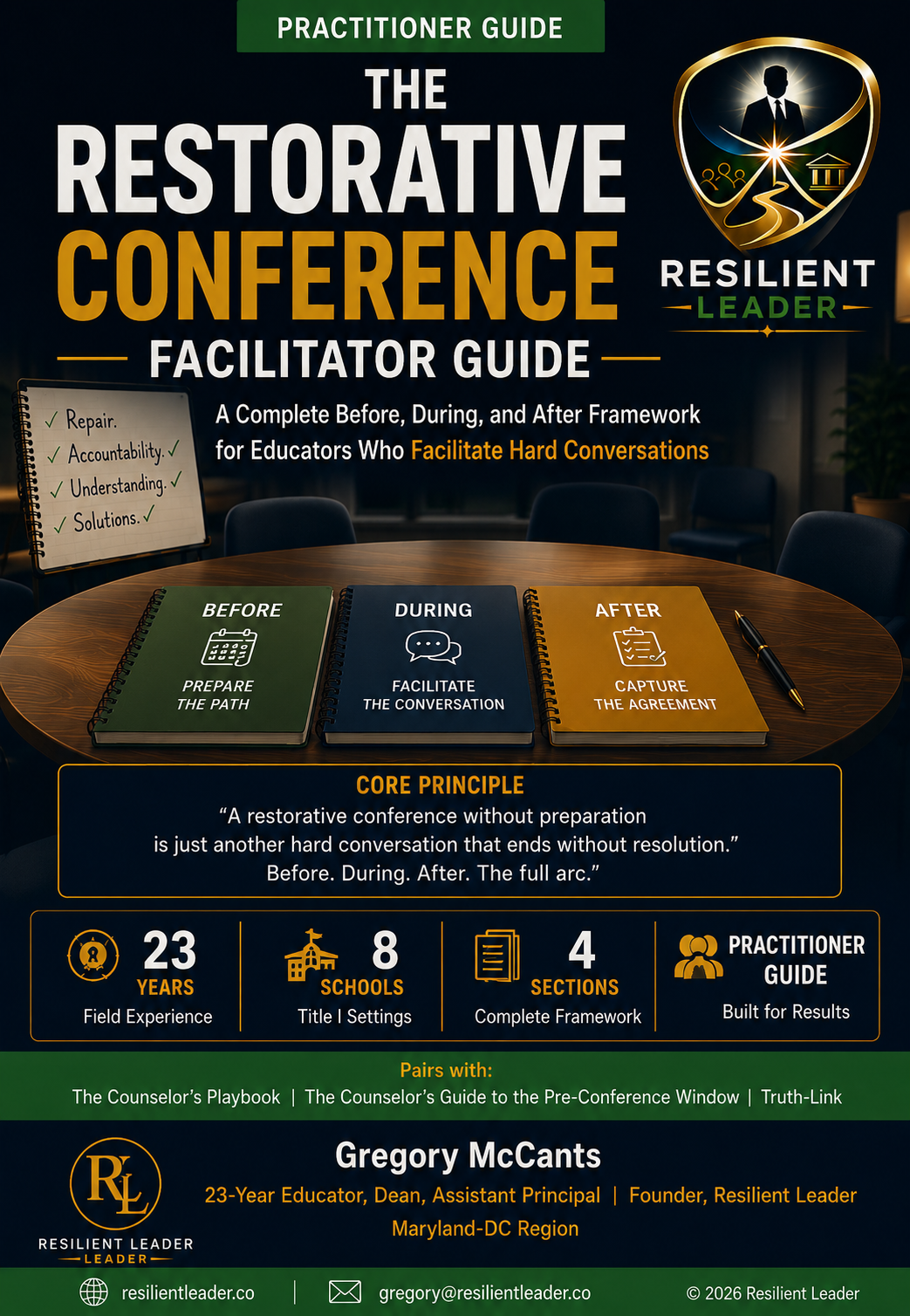
Written by a 23-year Title I teacher, dean, and assistant principal, this guide strips away the abstract educational theories to give you a highly disciplined, mechanical approach to conflict resolution. It maps out a complete 4-phase facilitation arc and provides 7 ready-to-use scripts to keep the room anchored when temperatures spike. Stop managing performative truces that collapse by Friday morning. Become the intentional architect of your building's restorative outcomes.
Who This Is For
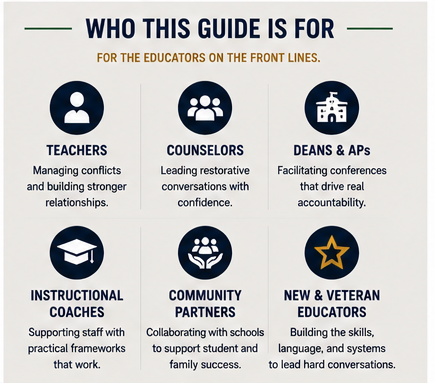
- School Counselors & Social Workers who find themselves running cold-start conflict circles and need a clear, step-by-step facilitation sequence rather than generic, abstract behavior theories.
- Deans of Students & Assistant Principals exhausted from running the exact same behavioral conferences for the same students cycle after cycle with zero long-term resolution.
- Frontline Tier 1 Specialists & Coaches looking for a shared, objective mediation framework to protect staff and keep student-teacher relationships from fracturing permanently.
What You Receive
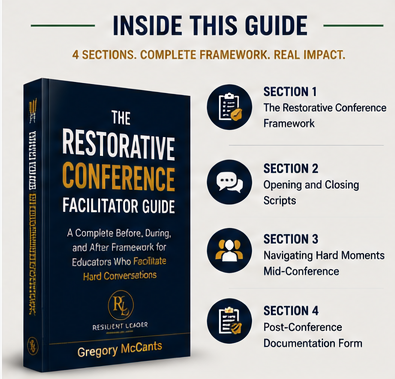
- The 4-Phase Facilitation Arc: A rigorous operational roadmap guiding practitioners sequentially from pre-work loops into live containment, resolution design, and post-conference tracking.
- 7 Ready-to-Use Scripts: Plug-and-play verbal models providing exact, copy-and-paste script language for Openings, Participant Redirections, Silent Gap Holds, Truth Escalation Tracks, and High-Activation Closes.
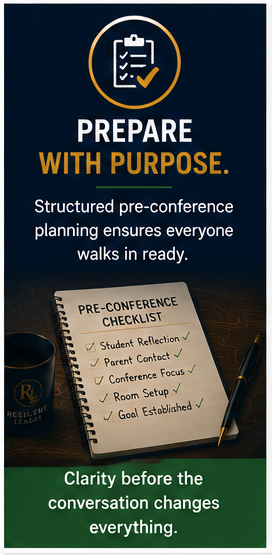
- The Facilitator Pre-Conference Checklist: A comprehensive intake audit tool to ensure student pre-work reflection is completed, parent alignment is secured, and physical room parameters are arranged deliberately before anyone takes a seat.
- The Active Management Sequence Protocol: Actionable steps to protect the psychological safety of the room, validate student experience without enabling behavior, and defuse defensive parent actions in real time.
- The Post-Conference Documentation Template: A professional, documentation-forward template ready for direct digital input to log commitments, track timeline milestones, and define 30-day success flags.
- Learning Policy Institute Data Analysis: Integrated reference metrics outlining the specific disciplinary and equity returns of high-fidelity restorative implementation across secondary schools.
What It Pairs With
To construct an airtight restorative and disciplinary ecosystem throughout your campus, this facilitator manual pairs natively with:
- The Restorative Practices Toolkit & Inside the Room: For transforming these core mediation criteria into a broader, schoolwide daily culture tracking matrix.
- Veteran AP Field Manual: For accessing legally bulletproof documentation formatting, language swap tables, and upstream referral templates to back up all post-conference logs.
- Who Owns the Arc: For establishing explicit, named staff accountability and monitoring sequences across the critical 30-day post-conference recovery window.