
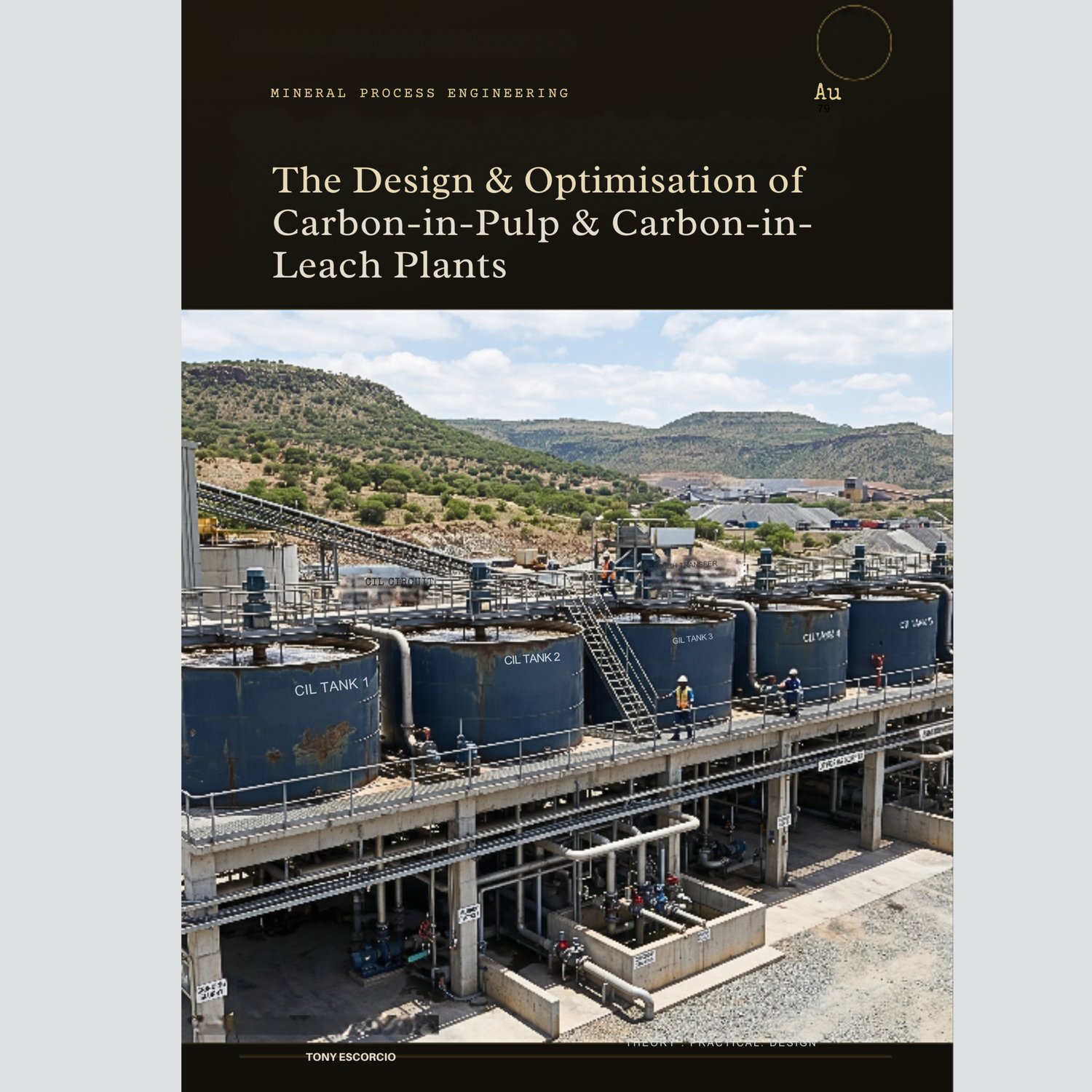
THE DESIGN AND OPTIMISATION OF CARBON IN PULP AND CARBON IN LEACH PLANTS
There is a gap in the CIP/CIL literature that I have spent my career bumping into.
Academic texts cover the surface chemistry and mass transfer mathematics — rigorously, thoroughly, and in a form that is largely inaccessible to the people who actually run these plants.
Operating procedures tell technicians what to do, without ever explaining why. That leaves them unable to diagnose problems, adapt to changing conditions, or recognise when something is going wrong before it becomes a crisis.
Neither extreme serves the working metallurgist.
I wrote this book to bridge that gap.
📘 Carbon-in-Pulp and Carbon-in-Leach: Theory, Simulation, and Plant Practice is a single-volume reference for the laboratory technicians, graduate metallurgists, and process engineers who need both the theoretical foundation and the practical tools to understand and optimise carbon circuit performance.
What's inside:
▸ The surface chemistry and pore structure of activated carbon — why it works, and why it sometimes stops
▸ Adsorption equilibrium, isotherm theory, and kinetics applied to gold plant conditions
▸ A fully worked steady-state simulation of a six-tank countercurrent CIP circuit, with sensitivity and economic analysis at current gold prices
▸ The Kaystar Carbon Activity Test: narrative procedure, worked Kav calculation, and interpretation guidance
▸ A structured troubleshooting guide organised by the symptoms a plant metallurgist sees first
▸ A carbon sampling protocol grounded in the Theory of Sampling
Every hour of every day, gold is lost to tailings in circuits that are underperforming. Often the reason is not equipment failure — it is a gap in understanding that no one has had the tools to close.
This book is for the people who want to close it.