



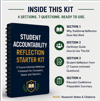
Student Accountability Reflection Starter Kit: A Trauma-Informed Reflection Framework for Counselors, Deans, and Teachers
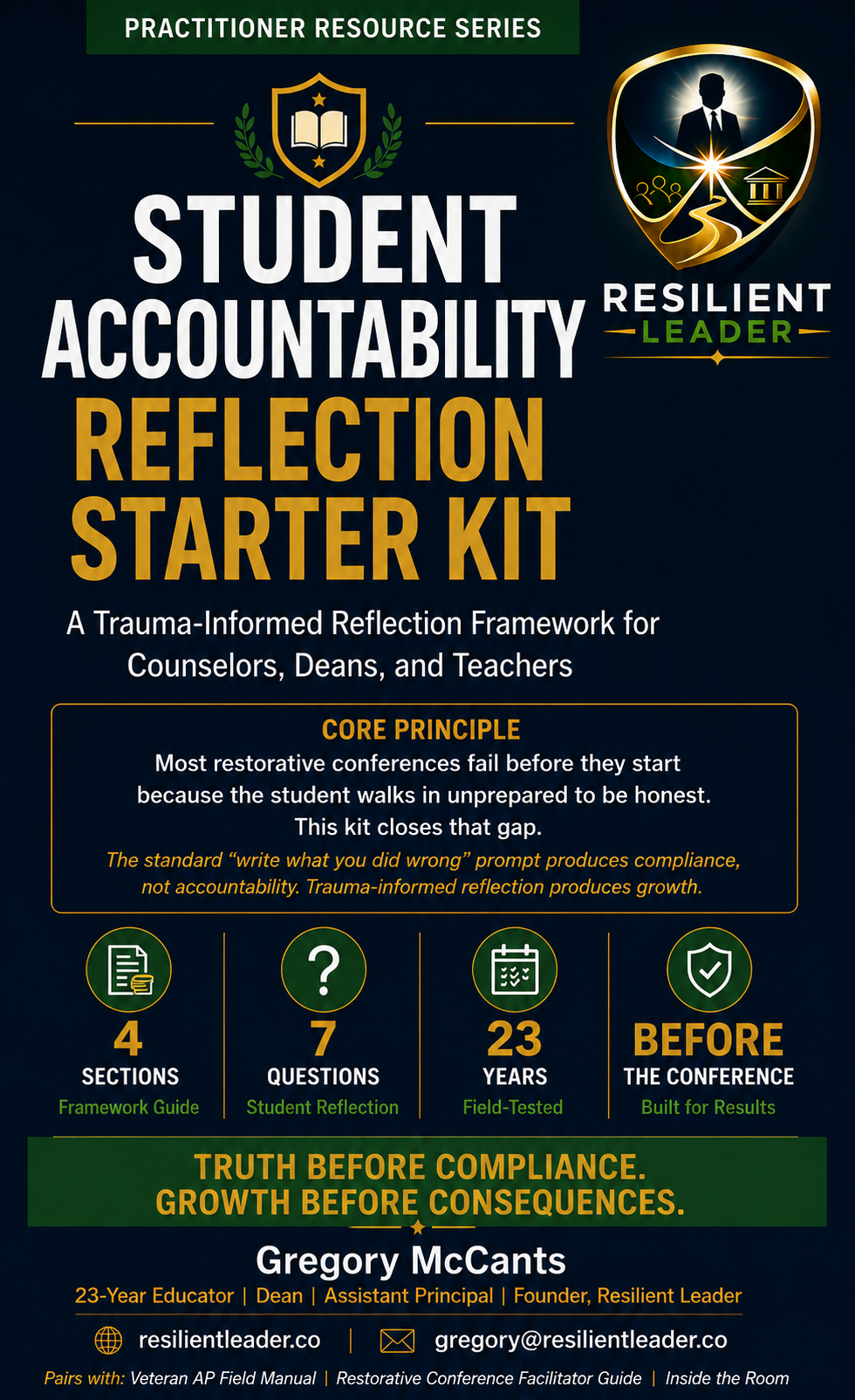
The standard 'write what you did wrong' prompt produces compliance, not accountability. Trauma-informed reflection produces growth. These are different tools.
Most restorative conferences fail before the participants even take a seat in the office. This breakdown doesn't occur because the adults in the room are unprepared or lacking dedication. It hits a brick wall because the student walks into the room completely unprepared to be honest, while the adult walks in entirely unprepared for what they are actually about to hear.
Think about the traditional reflection drill. A student is sent out of a classroom following a disruption, handed a blank lined sheet, and told to "write what you did wrong and what you should have done differently."
This is a structural mistake. The framing instantly triggers a defensive threat response. When you demand self-blame from a brain that is actively trying to survive a perceived institutional threat, the real story stays completely buried. The student doesn't reflect; they execute a quick risk-management strategy, writing exactly what they think the authority figure wants to hear to close the conversation as fast as possible.
Authentic accountability requires a completely different processing pipeline. Behavior never comes from a vacuum. According to landmark neuroscience research on affect labeling, putting complex internal feelings into concrete words immediately reduces emotional reactivity by activating the prefrontal cortex and dampening the amygdala response. Students who are given a private space to label what they were feeling before a high-stakes meeting arrives at the table with significantly higher regulation capacity.
Written by a 23-year Title I teacher, dean, and assistant principal, this printable toolkit replaces useless, performative confessions with a strict, trauma-informed preparation sequence. Help students process the hardest parts of the conflict in private so that the live conference can pivot immediately toward actual relational repair.
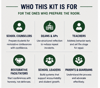
Who This Is For
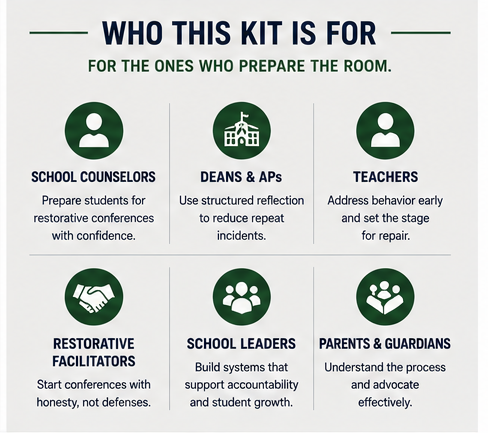
- School Counselors & Social Workers who are tired of cold-start conflict circles and need a predictable, pen-and-paper intake protocol to prepare their caseload before mediation opens.
- Deans of Students & Assistant Principals who want to stop collecting performative student truces and need a rigorous, trauma-informed re-entry tool following a suspension.
- Classroom Teachers managing frequent behavior flips who want an objective, non-punitive reflection process to use directly within their rooms when a student says "I don't know" during redirection.
What You Receive
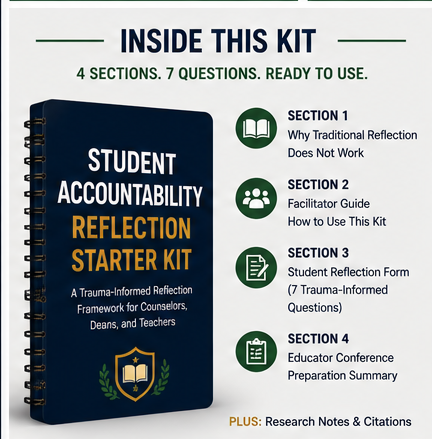
- The Traditional Reflection Failure Analysis: An in-depth structural review unpacking the four distinct reasons standard disciplinary prompts fail—detailing how they weaponize blame, skip core emotions, ignore systemic impact, and function purely as punitive documentation.
- The Practitioner's Facilitation Guide: Clear operational instructions mapping precisely Who should deploy the tool, When to execute it across workflows, and How to safely protect student writing privacy to maximize honesty.
- The "I Don't Know" Recovery Protocol: Gritty verbal templates designed to gracefully bypass a student's default defensive stalling phrases and gently guide them back to specific situational triggers.
- The Printable 7-Question Student Reflection Form: A beautifully spaced, non-judgmental workspace page ready to print and hand directly to a student to map out experienced facts, core driving emotions, affected bystanders, and personal repair needs.
- The Educator Conference Preparation Summary: A professional, single-page summary blueprint allowing practitioners to securely log core emotions, document accountability thresholds, isolate structural discrepancies, and draft targeted opening questions before the meeting room fills up.
- Neurological Affect Labeling Data Brief: Integrated research citations summarizing landmark fMRI and psychological findings on how structured verbal labeling disrupts amygdala activity to stabilize adolescent stress states.
What It Pairs With
To establish a completely seamless, automated behavioral and restorative pipeline across your entire campus site, this printable kit links natively with:
- The Restorative Conference Facilitator Guide: For taking the student’s prepared reflection data and executing the live, four-phase facilitation arc under heavy pressure.
- Inside the Room: For mastering real-time behavioral postures, room layout equity, and boundary-holding techniques when all three sides of the conflict triangle meet face-to-face.
- Veteran AP Field Manual: For accessing advanced copy-and-paste language swap matrices to securely purge emotional, conclusion-heavy labels from official student records.
- Truth-Link: The official Resilient Leader digital equivalent that automates this entire trauma-informed reflection loop on student devices and synthesizes real-time dashboard data for educators.