
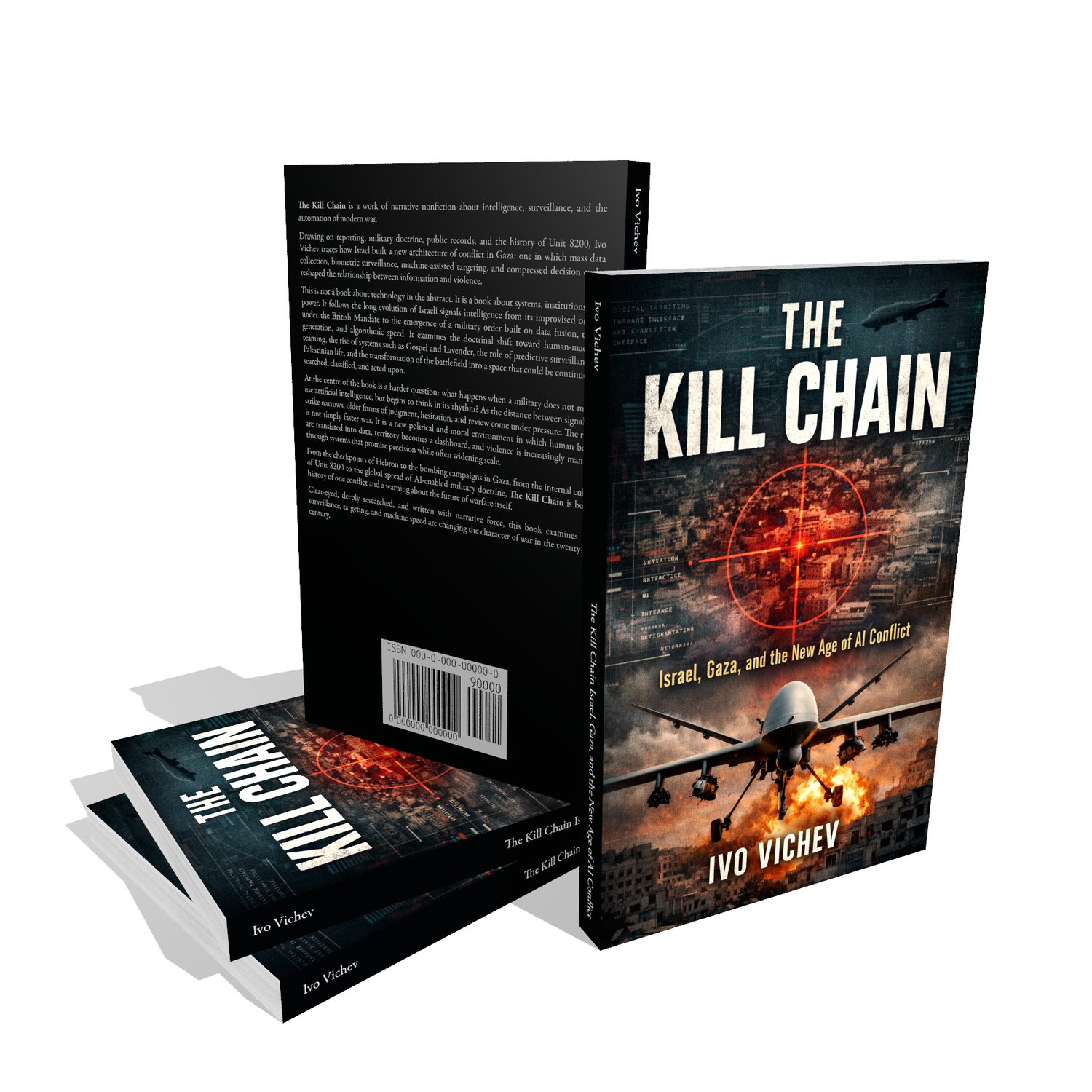
The Kill Chain Israel, Gaza, and the New Age of AI Conflict
The Kill Chain
Israel, Gaza, and the New Age of AI Conflict
Ivo Vichev
War did not enter the age of artificial intelligence in theory. It entered it in practice.
In The Kill Chain, Ivo Vichev traces how Israel built a new architecture of conflict in Gaza: one shaped by mass surveillance, biometric control, machine-assisted targeting, and the compression of time between signal and strike. At the centre of this transformation stands Unit 8200, the secretive intelligence powerhouse whose evolution helps explain how data became one of the central materials of modern war.
This is not a book about technology in the abstract. It is a history of power. It follows the long path from improvised signals intelligence under the British Mandate to the rise of systems that could search populations, generate targets, rank suspicion, and accelerate killing on an industrial scale. It examines the doctrines, institutions, and political choices that made this world possible, and the human consequences that followed when surveillance, automation, and war fused into a single operational logic.
From the checkpoints of Hebron to the bombing campaigns in Gaza, from the ideology of human-machine teaming to the catastrophic intelligence failure of 7 October, The Kill Chain shows how a military system built to eliminate uncertainty became increasingly dependent on machines that promised speed, pattern, and control — while never escaping the older realities of error, blindness, and moral responsibility.
Clear-eyed, unsettling, and deeply researched, this is a book about Israel and Gaza. It is also a warning about the future of conflict itself.
Here’s a slightly more commercial version if you want it to hit harder on the back cover:
War is changing faster than law, politics, or public language can keep up.
In The Kill Chain, Ivo Vichev examines how Israel’s wars in Gaza became a testing ground for a new kind of conflict — one driven by data, surveillance, AI-assisted targeting, and machine-paced decision-making. At the centre of this story is Unit 8200, the intelligence system that helped turn mass information into operational power.
Tracing the path from early signals intelligence to biometric checkpoints, predictive surveillance, target-generation systems, and the automation of the strike process, Vichev shows how modern war is being rebuilt around speed. But he also shows the cost: the erosion of hesitation, the widening of targetability, and the transformation of human beings into searchable records inside a battlespace increasingly governed by machines.
The Kill Chain is both a history of Israel, Gaza, and the rise of AI conflict, and a chilling account of what happens when a military begins to think in the rhythm of the algorithm.