

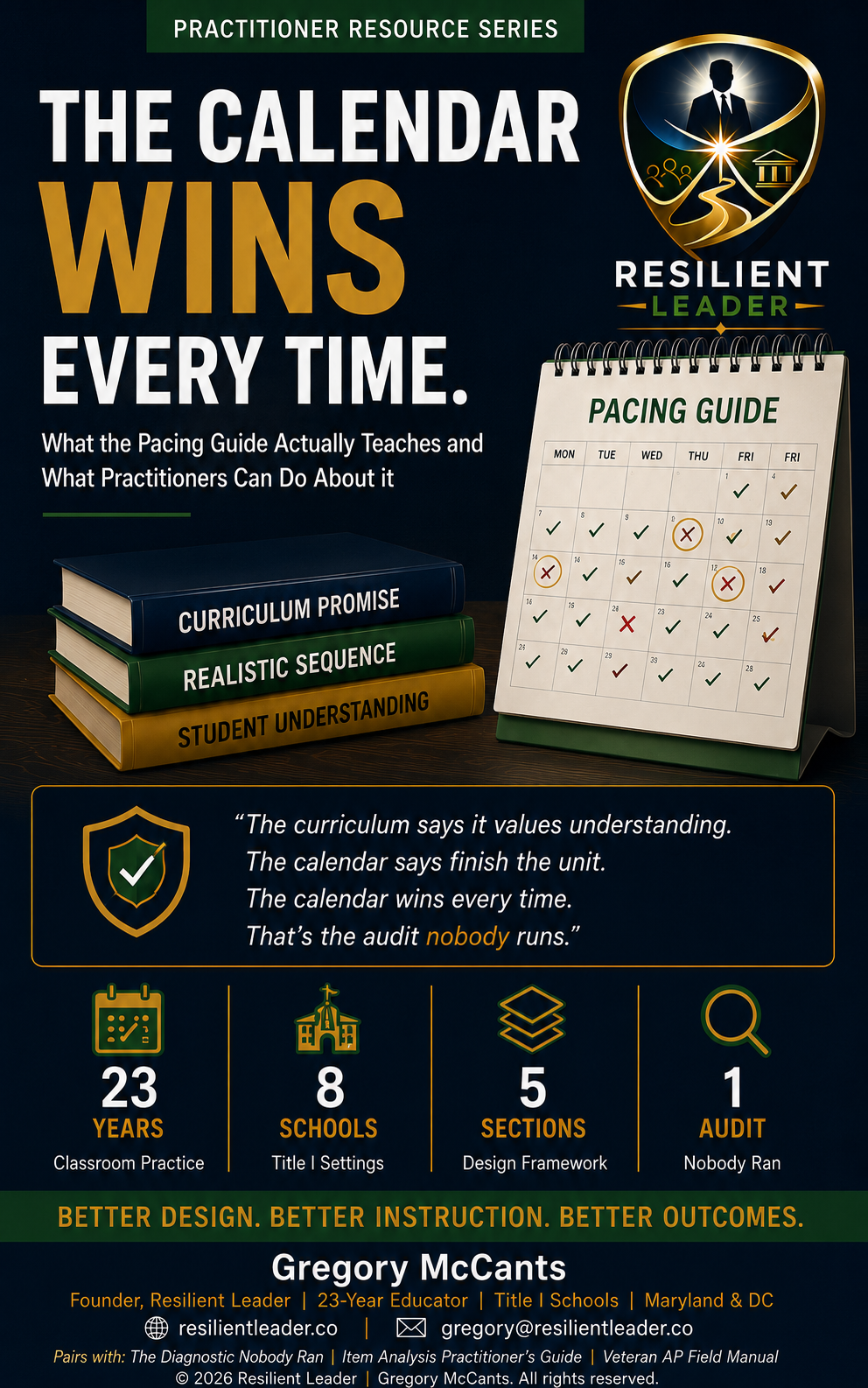


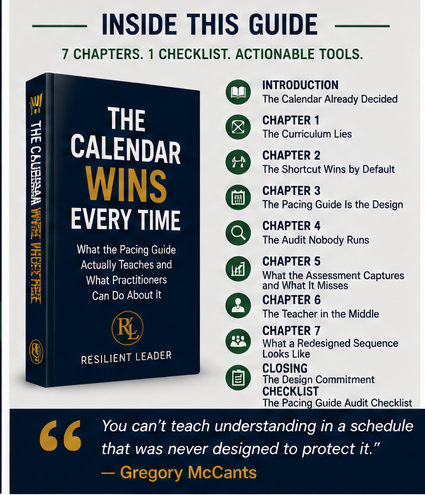




The Calendar Wins Every Time: What the Pacing Guide Actually Teaches and What Practitioners Can Do About It
The curriculum says it values understanding. The calendar says finish the unit. The calendar wins every time. That's the audit nobody runs.
Every year, school districts publish beautiful, glossy curriculum frameworks packed with advanced statements about "deep conceptual exploration," "student-led inquiry," and "mastery-based instruction". They tell teachers that the ultimate goal is ensuring every single child builds a durable, structural foundation of knowledge.
Then, they issue the pacing guide.
Think about the rigid trap that closes around educators every single fall. The pacing guide outlines an unrelenting, chronological schedule: you have exactly four days to introduce a complex prerequisite standard, one day for a practice worksheet, and then the common assessment window slams shut. There is absolutely zero built-in flexibility for learning progressions.
When forty or fifty percent of your classroom completely misses the core concept on Wednesday, you face an impossible professional choice. Do you pause the timeline to remediate the learning gap, honor your student relationships, and protect the instructional sequence? Or do you ignore the data, march blindly ahead to the next unit, and satisfy the administrative compliance deadline?
In almost every school building across the country, the calendar wins.
The system treats a class section falling behind pace as an individual teacher planning error rather than a structural flaw in the district’s design. Because there is no institutional recovery mechanism built into the timeline, the teacher is forced to fill the gap entirely alone, scraping together improvised shortcuts in the margins of a school day. We pretend these timelines are built around learning progressions, but they are engineered solely to satisfy a coverage or assessment compliance requirement.
Written by a 23-year Title I classroom math teacher, dean, and assistant principal, The Calendar Wins Every Time dismantles the coverage illusion. This book strips away vague educational theories to hand you an explicit, field-tested engineering framework to audit your building's pacing sequence. Stop internalizing an impossible calendar design as a personal instructional failure. Reclaim your time, expose the structural flaws in your schedule, and build an environment where student mastery is actually protected.
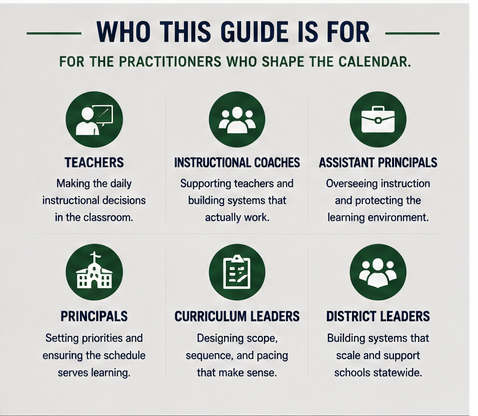
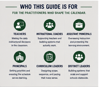
Who This Is For
- Classroom Teachers who are completely exhausted by the constant, low-grade panic of trying to balance authentic student understanding with an uncompromising, rigid testing timeline.
- Instructional Coaches & Curriculum Specialists looking for an objective, non-evaluative diagnostic tool to audit why identical student misconception patterns and gaps keep recycling year after year.
- School Principals & Assistant Principals ready to look past superficial walkthrough lists to analyze the structural systemic constraints forcing their top talent to prioritize coverage over mastery.
What You Receive
- 7-Chapter Instructional Design Manual: A thorough, clear-eyed examination of the hidden mechanics running school timelines, detailing what pacing guides actually teach students and staff.
- The Pacing Audit Tool Checklist: A practical, plug-and-play evaluation matrix to trace structural alignment, map prerequisite gaps, and catch calendar drift before a unit opens.
- The Recovery Mechanism Diagnostic: Explicit parameters to evaluate how your building handles class sections that fall behind pace, highlighting the hidden costs of forcing teachers to improvise solutions individually.
- The Design Intention Framework: A step-by-step method to analyze whether your instructional schedule was built around true learning progressions or simply engineered for coverage compliance.
- The Knowledge Capture Protocol: Practical strategies to identify, document, and preserve the decentralized, body-locked practitioner methods that traditional pacing guides completely fail to record.
What It Pairs With
To erect an automated, data-driven framework that permanently protects your building's instructional time, this guide links natively as part of an institutional design library with:
- The Diagnostic Nobody Ran: For executing a structural audit on schoolwide teacher burnout metrics and exposing the administrative environment design errors that produce talent turnover.
- Item Analysis Practitioner's Guide: For taking the pacing sequence adjustments from this book and anchoring them to a highly disciplined, rapid student error-tracking loop.
- Veteran AP Field Manual: For standardizing upstream behavior records, legal risk parameters, and objective documentation templates across administrative offices.