
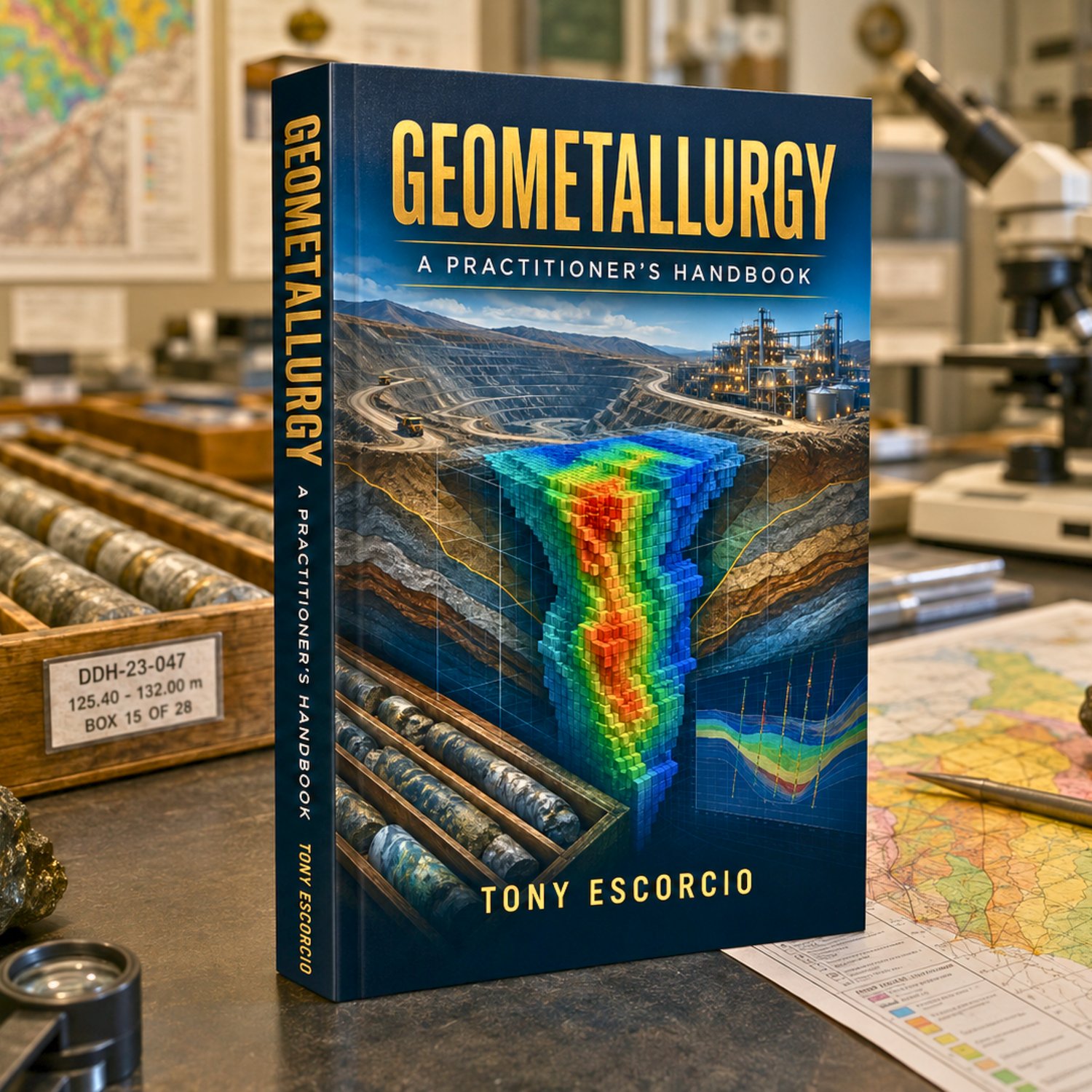
Geometallurgy: A Practitioner's Handbook
Geometallurgy: A Practitioner’s Handbook is a practical guide to understanding and managing ore variability from the orebody to the processing plant. Written for mining professionals, metallurgists, geologists, geostatisticians, mine planners and students, this handbook explains how geometallurgy connects geological information with metallurgical performance and project value.
Rather than treating grade alone as the key driver of value, this book shows how factors such as hardness, recovery, product quality, penalties, throughput and processing cost can be modelled spatially and used to improve mine planning and plant performance. It presents geometallurgy as a decision-making discipline that supports better design, better scheduling and better operational outcomes.
The book covers the foundations of geometallurgical thinking, including sampling, domaining, testwork, proxy calibration, spatial estimation, additivity, uncertainty and reconciliation. It also explores practical applications in comminution, recovery modelling, blending, ore sorting, mine planning and digital-twin concepts. Throughout, the emphasis is on clear explanation, practical logic and real operational usefulness.
Packed with diagrams, case-study style illustrations and applied guidance, Geometallurgy: A Practitioner’s Handbook is designed to help readers move beyond theory and apply geometallurgical principles in real mining and mineral-processing environments.
Whether you are building a new geometallurgical program, refining an existing model, or simply seeking a clearer understanding of how ore characteristics influence value, this handbook provides a practical and accessible reference.