

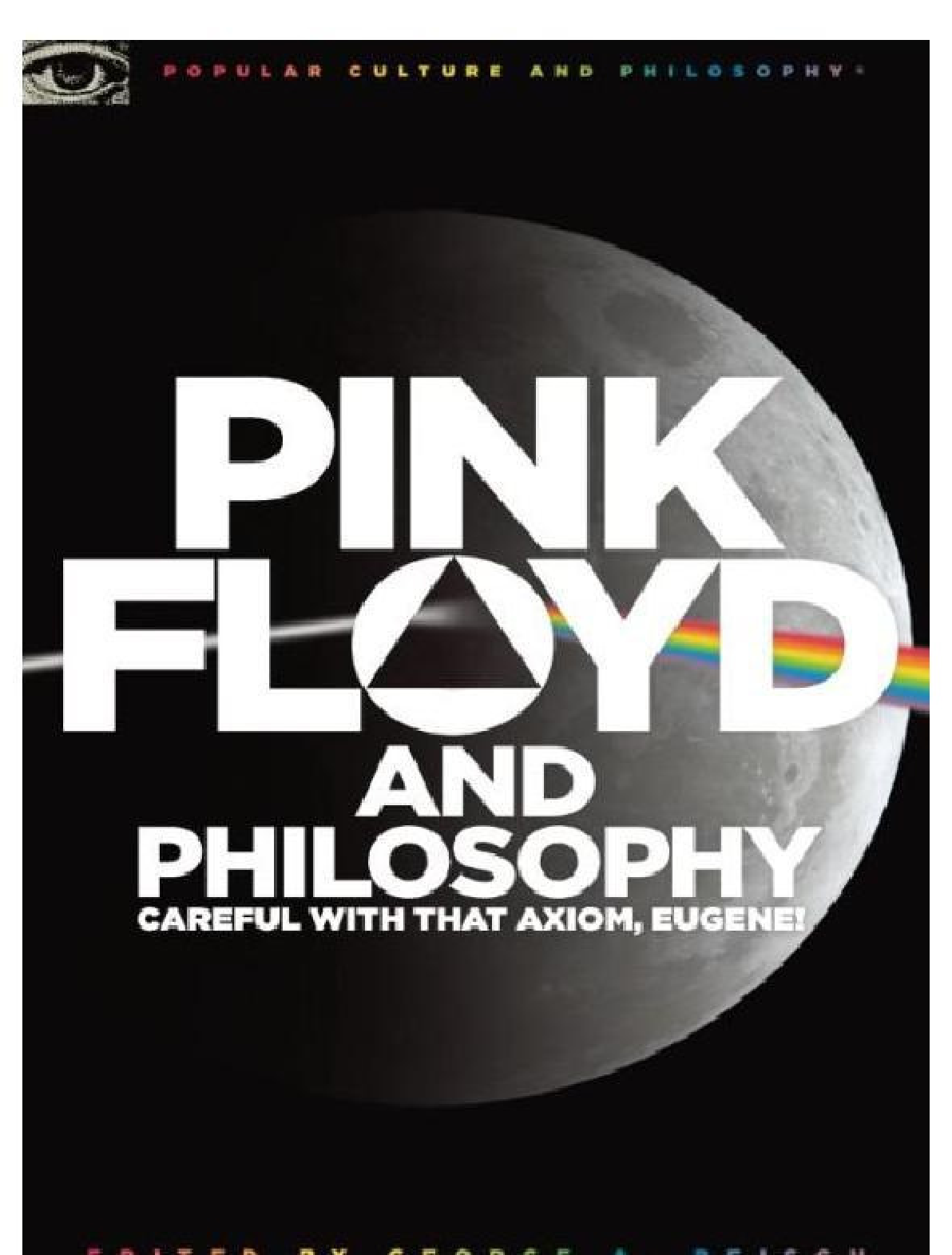
Pink Floyd and Philosophy (Popular Culture and Philosophy) pdf
By 1971, Pink Floyd had set the controls for the heart of philosophy. That year,
Adrian Maben made his extraordinary concert film, Pink Floyd at Pompeii. It begins with
the desolate, lonely strains of “Echoes” as Maben’s camera—impossibly high above the
ancient Roman amphitheatre at Pompeii—descends with almost imperceptible slowness
into the circular theatre of stone. The band, its truckloads of equipment, and miles of cables are set up in the middle of the enormous circle below.
Pink Floyd had just begun writing and recording Dark Side of the Moon and had
yet to be jolted by the international stardom that would propel them through the 1970s
and culminate in their second monster album, The Wall, in 1979. That’s why the setting
and venue could not be more perfect—or ironic. For this enormous stone amphitheatre is
a circular wall, built up long ago brick by brick, isolating Roger Waters, Nick Mason,
David Gilmour, and Rick Wright from the outside world. It was originally designed to
hold a live audience, of course. But there is none in this film. Pink Floyd simply
plays—to themselves, to each other, to a handful of sound technicians—with the
seriousness and concentration for which they were becoming famous. There is no public
performance, no on-stage banter, no corporate sponsorship, no advertising. Those who
might have come expecting to see Pink Floyd “in the flesh,” to get drunk, stoned, or
rowdy (or all three), might have felt that something was eluding them. But no audience
was present, so the film shows no trace of the slowly growing discord between Roger
Waters, in particular, and the rapidly growing audiences that Pink Floyd played to during
the rest of the 1970s.
By the end of the decade, things had turned around completely. The very first
song of The Wall has the album’s protagonist, Pink, interrogating a stadium-sized crowd
of inebriated teenagers:
So ya thought ya might like to go to the show.
To feel the warm thrill of confusion
That space cadet glow.
Tell me, is something eluding you, Sunshine? His anger culminated in 1977 during
a show in Montreal, Waters recalls in interviews. Noisy, disruptive fans so annoyed him
that he spit on them from the stage. He was appalled at his behavior, he admits, and
began to think seriously about how and why large audiences had become so disconnected
from the music they had paid to hear, and from the musicians they had come to see “in
the flesh.” Soon, he was toying with the concept of a rock band separated from its
audience by a huge brick wall. But even that idea did not assuage his sarcasm and
bitterness. Early drafts of Waters’s screenplay for the film version (released in 1982)
included military airplanes dive bombing the audience.1
Here in the ruins of Pompeii, however, Waters and the band play without a hint of
the frustration or bitterness that was to come. They are happy playing alone, behind their
wall, without any suggestion that this is some psychotic confinement or retreat from a
cruel, unbearable world. Those themes and messages had not yet become real and
pressing for Waters. The event Maben’s cameras capture is noncommerical, artistic, and
musical.
And philosophical. Pink Floyd seems natural and comfortable in this setting not
simply because they play so well or because the cameras glide around the band and the
open-air amphitheatre so elegantly. It is because the themes and ideas they had just begun
to explore musically on Meddle and Dark Side—such as time, death, madness, loss, and
empathy—are among those that philosophers of ancient Greece and Italy began to
scrutinize over two thousand years ago. Not far from the time and the place, that is,
where the volcano Vesuvius erupted to strip away all but the stone buildings of this once
bustling Italian village.......