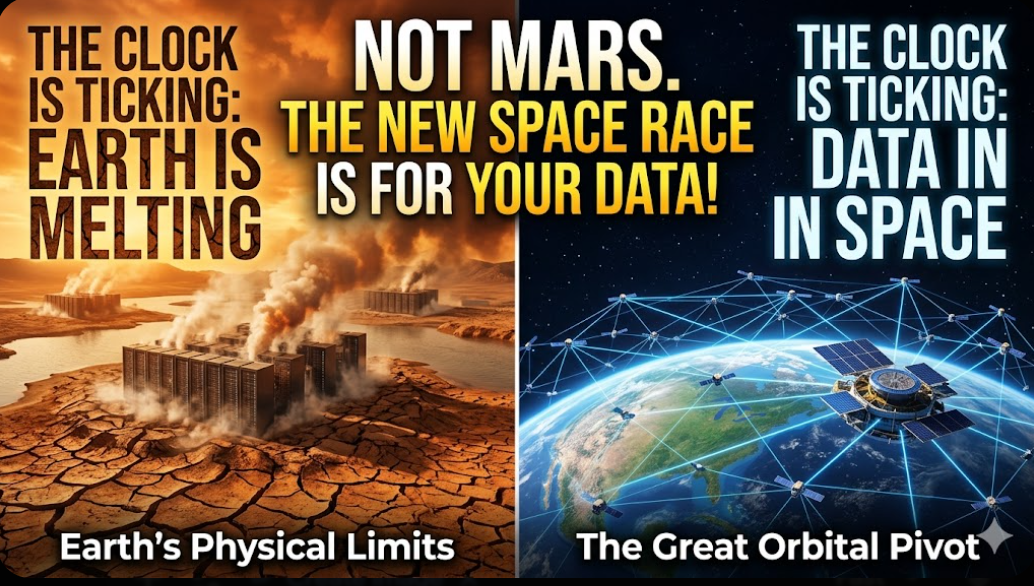
The New Space Race Isn't About Mars—It's About Data
Notebook Title: The New Space Race Isn't About Mars—It's About Data
Overview & Value Proposition The digital revolution is colliding with Earth’s hard physical limits. As terrestrial AI data centers consume unprecedented amounts of water and electricity, the world's most powerful tech and aerospace companies are executing a "Great Orbital Pivot". This notebook provides a comprehensive deep dive into the transition from the romanticized goal of planetary colonization to the immediate industrialization of Low Earth Orbit (LEO).
By exploring this notebook, you will gain unparalleled insights into the multi-trillion-dollar race to deploy orbital supercomputers, establish lunar data hubs, and secure digital sovereignty in space. You will understand why the future of global intelligence relies on solving the extreme physical, economic, and legal challenges of putting the cloud above the clouds.
What You Will Learn
- The Economics of Orbital Compute: Explore the financial realities of launching AI infrastructure into space, including the requirement for launch costs to drop below $300 per kilogram to make space-based data centers economically viable against terrestrial alternatives.
- Technological Hurdles & Solutions: Learn how engineers are combating harsh cosmic radiation (Single-Event Upsets and Multiple-Cell Upsets) using application-aware AI like RedNet and transitioning from expensive radiation-hardened chips to Commercial-Off-The-Shelf (COTS) GPUs.
- The Optical Data Web: Discover how programs like DARPA’s Space-BACN and the EU's IRIS² are building an "internet of satellites" using high-bandwidth laser communications to bypass terrestrial networks.
- Environmental & Legal Threats: Understand the terrifying reality of the "CRASH Clock" and Kessler Syndrome, the atmospheric pollution caused by burning satellites, and the legal loopholes of "Digital Soil" that allow tech giants to operate outside of Earth's data privacy laws.
- The Geopolitics of the Final Frontier: Analyze the strategic rivalry between the US-led Artemis Accords and China’s lunar ambitions, and how control over the Moon's South Pole dictates the future of deep-space refueling and data dominance.
Learning Outcomes By completing the materials in this notebook, you will be able to:
- Evaluate the cost-benefit analysis of terrestrial vs. space-based AI data centers, accounting for solar efficiency, radiative cooling in a vacuum, and launch logistics.
- Identify the major corporate and national players in the new space race (e.g., SpaceX's Starlink V3, Blue Origin's Project Sunrise, Google's Project Suncatcher, and China's "Three-Body" constellation) and their distinct strategic goals.
- Assess the critical need for In-Orbit Servicing, Assembly, and Manufacturing (ISAM) and active debris removal missions spearheaded by companies like Astroscale and ClearSpace to ensure orbital sustainability.
- Debate the ethical and regulatory gaps in the 1967 Outer Space Treaty and formulate solutions for governing autonomous AI, preventing space monopolies, and protecting Earth's atmosphere.
Full Access to All Sources Included You have complete, unrestricted access to the rich library of underlying source materials that power this notebook. This includes:
- Academic papers and technical feasibility studies on space radiation, COTS GPU deployment, and European net-zero space clouds (ASCEND).
- Market intelligence reports and financial analyses on the orbital data center industry and launch economics.
- Transcripts from leading news networks and space commentators covering SpaceX, NASA's Artemis missions, and international space defense strategies.
- Legal and policy briefs detailing the governance of outer space and ethical AI deployment.
Interactive Studio Features Available To enhance your mastery of the material, this notebook is fully integrated with the following Studio learning tools:
- Audio Overviews: Podcast-style discussions analyzing the friction between Earth-bound AI energy crises and the push for orbital compute.
- Video Overviews: Engaging visual explainers detailing the mechanics of optical intersatellite links or the dangers of space debris.
- Tailored Reports: Executive summaries or deep-dive technical reports on specific topics like lunar resource extraction or the FCC's satellite regulations.
- Flashcards: Test your recall on key terminology, from Kessler Syndrome to Single-Event Upsets (SEUs).
- Quizzes: Challenge your understanding of the geopolitical and economic forces driving the space race with adaptive, difficulty-scaled questions.
- Infographics: Visualize complex data, such as the scale of the Starlink megaconstellation, the CRASH Clock timeline, or the Earth vs. Space energy trade-offs.
- Slide Decks: Presentation-ready slides to communicate the strategic shifts in global space governance and AI infrastructure.