
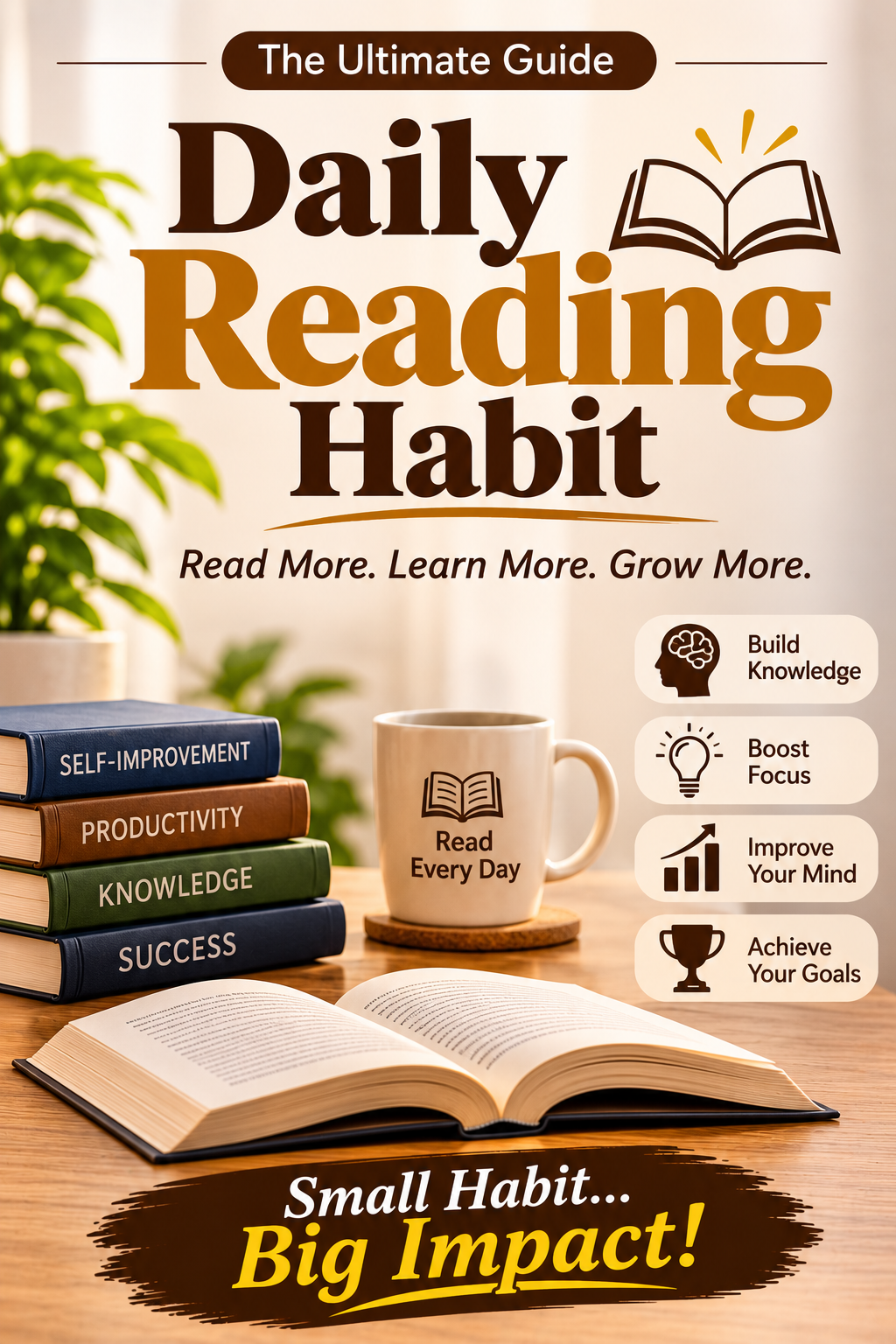
A Guide to a Daily Reading Habit
Content :
A guide to building a daily reading habit (The Daily Reading Habit, 39 pages) that teaches how to read more, remember more, and build a lasting reading practice in 30 days. Its premise is that the problem is not a lack of time or discipline, but the lack of a system that makes reading the easy default. It includes:
Why reading matters: what it gives you (knowledge, vocabulary, focus, empathy, relaxation, and joy), honest expectations, and defining what your reading is for. One arithmetic example: 20 minutes a day adds up to roughly 16 books a year.
Diagnosing obstacles: seven common obstacles (time, phone, tiredness, wrong books, wandering attention, perfectionism, and no accountability), the "attention muscle" idea, and a time audit to find your reading windows.
Choosing books you will finish: choosing by curiosity, the five-page test, permission to quit a book, a reading queue, and a Reading Matrix (gateway books and deep favorites).
Time and space: a tiny habit, habit stacking onto an existing routine, designing your reading environment, and the 10-Page Rule for busy days.
Active reading: the three-pass method for non-fiction (preview, read, review), questions to ask while reading, light annotation, and a reality check on speed reading.
Remembering: a one-page book summary written from memory, explaining ideas simply, spaced review, turning ideas into action, and a reading journal.
Different goals and formats: fiction, non-fiction, and technical material, paper, e-books, and audiobooks, reading in another language, and reading with children.
Reading with others: book clubs, reading buddies, discussion questions, and writing short reviews.
Sustaining the habit for life: tracking and celebrating, wise annual goals, handling reading slumps, review rhythms, and building a reader identity.
30-day plan: a week to set the foundation, a week to build the daily habit, a week to read actively and remember, and a week to share and sustain, plus a progress scorecard, templates (a daily checklist and a book review), FAQs, and a summary.
Benefits :
More reading with less effort: a tiny habit (ten minutes) anchored to a daily routine, plus the "never miss twice" rule, keeps the habit alive even on busy days.
Books you actually finish: choosing by curiosity, a quick test, and permission to quit reduce the guilt of unread books.
Deeper focus: gradual training of the attention muscle and ways to deal with the pull of the phone.
A stronger memory: retrieval, spaced review, and applying one idea from each book make what you read stick.
Flexibility: audiobooks count as reading, and mixing formats and genres fits your schedule and energy.
Accountability and enjoyment: a book club or reading buddy and short reviews increase commitment and pleasure.
Sustainability: realistic goals, steps for getting through slumps, regular weekly, monthly, and yearly reviews, and a firm reader identity.
Honest expectations: the guide makes clear that the benefit comes from attention and reflection, not from the number of books, and it does not promise magical speed reading.
Responsible note: it says the book titles mentioned are general examples, not endorsements, and advises consulting a professional for vision problems or learning differences such as dyslexia, noting that audiobooks are an excellent alternative.