




Rewire Your Brain workbook & journal
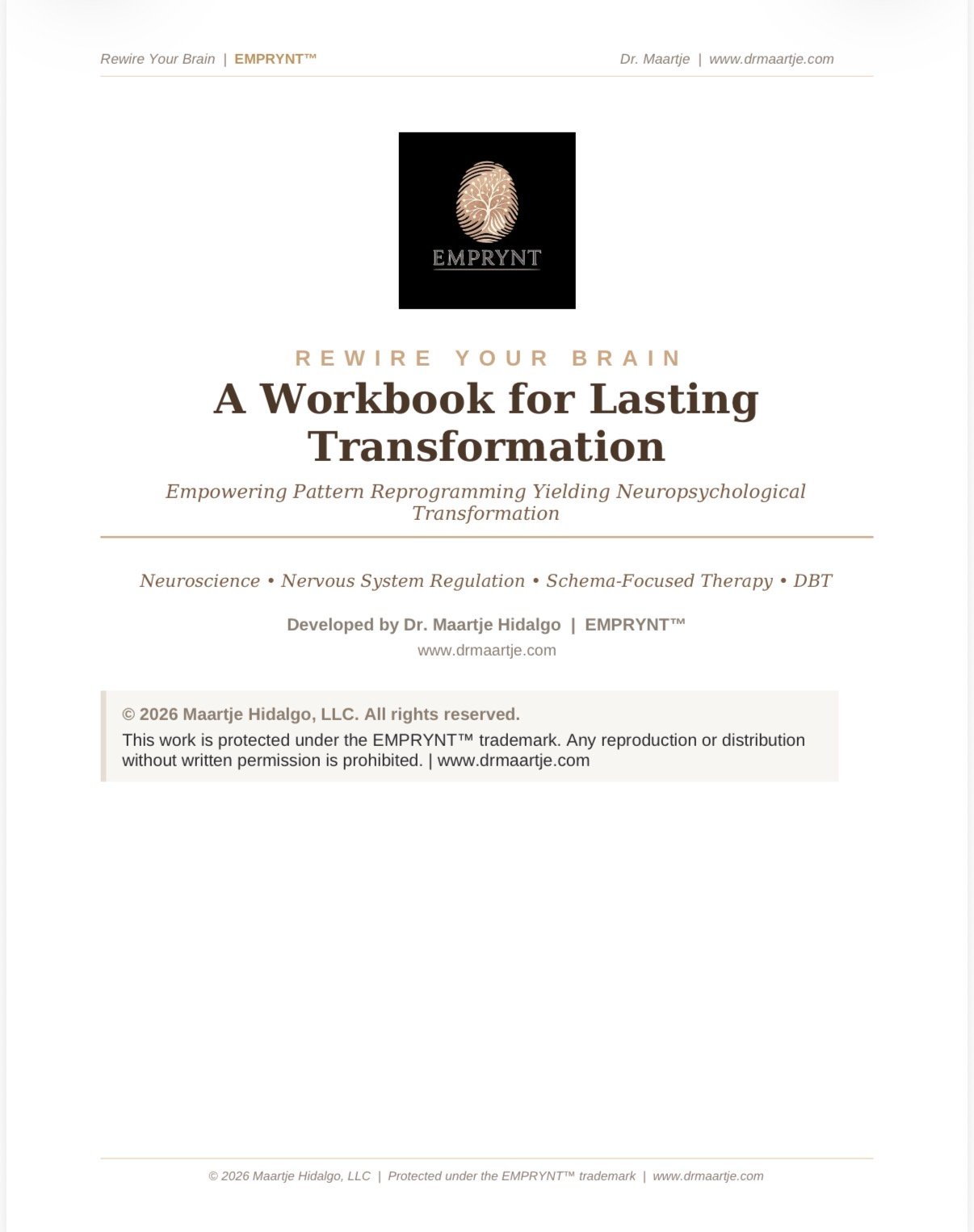
Rewire Your Brain
A Workbook for Lasting Transformation
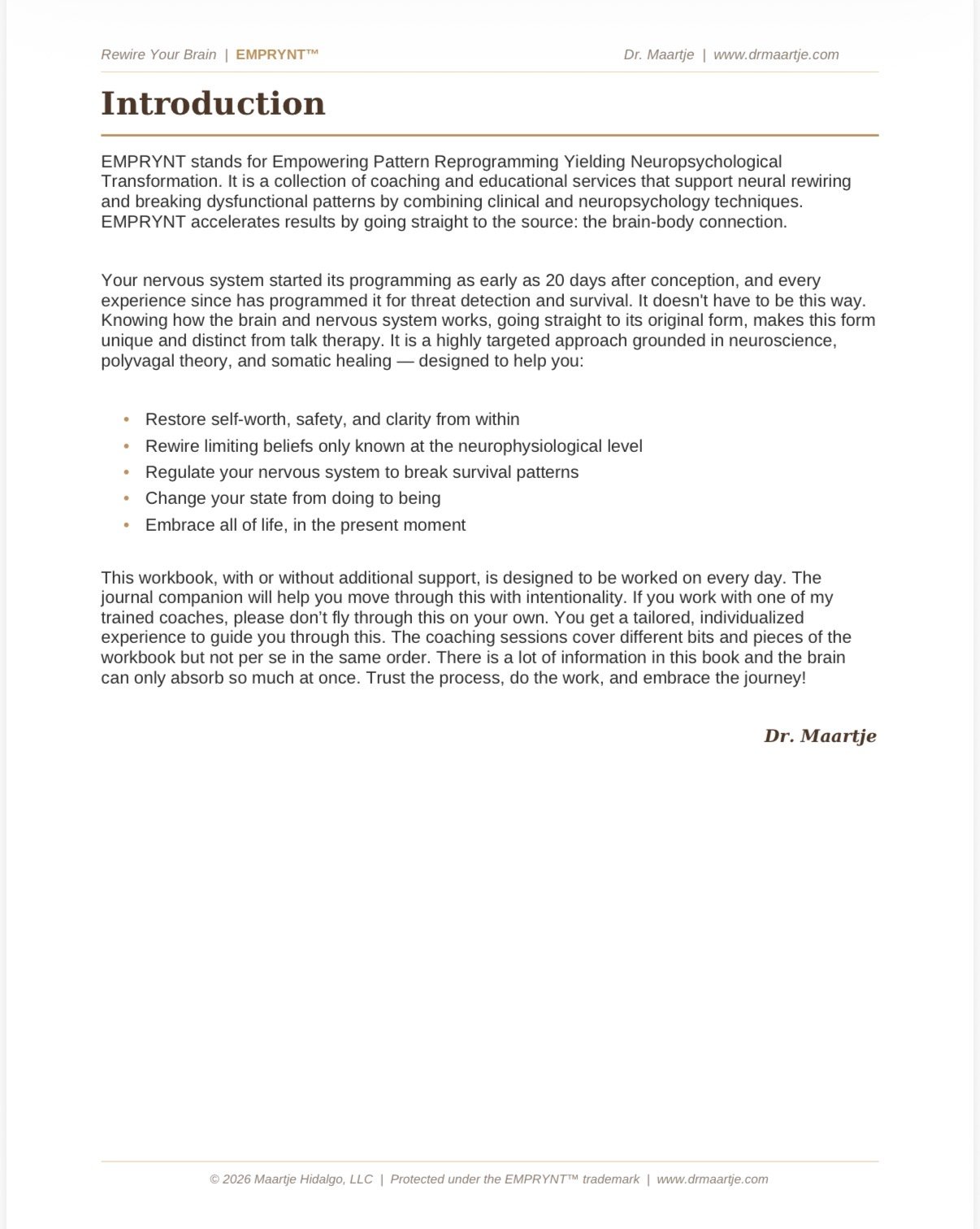
Your nervous system started its programming as early as 20 days after conception.
Every experience since has been running the same code — threat detection, survival shortcuts, patterns laid down before you were old enough to choose them. The way you respond to stress. The way you shut down or explode. The way you reach for what is familiar even when it hurts you. The way you talk to yourself at 2am.
None of this is a character flaw. It is a nervous system doing exactly what it was trained to do.
The question is: are you ready to retrain it?
Who this is for
You know something needs to change. You have known for a while. But the self-awareness has not translated into actual change — because insight alone was never going to be enough.
You keep repeating the same patterns in different relationships and want to understand why at a level deeper than behavior.
You are in the process of rebuilding after heartbreak, a difficult chapter, or a long stretch of surviving rather than living.
You want to do serious, grounded work on yourself — not inspiration, not affirmations, but a real clinical framework translated into something you can actually use.
What this workbook covers
The workbook moves through six chapters — each one building on the last, each one taking you deeper into the rewiring process.
Chapter 1 — Awaken
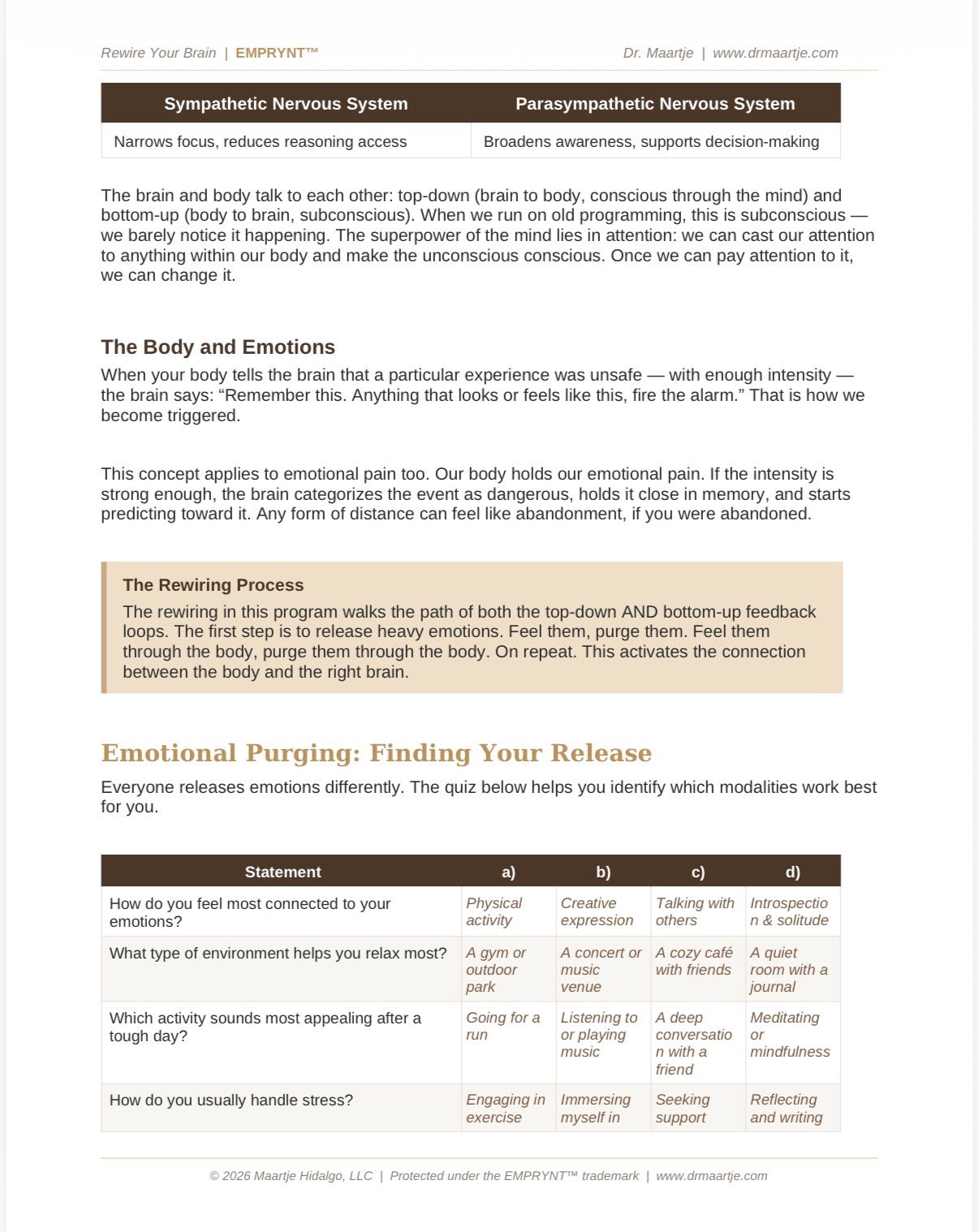
We begin where every real change begins: with grief. Not the grief of loss alone, but the grief of waking up — recognizing that the patterns you have been living by are no longer serving you. The Kübler-Ross model applied to personal transformation. The traumatized brain explained in plain language. Top-down and bottom-up processing — how the brain and body talk to each other, and how to use both directions for change. Your emotional release style. Observer Mode: the medial prefrontal cortex technique that cools emotional intensity almost instantly. Core values as your compass when everything else feels unstable.
Chapter 2 — Feel
Most people have spent years managing their emotions rather than moving through them. This chapter teaches the difference. The meaning of emotions — what each one is actually telling you. The autonomic nervous system and your personal setting: predominantly sympathetic, predominantly parasympathetic, or mixed. What your nervous system baseline says about your history and your work.
Chapter 3 — Unlearn
Before you can build something new, you have to understand what built the old. Your temperament — why siblings raised in the same house turn out completely differently. The goodness-of-fit principle: the mismatch between your needs and what was provided. The emotional thermometer exercise. Schema modes — the states that activate when old wounds are triggered. A Schema Mode Questionnaire with scoring. And then: the non-negotiables your brain needs to function — sleep, fuel, hormonal health.
Chapter 4 — Neural Rewiring
This is the clinical core of the workbook. The top-down and bottom-up rewiring method: how to use affirmation and somatic anchoring together to change a deep belief at the neurological level. The Red Exercise — a five-minute demonstration of how the brain's confirmation bias works, and how to use it for you instead of against you. Cognitive reframing. The growth mindset framework applied to self-esteem. Daily practices for building self-worth from the inside out.
Chapter 5 — Ascend
The Five Pillars: the five domains that, when tended, make you feel like yourself — and the principle that your partner is never a pillar. Habit stacking. The Time Audit. The Nurture framework. And your non-negotiables: the short, honest list of what you will not accept, in relationships and in life.
Chapter 6 — What's Next?
The three readiness principles for knowing when you are genuinely ready to date again — not when the loneliness kicks in, not when enough time has passed, but when you know your value, know what you value, and know what you will walk away from.
This workbook is grounded in polyvagal theory, schema-focused therapy, dialectical behavioral therapy, and neuroscience — translated into practical tools that work at the level where patterns actually live.
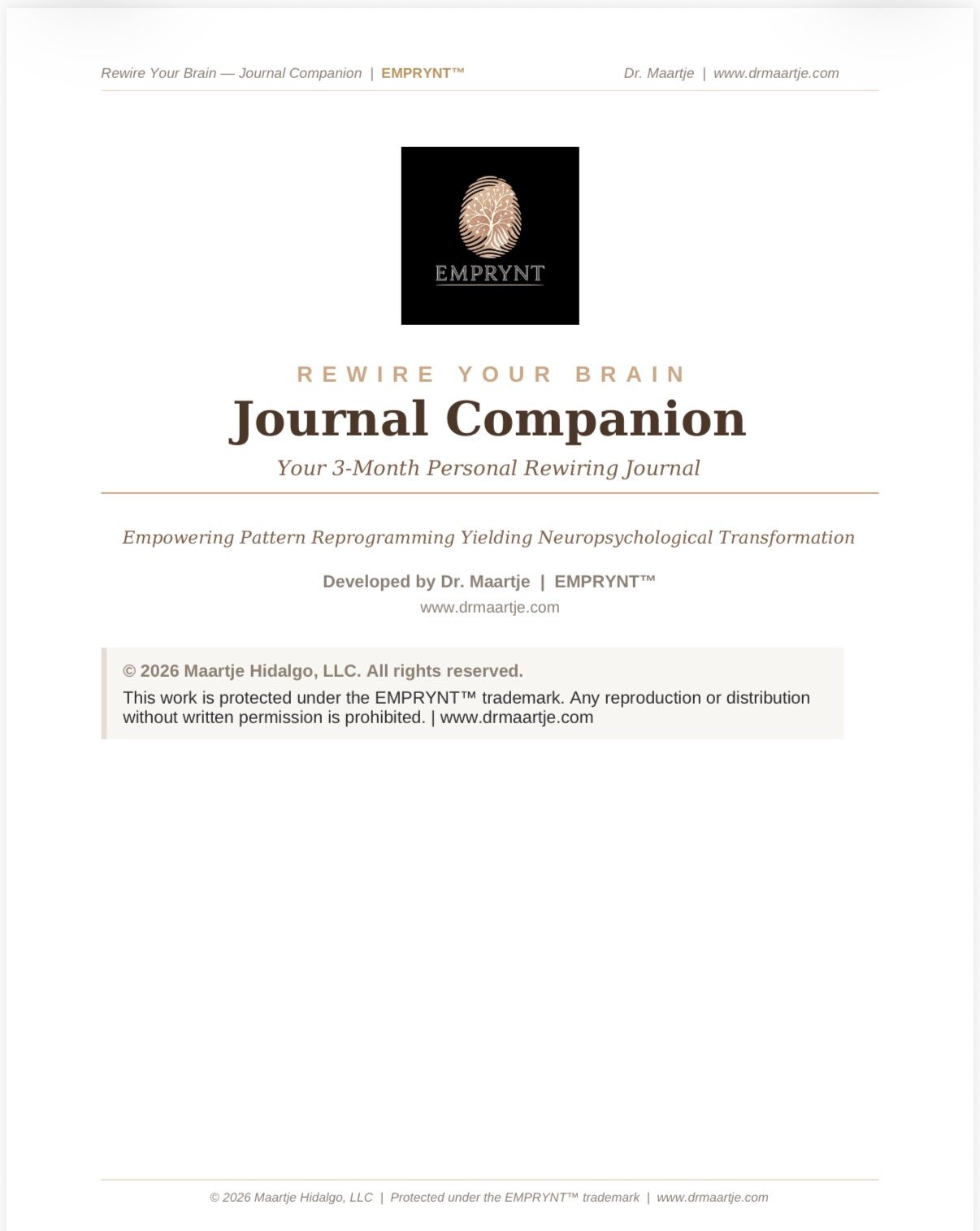
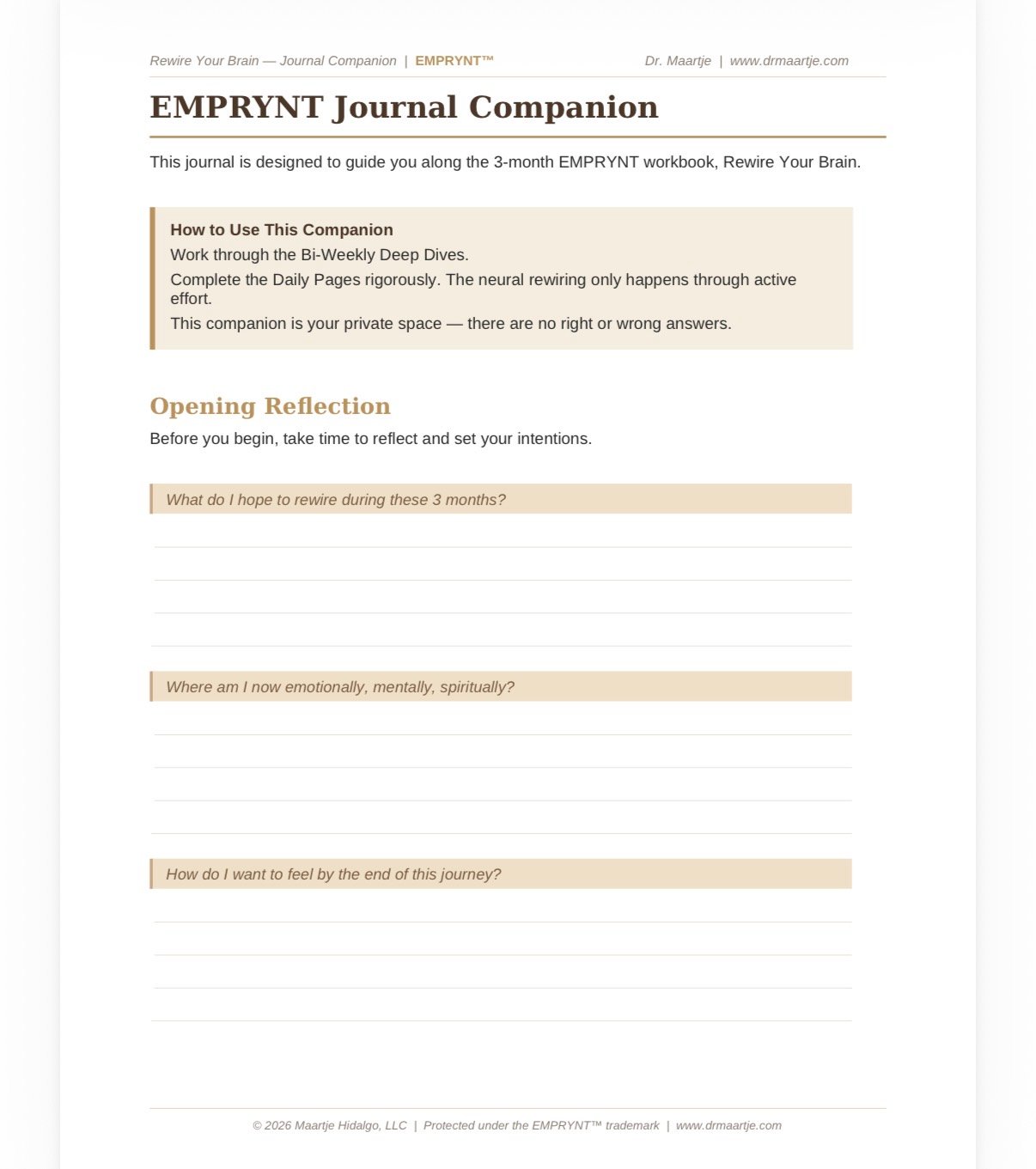
The Journal Companion
A 3-Month Daily Practice to Rewire Your Brain
The workbook gives you the framework. The journal does the daily work.
Because rewiring the brain is not something that happens in a single session of insight. It happens in the accumulation of small, consistent, intentional acts across weeks and months — in the daily return to the same questions, as you change, and as your answers begin to change with you.
This is what the Journal Companion is for.
How it works
The journal is structured around three months of daily pages — 84 in total — alongside six guided coaching sessions spaced throughout the program. Together they create a complete 90-day practice that tracks your growth, anchors the work from the Rewire Your Brain workbook into daily life, and builds the neural pathways that lasting transformation requires.
What's inside
Six Unguided Sessions
Spaced throughout the three months, each deep-dive takes you deeper into the EMPRYNT™ framework — working through schema awareness, nervous system baseline, the rewiring exercises, and the ascension practices. The sessions are designed to be worked through in full before continuing with the daily pages that follow.
84 Daily Pages
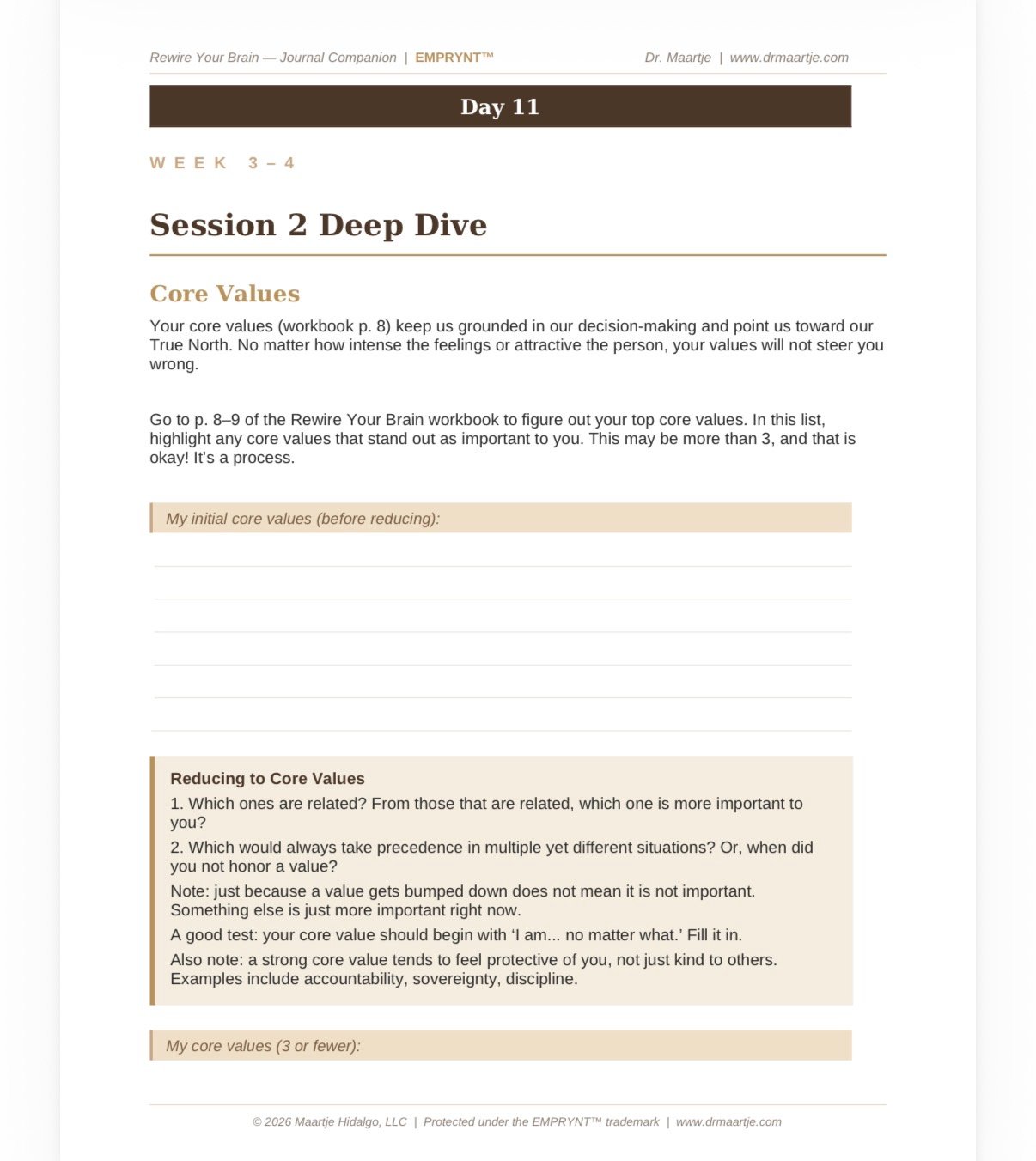
Each day includes a core set of reflection prompts that build progressively across the three months:
From Day 1: a morning intention and an evening reflection — what served you, what you are releasing, what you are grateful for.
From Day 29: the Best Self practice is added — a daily return to the felt sense and vision of who you are becoming, anchored in the body.
From Day 43: Neural Rewiring — the daily top-down and bottom-up practice, building the new belief at the neurological level, one repetition at a time.
From Day 57: Daily Value — three ways you added value to yourself, three ways you brought value to others.
From Day 71: Pillars check-in — which pillars are strong, which need attention, what action you are taking.
Why the daily structure matters
Neuroplasticity is not a single event. It is a process. The research on habit formation shows that new neural pathways require consistent repetition over weeks and months before they become automatic (Lally et al., 2010). The journal is designed around that research — building the practice gradually, adding new layers as your capacity grows, creating the conditions for change that actually holds.
The prompts accumulate by design. By month three you are doing in two minutes what would have taken twenty when you started — because the pathway has been built. That is the rewiring you are here for.
About Dr. Maartje
I developed the EMPRYNT™ methodology because I kept watching intelligent, self-aware people understand their patterns completely — and still not be able to change them. The missing piece was always the same: the work was staying in the head. The patterns live in the body. This workbook goes there.
— Dr. Maartje
What EMPRYNT™ is
EMPRYNT stands for Empowering Pattern Reprogramming Yielding Neuropsychological Transformation.
It is a methodology developed through years of clinical neuropsychology practice that goes straight to the source — the brain-body connection — rather than staying at the level of insight and talk. Because insight alone does not change a pattern. Understanding why you do something does not automatically make you stop doing it. What changes a pattern is working at the level where the pattern actually lives: the nervous system, the body, and the right brain.
This workbook is the self-guided version of that work.
© 2026 Maartje Hidalgo, LLC · Protected under the EMPRYNT™ trademark · www.drmaartje.com