

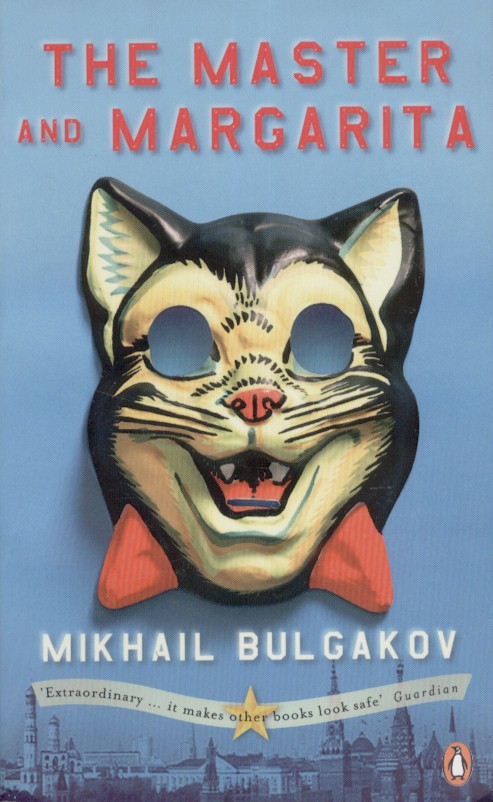
Mikhail Bulgakov - The Master And Margarita
MASTERPIECE
Mikhail Bulgakov - The Master and Margarita, translated from the Russian by Richard Pevear and Larissa Volokhonsky (Penguin, 1997).
432 pages | EPUB
The Master and Margarita, Mikhail Bulgakov's masterpiece, is a fiercely satirical fantasy that remained unpublished in its author's home country for over thirty years. This new edition is translated with an introduction by Richard Pevear and Larissa Volokhonsky, the acclaimed translators of Tolstoy's Anna Karenina.
In Soviet Moscow, God is dead, but the devil -- to say nothing of his retinue of demons, from a loudmouthed, gun-toting tomcat, to the fanged fallen angel Koroviev -- is very much alive. As death and destruction spread through the city like wildfire, condemning Moscow's cultural elite to prison cells and body bags, only a madman, the Master, and Margarita, his beautiful, courageous lover, can hope to end the chaos. Written in secret during the darkest days of Stalin's reign and circulated in samizdat form for decades, when The Master and the Margarita was finally published it became an overnight literary phenomenon, signalling artistic freedom for Russians everywhere.
This luminous translation from the complete and unabridged Russian text is accompanied by an introduction by Richard Pevear exploring the extraordinary circumstances of the novel's composition and publication, and how Bulgakov drew on carnivalesque folk traditions to create his ironic subversion of Soviet propaganda. This edition also contains a list of further reading and a note on the text.
Review
"One of the great novels of the 20th century, a scary, darkly comic allegory." -- Daily Telegraph
CHAPTER 1
Never Talk with Strangers
At the hour of the hot spring sunset two citizens appeared at the Patriarch’s Ponds.1 One of them, approximately forty years old, dressed in a grey summer suit, was short, dark-haired, plump, bald, and carried his respectable fedora hat in his hand. His neatly shaven face was adorned with black horn-rimmed glasses of a supernatural size. The other, a broad-shouldered young man with tousled reddish hair, his checkered cap cocked back on his head, was wearing a cowboy shirt, wrinkled white trousers and black sneakers.
The first was none other than Mikhail Alexandrovich Berlioz,2 editor of a fat literary journal and chairman of the board of one of the major Moscow literary associations, called Massolit3 for short, and his young companion was the poet Ivan Nikolaevich Ponyrev, who wrote under the pseudonym of Homeless.4
Once in the shade of the barely greening lindens, the writers dashed first thing to a brightly painted stand with the sign: ‘Beer and Soft Drinks.’
Ah, yes, note must be made of the first oddity of this dreadful May evening. There was not a single person to be seen, not only by the stand, but also along the whole walk parallel to Malaya Bronnaya Street. At that hour when it seemed no longer possible to breathe, when the sun, having scorched Moscow, was collapsing in a dry haze somewhere beyond Sadovoye Ring, no one came under the lindens, no one sat on a bench, the walk was empty.
‘Give us seltzer,’ Berlioz asked.
‘There is no seltzer,’ the woman in the stand said, and for some reason became offended.
‘Is there beer?’ Homeless inquired in a rasping voice.
‘Beer’ll be delivered towards evening,’ the woman replied.
‘Then what is there?’ asked Berlioz.
‘Apricot soda, only warm,’ said the woman.
‘Well, let’s have it, let’s have it! ...’
The soda produced an abundance of yellow foam, and the air began to smell of a barber-shop. Having finished drinking, the writers immediately started to hiccup, paid, and sat down on a bench face to the pond and back to Bronnaya.
Here the second oddity occurred, touching Berlioz alone. He suddenly stopped hiccuping, his heart gave a thump and dropped away somewhere for an instant, then came back, but with a blunt needle lodged in it. Besides that, Berlioz was gripped by fear, groundless, yet so strong that he wanted to flee the Ponds at once without looking back.
Berlioz looked around in anguish, not understanding what had frightened him. He paled, wiped his forehead with a handkerchief, thought: ‘What’s the matter with me? This has never happened before. My heart’s acting up ... I’m overworked ... Maybe it’s time to send it all to the devil and go to Kislovodsk ...’5
And here the sweltering air thickened before him, and a transparent citizen of the strangest appearance wove himself out of it. A peaked jockey’s cap on his little head, a short checkered jacket also made of air ... A citizen seven feet tall, but narrow in the shoulders, unbelievably thin, and, kindly note, with a jeering physiognomy.
The life of Berlioz had taken such a course that he was unaccustomed to extraordinary phenomena. Turning paler still, he goggled his eyes and thought in consternation: ‘This can’t be!...’
But, alas, it was, and the long, see-through citizen was swaying before him to the left and to the right without touching the ground.
Here terror took such possession of Berlioz that he shut his eyes. When he opened them again, he saw that it was all over, the phantasm had dissolved, the checkered one had vanished, and with that the blunt needle had popped out of his heart.
‘Pah, the devil!’ exclaimed the editor. ‘You know, Ivan, I nearly had heatstroke just now! There was even something like a hallucination ...’ He attempted to smile, but alarm still jumped in his eyes and his hands trembled. However, he gradually calmed down, fanned himself with his handkerchief and, having said rather cheerfully: ‘Well, and so ...’ went on with the conversation interrupted by their soda-drinking.
This conversation, as was learned afterwards, was about Jesus Christ. The thing was that the editor had commissioned from the poet a long anti-religious poem for the next issue of his journal. Ivan Nikolaevich had written this poem, and in a very short time............