
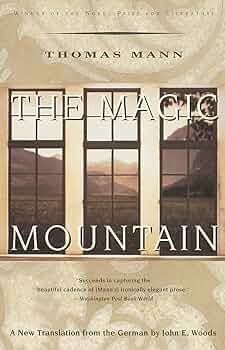
Thomas Mann - The Magic Mountain
The Magic Mountain (German: Der Zauberberg, pronounced [deːɐ̯ ˈtsaʊbɐˌbɛʁk] ⓘ) is a German novel written by Thomas Mann, published in November 1924 about a young and aspiring engineer Hans Castorp. While staying in the secluded world of a high-altitude sanatorium in the years leading up to 1914, Hans encounters otherworldly figures who confront him with politics, philosophy, but also romance, illness, and death. Enchanted by his love for a woman he meets in the sanatorium, which prompts him to reflect on an early and formative schoolboy romance, he stays considerably longer than originally planned.
The novel was inspired by the conditions at a sanatorium in Davos, which the author had visited in 1912 while caring for his wife, who was suffering from tuberculosis.
The Magic Mountain was republished in several editions and translated into numerous languages.
Mann began developing his first ideas for The Magic Mountain in 1912. He initially conceived it as a novella that would revisit aspects of his earlier work Death in Venice in a more humorous manner. The new project was shaped by his wife's residence at Dr. Friedrich Jessen's [de] Waldsanatorium in Davos, Switzerland, while she was being treated for suspected tuberculosis. In numerous letters to him (many of which are now lost), she described everyday life in the sanatorium. In a three-week visit in May and June of 1912, Mann experienced the place first-hand and became acquainted with the doctors and patients. According to an afterword later included in the English translation of the novel, this stay inspired the opening chapter, "Arrival".
The outbreak of World War I disrupted his work on the book. Like many other Germans of the time, Mann initially supported the German Empire and the war effort.[5] During what he described as a state of "sympathy with death", together as part of the intellectual military service that he regarded as his duty, he wrote the essays Gedanken im Kriege (Thoughts in Wartime), Gute Feldpost (Good News from the Front), and Friedrich und die große Koalition (Frederick and the Great Coalition).
In response to anti-war intellectuals, Mann wrote a book-length essay, Reflections of a Nonpolitical Man, which was published in 1918. His position, however, was challenged by other intellectuals, such as his older brother, Heinrich Mann, who, unlike Thomas, did not support the German state. Heinrich was the author of the satirical novel Der Untertan and the essay "Zola", which defended the idea of Germany's inevitable defeat as the path to democratization. Yet, the end of the war led Thomas Mann to rethink his position. In 1919, Thomas Mann changed the tone of the novel that would become The Magic Mountain to reflect the realities of war rather than its romanticized depiction. He introduced conflicts between the characters, which drew on his relationship with Heinrich.
Mann later became interested in studying European bourgeois society. He explored the sources of much of civilized humanity's destructive nature and speculated about personal attitudes toward life, health, illness, sexuality, and mortality. His political stance during this period shifted from opposition to the Weimar Republic, to support for it. Mann eventually published The Magic Mountain (as Der Zauberberg) through the publisher S. Fischer Verlag in Berlin