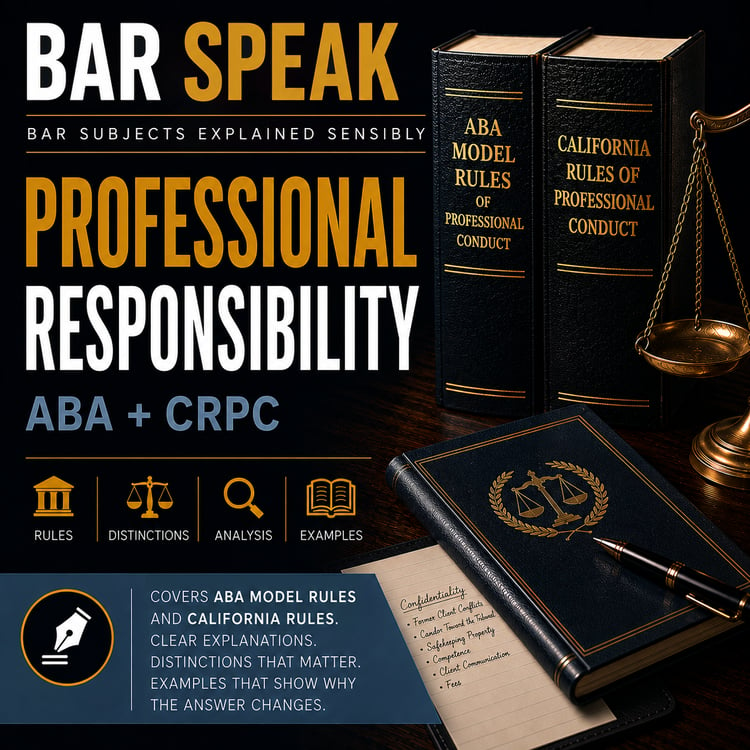
COMMUNITY PROPERTY
BAR SPEAK: Community Property is a comprehensive California bar-prep guide designed to make community property easier to understand, organize, and apply. Rather than treating characterization, title, tracing, reimbursement, and division as isolated rules, BAR SPEAK presents them as parts of a single framework so students can determine what property is community property, separate property, or quasi-community property, identify which presumptions apply, and recognize when the result changes at divorce or death.
The guide covers the community property topics tested on the California Bar Exam, including the marital economic community, characterization of property acquired before and during marriage, quasi-community property, putative spouses and unmarried cohabitants, management and control of community property, fiduciary duties between spouses, business interests and Pereira/Van Camp apportionment, commingled funds and tracing, credit acquisitions, title presumptions, stock options, life insurance, debt and tort liability, transmutations, reimbursement rights, retirement and pension benefits, Moore/Marsden apportionment, disability benefits, personal-injury awards, and creditors’ rights.
Throughout the guide, closely related rules are separated and compared so students can see exactly which presumption controls and when the analysis changes. Particular attention is given to distinctions such as the Lucas rule at death versus Anti-Lucas rules at divorce, joint-title presumptions, separate-property contributions and Family Code § 2640 reimbursement, direct and family-expense tracing, the treatment of quasi-community property, transmutation requirements, and the allocation of mixed community and separate interests in businesses, residences, pensions, and other assets.
What makes BAR SPEAK different:
- Clear rules followed by plain-English explanations
- Characterization rules organized around acquisition, source of funds, title, and applicable presumptions
- Divorce and death rules distinguished where the result changes
- Lucas and Anti-Lucas rules explained side by side
- Tracing and reimbursement rules presented as separate but related concepts
- Examples showing how community and separate interests are calculated in realistic fact patterns
- Particular emphasis on Pereira / Van Camp, Moore / Marsden, quasi-community property, transmutations, pensions, debts, and creditor rights
- Built for understanding first, memorization second
This is not a stripped-down attack outline that gives students a list of presumptions without explaining how they interact. It is a stand-alone Community Property guide for students who want to understand how California classifies, traces, apportions, reimburses, and ultimately divides marital property, and how to recognize the distinctions that determine the result before they are expected to memorize and apply them.
BAR SPEAK
Bar Subjects Explained Sensibly