

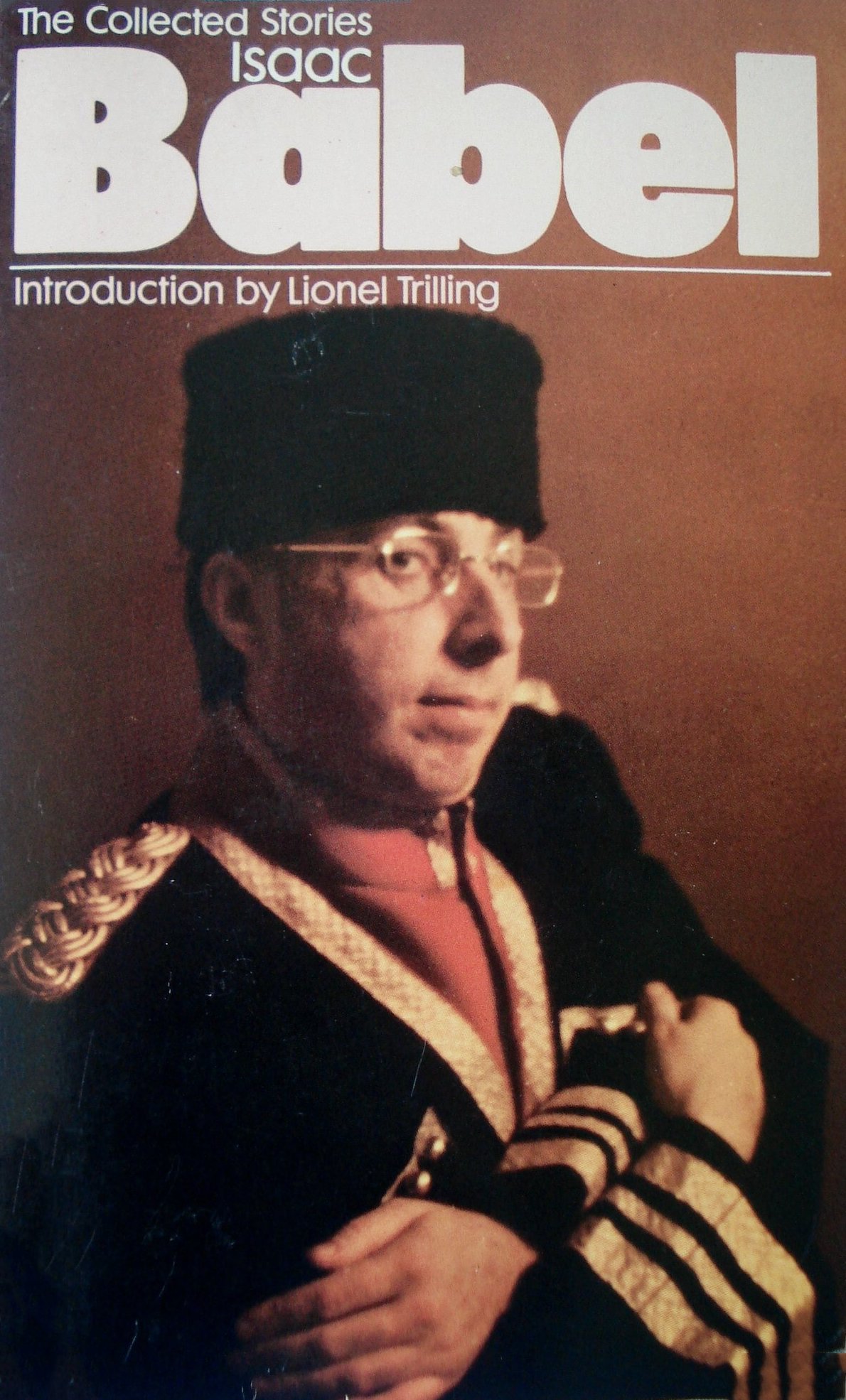
Isaac Babel - Collected Stories
Introduction
A GOOD MANY YEARS AGO, IN 1 929, I CHANCED TO READ A
book which disturbed me in a way I can still remember.
The book was called Red Cavalry; it was a collection of
stories about Soviet regiments on horse operating in Poland.
I had never heard of the author, Isaac Babel--or I. Babel
as he signed himself-and nobody had anything to tell me
about him, and part of my disturbance was the natural
shock we feel when, suddenly and without warning, we
confront a new talent of great energy and boldness. But the
book was disturbing for other reasons as well.
In those days one still spoke of the "Russian experiment"
and one might still believe that the light of dawn glowed on
the test-tubes and crucibles of human destiny. And it was
still possible to have very strange expectations of the new
culture that would arise from the Revolution. I do not
remember what my own particular expectations were, ex
cept that they involved a desire for an art that would have
as little ambiguity as a proposition in logic. Why I wanted
this I don't wholly understand. It was as if I had hoped
that the literature of the Revolution would realize some
simple, inadequate notion of the "classical" which I had
picked up at college; and perhaps I was drawn to this
notion of the classical because I was afraid of the literature
of modern Europe, because I was scared of its terrible
intensities, ironies, and ambiguities. If this is what I really
9
IO INTRODUCTION
felt, I can't say that I am no'Y wholly ashamed of my
cowardice. If we stop to think of the museum knowingness
about art which we are likely to acquire with maturity, of
our consumer's pride in buying only the very best spiritual
commodities, the ones which are sure to give satisfaction,
there may possibly be a grace in those moments when we
lack the courage to confront, or the strength to endure,
some particular work of art or kind of art . At any rate,
here was Babel's book and I found it disturbing. It was
obviously the most remarkable work of fiction that had yet
come out of revolutionary Russia, the only work, indeed,
that I knew of as having upon it the mark of exceptional
talent, even of genius. Yet for me it was all too heavily
charged with the intensity, irony, and ambiguousness from
which I wished to escape.
There was anomaly at the very heart of the book, for
the Red cavalry of the title were Cossack regiments, and
why were Cossacks fighting for the Revolution, they who
were the instrument and symbol of Tsarist repression ? The
author, who represented himself in the stories, was a Jew ;
and a Jew in a Cossack regiment was more than an anom
aly, it was a joke, for between Cossack and Jew there
existed not merely h atred but a polar opposition. Yet here
was a Jew riding as a Cossack and trying to come to terms
with the Cossack ethos. At that first reading it seemed to me
-although it does not now-that the stories were touched
with cruelty. They were about violence of the most extreme
kind, yet they were composed with a striking elegance and
precision of objectivity, and also with a kind of lyric joy,
so that one could not at once know just how the author
was responding to the brutality he recorded, whether he
thought it good or bad, justified or not justified .