

NEXIE BRIDGE™
Building Responsive, Integrated Developmental Guidance for Educators
Learn it. Apply it. Evidence it. Carry it into practice.
Completing a qualification can provide important knowledge and skills.
But educators still need to translate that learning into the complexity of real children, real families, real environments and real educational decisions.
NEXIE BRIDGE™ is designed to help make that connection.
It brings together:
- RTO learning
- NEXIE developmental education
- workplace application
- reflective evidence
to help educators move from knowing concepts to using them meaningfully in everyday practice.
What is NEXIE BRIDGE™?
NEXIE BRIDGE™ is the RTO integration and qualification-enhancement layer of the NEXIE ecosystem.
BRIDGE stands for:
Building Responsive, Integrated Developmental Guidance for Educators
It is designed to sit alongside nationally recognised training, not replace it.
NEXIE provides the applied developmental method, learning resources, WAGOLL examples, workplace activities and implementation tools.
The participating RTO remains responsible for nationally recognised training requirements, including formal mapping, assessment, validation and competency decisions.
Choose a pricing plan
Price
AUD $2,850
One-time access to the NEXIE BRIDGE™ specialisation.
Commercial NEXIE service rights, facilitator authorisation and organisational licensing are separate where applicable.
Ready to bridge learning into practice?
NEXIE BRIDGE™
Learn it. Apply it. Evidence it. Improve it.
NEXIE Hub Membership — BRIDGE
A$49
per month
AUD $49/month. Includes the NEXIE BRIDGE professional learning pathway, six guided Entry and Exit application lessons, the complete BRIDGE Playbook Series (BR00–BR11), practical learning-design and resource-development activities, professional portfolio guidance and access to the shared NEXIE Hub. Learn to connect educational understanding with inclusive applied learning, proposed evidence opportunities and responsible resource review. Subscription renews monthly until cancelled.
Course curriculum
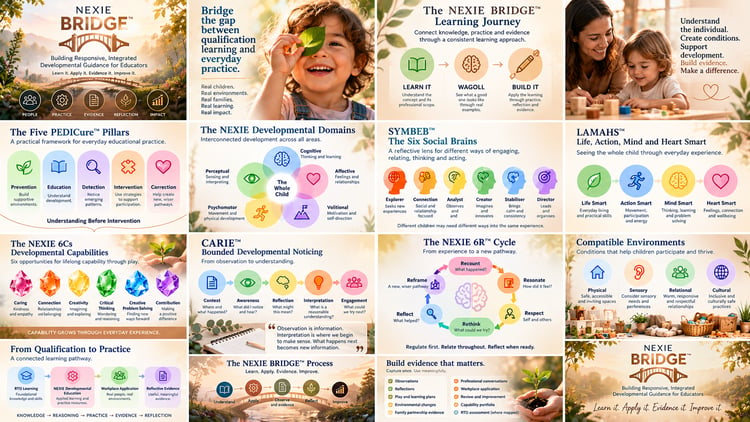
NEXIE BRIDGE™ connects qualification learning with applied developmental practice. Use LEARN IT → WAGOLL → BUILD IT to strengthen observation, developmental reasoning, family partnership, environmental response, reflection and workplace evidence. NEXIE BRIDGE complements nationally recognised training; formal assessment and competency decisions remain with the participating RTO.
1. Understanding Child Development
Understand development before planning for it.
Explore child development, neurodevelopment, strengths, individual difference and the conditions that influence participation and learning.
2. Learning Frameworks in Practice
Turn the framework into everyday practice.
Connect approved learning frameworks with observation, planning, intentional teaching, reflection and responsive educator practice.
3. Play, Learning and Capability
Understand what children are building through play.
Use child-led and intentional play to notice strengths, interests and emerging capability, including the NEXIE 6Cs and LAMAHS™.
4. Observation to Understanding
See what is happening before deciding what it means.
Strengthen observation, cautious interpretation and reflective reasoning using:
Observation → Interpretation → Hypothesis → Action → Response → Reflection
5. Relationships, Behaviour and Co-Regulation
Understanding before behaviour management.
Explore behaviour as communication, relational safety, co-regulation and developmentally responsive ways of supporting participation.
6. Inclusion, Participation and Belonging
Change the conditions, not the child.
Consider neurodiversity, accessibility, strengths, cultural responsiveness, family knowledge and compatible environments.
7. Nature, Environment and Development
Use the environment as a partner in development.
Examine how physical, sensory, social and natural environments can support development, participation, regulation and learning.
How each course works
Each area uses the NEXIE BRIDGE learning structure:
LEARN IT → WAGOLL → BUILD IT
LEARN IT — understand the concept.
WAGOLL — see what good applied practice can look like.
BUILD IT — apply the learning through a workplace or practice activity.
The BRIDGE material is designed as an applied-practice layer that can sit alongside relevant qualification learning, while formal mapping, assessment and competency decisions remain with the authorised RTO.
NEXIE BRIDGE
-
Why BRIDGE exists
A learner may understand a concept in training and still ask:
What does this actually look like with a child?
How do I know what I am observing?
What should I change first?
How do I work with the family?
What evidence is useful?
How do I know whether the response helped?
NEXIE BRIDGE™ is designed around those questions.
It helps connect:
KNOWLEDGE → REASONING → PRACTICE → EVIDENCE → REFLECTION
-
The NEXIE difference
Rather than beginning with:
“How do we stop the behaviour?”
NEXIE begins with:
“Who is this child, what may the behaviour be communicating, what conditions are affecting capacity, and what could help development move forward?”
This is the foundation of:
Understanding Before Intervention
NEXIE BRIDGE helps learners apply that principle within the boundaries of their educational role.
-

Who is it for?
NEXIE BRIDGE complements nationally recognised training.
Where BRIDGE resources are used with a qualification, the participating RTO remains responsible for:
formal mapping, assessment, validation and competency decisions.NEXIE BRIDGE may be used with:
- early childhood education and care learners;
- trainees and apprentices;
- educators completing relevant qualifications;
- existing educators undertaking further professional learning;
- Registered Training Organisations;
- workplace supervisors;
- ECEC providers;
- Family Day Care services;
- educational leaders supporting learner development;
- organisations wanting stronger links between training and workplace practice.
It can also provide a structured bridge for learners moving from qualification learning into the broader NEXIE professional pathway.
-

How the learning works
Work through:
LEARN IT → WAGOLL → BUILD IT
LEARN IT
Understand the concept.
WAGOLL
See What A Good One Looks Like.
BUILD IT
Apply the learning in practice.
The aim is simple:
Learn it. Apply it. Evidence it. Improve it.
NEXIE frameworks included
Depending on the learning activity, you may work with:
PEDICure™
Prevention → Education → Detection → Intervention → Correction
CARIE™
Context → Awareness → Reflection → Interpretation → Engagement
LAMAHS™ and the 6Cs
Developmental Domains
SYMBEB™
NEXIE 6R™ Cycle
Compatible Environments
All are used within educational scope and are not diagnostic tools.
-

From qualification learning to applied capability
NEXIE BRIDGE can help learners explore areas such as:
Understanding the individual
Move beyond a behaviour description to consider:
- strengths;
- interests;
- communication;
- relationships;
- development;
- regulation;
- participation;
- environmental conditions.
-

What is NEXIE Bridge for?
Building Responsive, Integrated Developmental Guidance for Educators
Bridge learning into practice.
NEXIE BRIDGE™ helps educators connect qualification learning with real-world developmental practice.
It brings together:
RTO learning + NEXIE developmental education + workplace application + reflective evidence
so learners can move from understanding concepts to using them meaningfully with children, families and educational environments.
What you will learn
NEXIE BRIDGE™ helps you strengthen your ability to:
- understand behaviour in context;
- observe without labelling;
- recognise developmental strengths and emerging capacities;
- work with relationships and environments;
- partner with families;
- apply NEXIE developmental frameworks;
- reflect on what changed;
- create useful workplace evidence.