
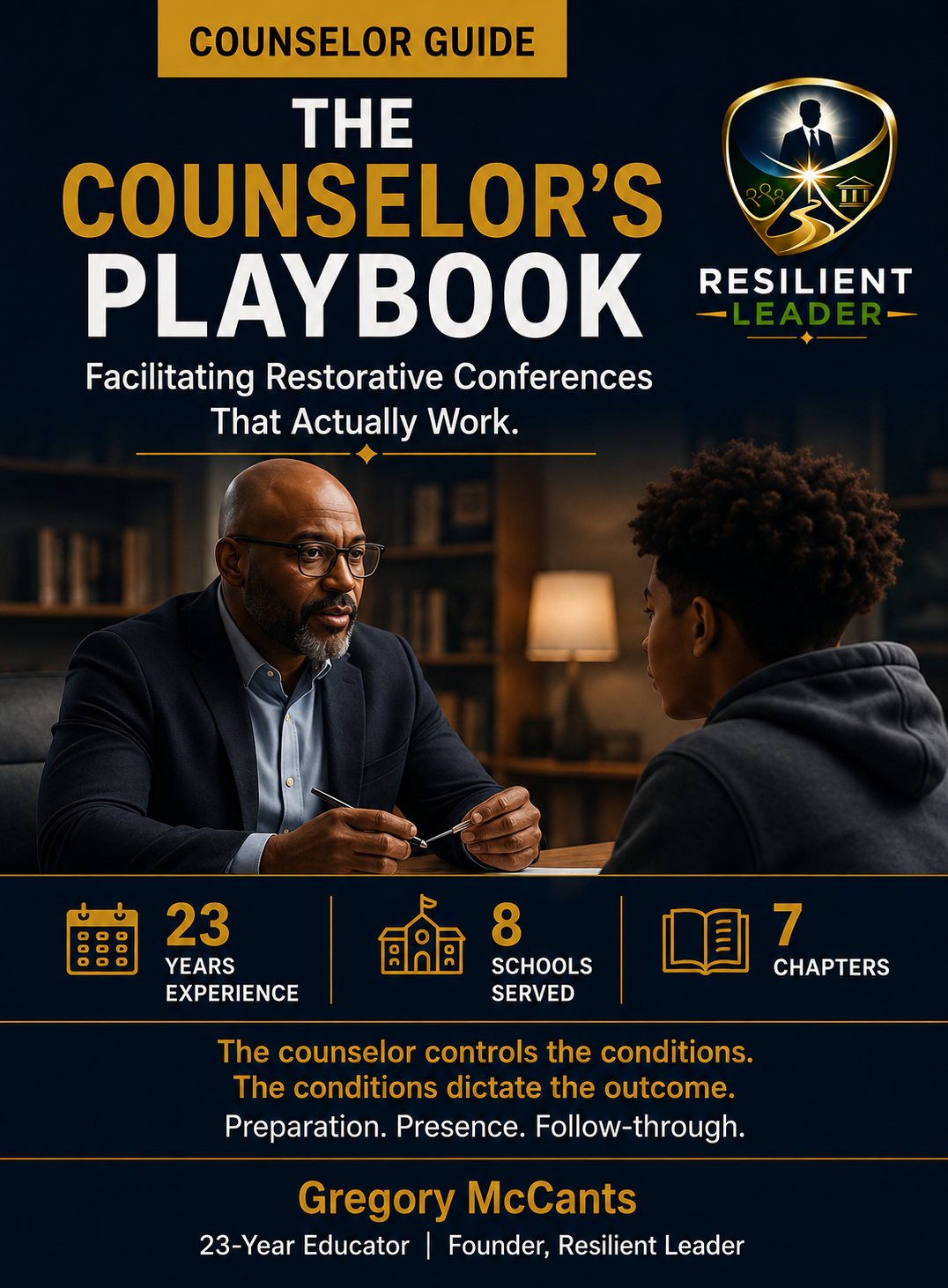





The Counselor's Playbook: Facilitating Restorative Conferences That Actually Work
The counselor is not a neutral party in a restorative conference.
It is 8:00 AM on a Thursday morning. A student is waiting outside your door after a massive classroom disruption. The parent is exactly three minutes away from pulling into the school parking lot, arriving with a defensive posture built from years of negative institutional battles . Meanwhile, the referring teacher is sitting in their room, completely exhausted and processing the heavy emotional cost of the blowout .
And the system expects you to step into the middle of this high-stakes tension and instantly manufacture a resolution.
School counselors routinely walk into restorative meetings holding more emotional weight than anyone else on campus. You carry the student’s behavior files, the teacher’s written referral, the family's historic suspicion, and whatever hidden trauma or trigger the student shared with you in private . You are forced to hold the complete system view while facilitating a room where every participant only sees their isolated piece of the wreckage. It is one of the most punishing, complex facilitation tasks in any modern profession.
Worse, traditional training only provides high-level conflict theories and vague restorative philosophies. It leaves you entirely stranded when the circle actually starts to unravel. In most school buildings, this structural vacuum forces counselors into managing a "restorative performance" . A circle format is hastily deployed, standard apologies are rehearsed, a behavior document is signed, and the file is marked resolved . But because the underlying environment never changed, the exact same behavior repeats itself three weeks later.
Your caseload is already stretched way past its design capacity, with national ratios sitting at a staggering 372 students per counselor. You do not have time to run performative truces that do not stick.
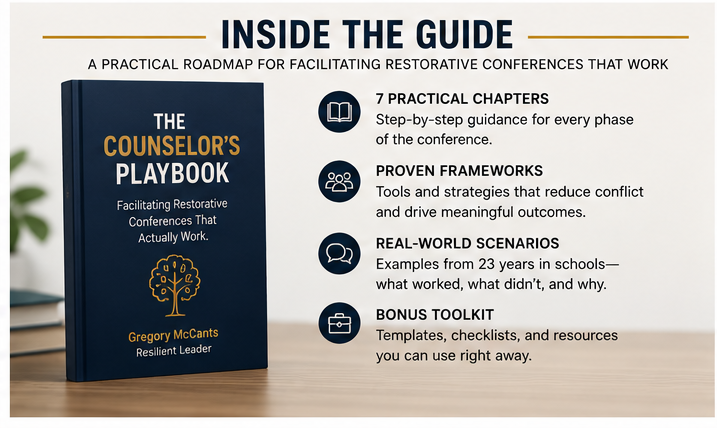
Written by a 23-year Title I school administrator and educator, The Counselor's Playbook provides a concrete, field-tested operational matrix to transition from reactive performance to structural practice. Built on the unyielding principle that preparation, presence, and systematic follow-through dictate outcomes, this manual gives you the ground-level blueprints needed to control the conditions of the room before anyone even takes a seat. Stop acting as the system’s reactive last resort, and start acting as its functional architect.
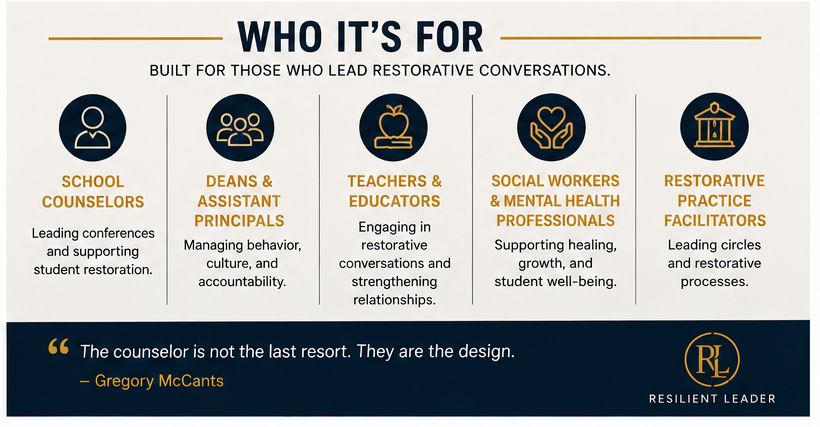
Who This Is For
- School Counselors & Social Workers managing heavy student caseloads who need a structured, step-by-step facilitation sequence rather than generic, abstract behavior theories.
- Deans of Students & Assistant Principals running restorative circles who want to stop running the exact same disciplinary meetings for the same students cycle after cycle.
- Higher Education Student Success Staff & Advisors looking to navigate complex adult student power dynamics and restrictive family privacy rules under FERPA compliance guidelines.
What You Get
- 7-Chapter Facilitation Playbook: A complete tactical blueprint mapping out schoolwide restorative infrastructure, room design, and multidimensional crisis facilitation.
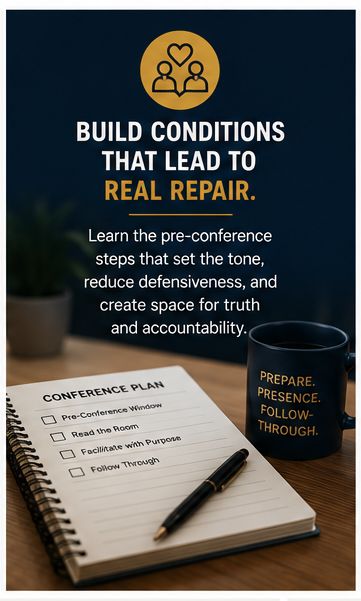
- The 3 Core Restorative Requirements Matrix: Direct operational parameters tracking your explicit criteria for Preparation (pre-work loops), Presence (real-time reading of the room), and Follow-Through (the vital 48-hour tracking window).
- The "Armor to Partnership" Parent Protocol: Concrete opening sequences and tactical questions to immediately shift defensive parents from legal adversaries to active context contributors.
- The Educator Emotional Labor Blueprint: Field-tested check-in questions and sequence tracking to protect and prepare teachers facing adaptive emotional regulation demands before they step into a circle.
- The "Circle Break" Recovery Protocols: Sharp, tactical recovery moves to deploy during sudden high-stakes disclosures, escalating parent accusations, or when an agreement collapses at the signature point.
- The Complete Facilitation Script Bank: A plug-and-play toolkit featuring raw, copy-and-paste language for Openings, Student Deepening Tracks, Silent Gap Holds, Escalation Redirects, and Graceful Closes Without Agreement.
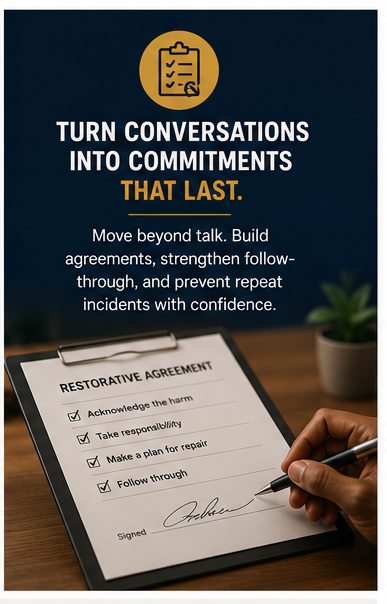
- The Post-Conference Summary Template: A clean, structural workspace blueprint to securely document explicit attendee commitments, unresolved items, and mandatory 48-hour follow-up metrics.
What It Pairs With
To establish a perfectly unified, legally defensible behavioral framework across your school campus, this text links natively with:
- The Pre-Conference Window: For utilizing automated student reflections to identify core emotions and environmental triggers days before a formal circle meets.
- The New Teacher Survival Guide: For exporting clean behavioral response scripts and classroom predictability structures directly to your frontline educators.
- Veteran AP Field Manual: For accessing legally bulletproof documentation formatting to back up administrative actions and track long-term restorative data points.