

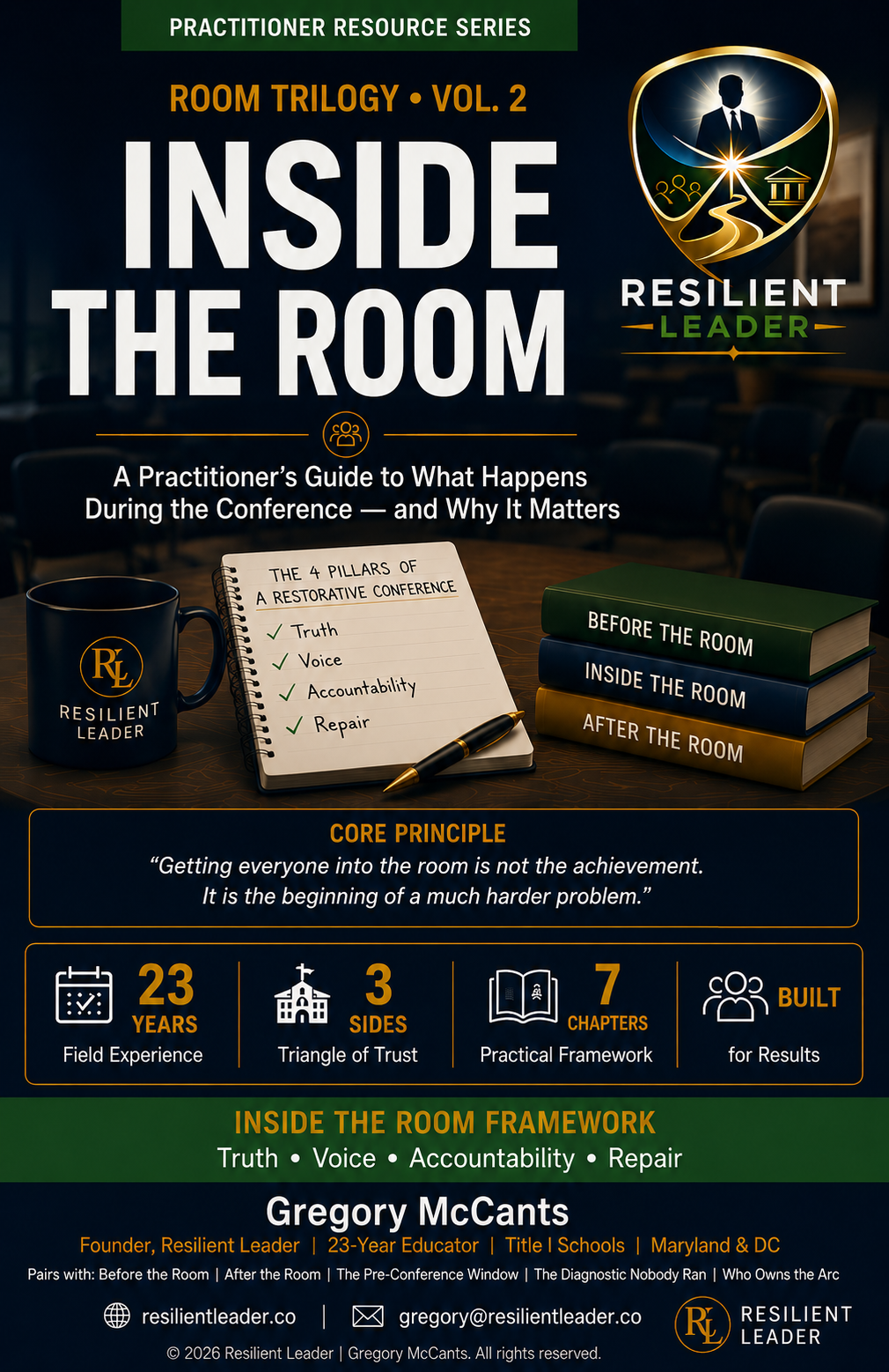





Inside the Room - Room Trilogy Vol. 2: A Practitioner's Guide to What Happens During the Conference and Why It Matters
Getting everyone into the room is not the achievement. It is the beginning of a much harder problem.
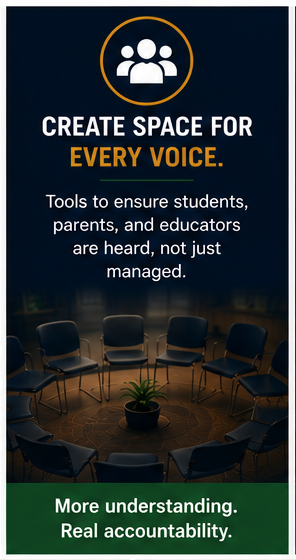
In twenty-three years of facilitating school disciplinary conferences, parent meetings, and restorative circles, I learned to accurately diagnose the outcome of a meeting before anyone even took a seat . I didn’t read the trajectory from the written administrative agenda. I read it straight from the layout of the chairs.
A standard rectangular conference table setup with the principal, dean, and teacher lined up on one side, and the family isolated on the other is not a neutral configuration. It is a physical architecture that actively reproduces the institutional power asymmetry the meeting is theoretically supposed to resolve. The student, wedged defensively beside a parent, is immediately positioned as an object of a clinical process rather than a dynamic participant in a human resolution. The room itself finishes its argument before a single adult opens their mouth.
The truth is that most school disciplinary conferences were never engineered for resolution. They were designed for documentation. The metric of success they are built to secure is a signed form, a behavior agreement or a re-entry plan that creates a legal paper trail the school can point to if things explode later. Genuinely resolving the root-cause conflict is merely a hoped-for byproduct.
This systemic design flaw creates an impossible environment because the conditions that produce flat, passive compliance and the conditions that produce true relational repair are almost mathematical opposites. Compliance demands a power asymmetry. Repair demands relational equity. When a room forces the structure of compliance but dresses it up as restorative practice, every participant inside the perimeter instantly feels the hypocrisy. The student performs remorse, the parent performs cooperation, the educator performs clinical neutrality, an agreement gets signed, and absolutely no one leaves the room changed.
Three weeks later, the exact same behavior repeats itself because nothing beneath the surface was addressed.
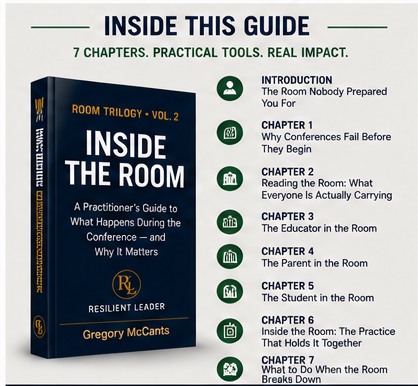
Written by a 23-year Title I teacher, dean, and assistant principal, Inside the Room enters the crucible of the conference to show you how to hold the frame under extreme interpersonal pressure. This book moves past abstract conflict-resolution theory to analyze the hidden emotional currents, structural breakdowns, and tactical facilitation choices that occur after the door closes . Stop managing empty, performative truces that collapse by Friday morning. Master the micro-moves required to convert a standard institutional hearing into a sustainable space for human accountability.
Who This Is For
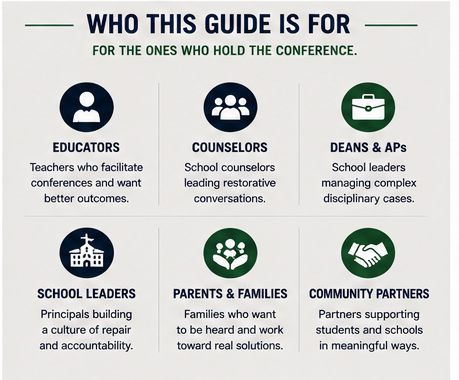
- School Counselors & Social Workers who are tired of executing technically correct circles that result in signed agreements nobody actually believes in.
- School Administrators & Deans running high-stakes behavioral intakes who want to shift away from managing legal liability toward engineering authentic equity.
- Classroom Teachers carrying the deep exhaustion of a brutal week who have to sit across from a family and discuss a situation that feels intensely personal.
What You Receive
- 7-Chapter Crucible Framework: A gritty, ground-level diagnostic of why school conferences systematically fail before they begin and how to structurally alter those outcomes.
- The Compliance vs. Repair Contradiction Matrix: Operational parameters outlining how to audit your meeting's layout, chair configuration, and language styles to dismantle default power asymmetries.
- The 3 Core Strands of Emotional Cargo: Critical breakdowns of what each party is secretly carrying into the room—unpacking student risk-management adaptations, parent protective armor, and the heavy biological cost of teacher emotional labor.
- The First Five Minutes Protocol: Tactical instructions on how to use the opening baseline moments to read eye contact, pacing, and physical postures before leading the discussion.
- The Goal-First Opening Move Sequence: A precise framing strategy to explicitly declare the structural purpose of the room ("We are not here to relitigate...") before touching the written agenda.
- The Strategic Voice Sequencing Rule: Concrete parameters establishing why the student must speak first regarding their experienced reality, followed sequentially by the educator and the parent.
- The "Holding the Silence" De-Escalation Tool: Explicit guidance on treating sudden student language walls or psychological freezes as vital data rather than active behavioral obstruction.
- The Strategic Break Recovery Blueprint: Concrete micro-moves to deploy structured pauses when an educator loses emotional regulation or a parent completely withdraws from collaboration.
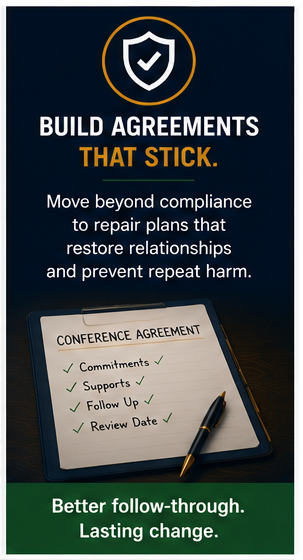
- The Honest Unresolved Close Strategy: A method to conclude a meeting without a clean agreement, preserving institutional honesty and setting a explicit next step without forcing a false signature.
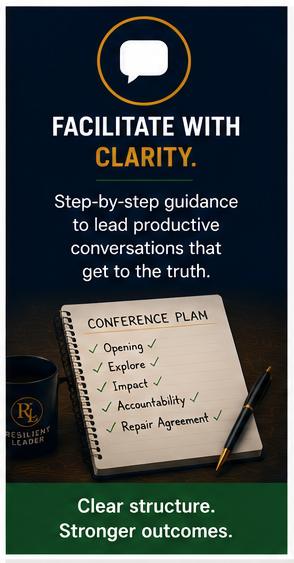
- The Inside the Room Conference Guide (Bonus): A device-ready, plug-and-play reference checklist charting required conditions across Before You Open, Opening the Room, During, Closing, and After the Conference milestones.
What It Pairs With
To erect a perfectly synchronized, legally bulletproof restorative pipeline across your entire building campus, this text links natively as the center volume of the trilogy with:
- Before the Room (Room Trilogy Vol. 1): For designing the automated student reflection data prompts and stabilizing parent panic in the window before the meeting fills up.
- After the Room (Room Trilogy Vol. 3): For mastering the hyper-fragile 48-hour post-conference window, tracking re-referral metrics, and adding permanent contextual notes to student files.
- The Counselor’s Playbook & Restorative Practices Toolkit: For exporting copy-and-paste script banks and Tier 2 check-in/check-out frameworks directly to your frontline student services teams.