

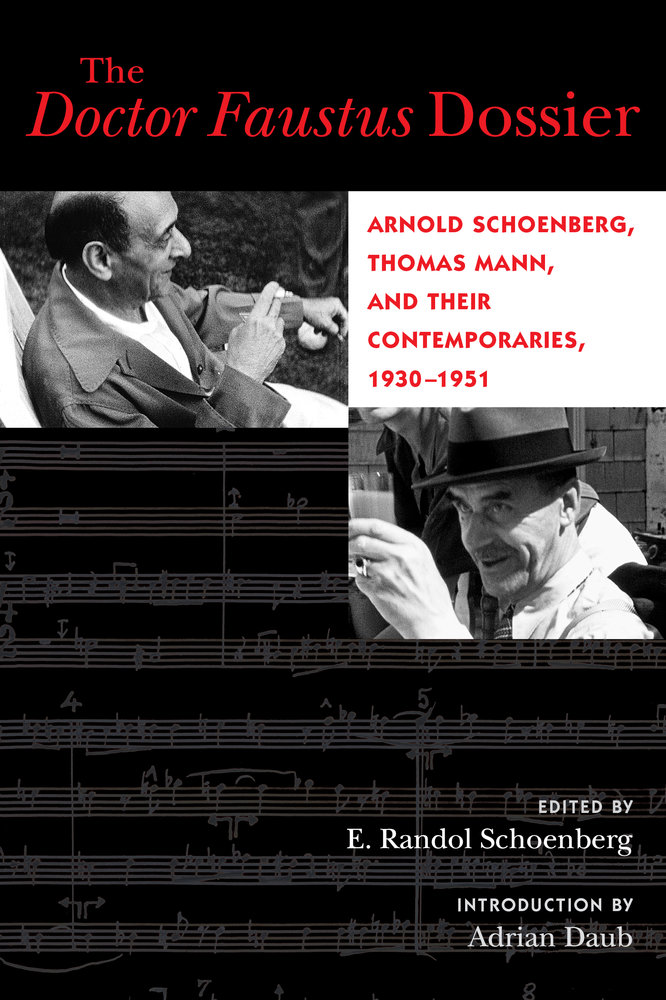
The Doctor Faustus Dossier: Arnold Schoenberg, Thomas Mann, and Their Contemporaries, 1930-1951
Introduction
California Haunting: Mann, Schoenberg, Faustus
Adrian Daub
Thomas Mann arrives in Los Angeles in 1940, eventually settling at 1550 San Remo Drive. By May of 1943 he begins to outline Doctor Faustus, writing to Bruno Walter about a novel “about pathological-illegitimate inspiration” and asking how to research composition training and music history. By May 8 his main character has the name “Leverkühn” and by May 17 the first name “Adrian.” Mann begins writing his first chapter on May 23, 1943, the same date as the novel’s narrator, Serenus Zeitblohm, begins to tell Leverkühn’s story.
Mann meets Theodor Wiesengrund Adorno in July 1943 at a dinner party hosted by Adorno’s erstwhile colleague at the Frankfurt Institute for Social Research, Max Horkheimer. By October he has asked Adorno to supply him with “musical intimacy and characteristic detail”1 for the Faustus project; over the next few years, Adorno writes fictional critical texts, descriptions of Mann’s protagonist’s fictional music, and descriptions of composition technique for Mann. Mann finishes the book on January 29, 1947, and celebrates final edits in February 1947, “with a champagne dinner to celebrate the completion of Faustus, and a reading of the Echo-chapter” to a “visibly seized” audience.2
The German edition appears with Fischer Verlag in 1947. In January of 1948 Mann sends a copy to Schoenberg with the inscription: “For Arnold Schoenberg, the real one [dem Eigentlichen], with best wishes” (see image on page 105 of this volume). Schoenberg never reads the entire novel because of his failing eyesight.3 Nevertheless, in February he responds with a literary parody imagining a third-millennium historian, “Hugo Triebsamen,” writing about a now-forgotten musician named Arnold Schoenberg and his “battle with the well-known German writer Thomas Mann, who was clearly the inventor of the method of composing with twelve tones.” Mann replies immediately that his portrait constituted “no diminution of your place in history.” Mann agrees to append a note acknowledging Schoenberg’s role and his fictionalization of it to the US translation by Helen Lowe-Porter.
By March of 1948 the controversy spills out into the press—somewhat ironically precisely because of Mann’s note and his personal dedication. Schoenberg and his camp think the note insufficient and the dedication’s reference to “the real one” an indicator that Schoenberg is the model for the novel’s syphilitic stand-in for Nazi Germany, which Schoenberg considers “an insult,” one for which he “might have to draw consequences.” Aline Valangin publishes an attack on Faustus in the Swiss periodical Unsere Meinung. And in a November 1948 letter to the Saturday Review of Literature, Schoenberg reaffirms his sense that “in his novel Dr. Faustus, Thomas Mann has taken advantage of my literary property,” and he fingers Adorno as “the informer” who has helped in Mann’s theft. At this point Mann has already completed The Story of a Novel, his own account of the writing of Doctor Faustus. This document, an attempt to set the record straight in a number of respects, becomes the subject of a tug-of-war between Adorno, who would like his contributions recognized, and Katia and Erika Mann, who can’t stand Adorno and wants the same contributions minimized.
This introductory essay is not intended to provide a definitive version of events nor to offer a conclusive interpretation of them. There are already many impressive attempts to do that.4 The essay intends instead to guide readers through the thicket of acquaintances, old grudges and new anxieties, problems of politics and aesthetics that resonate—sometimes faintly, sometimes clearly—between the lines in the essays and exchanges gathered here. These are, after all, one reason scholars, students, and lay readers have returned to the Faustus controversy time and time again. The other is that rarely has a literary controversy spoken so directly to a unique place and time: Faustus could not have been written, and Faustus could not have generated the controversy that it did, outside of the highly peculiar setting of Southern California during the Second World War.