
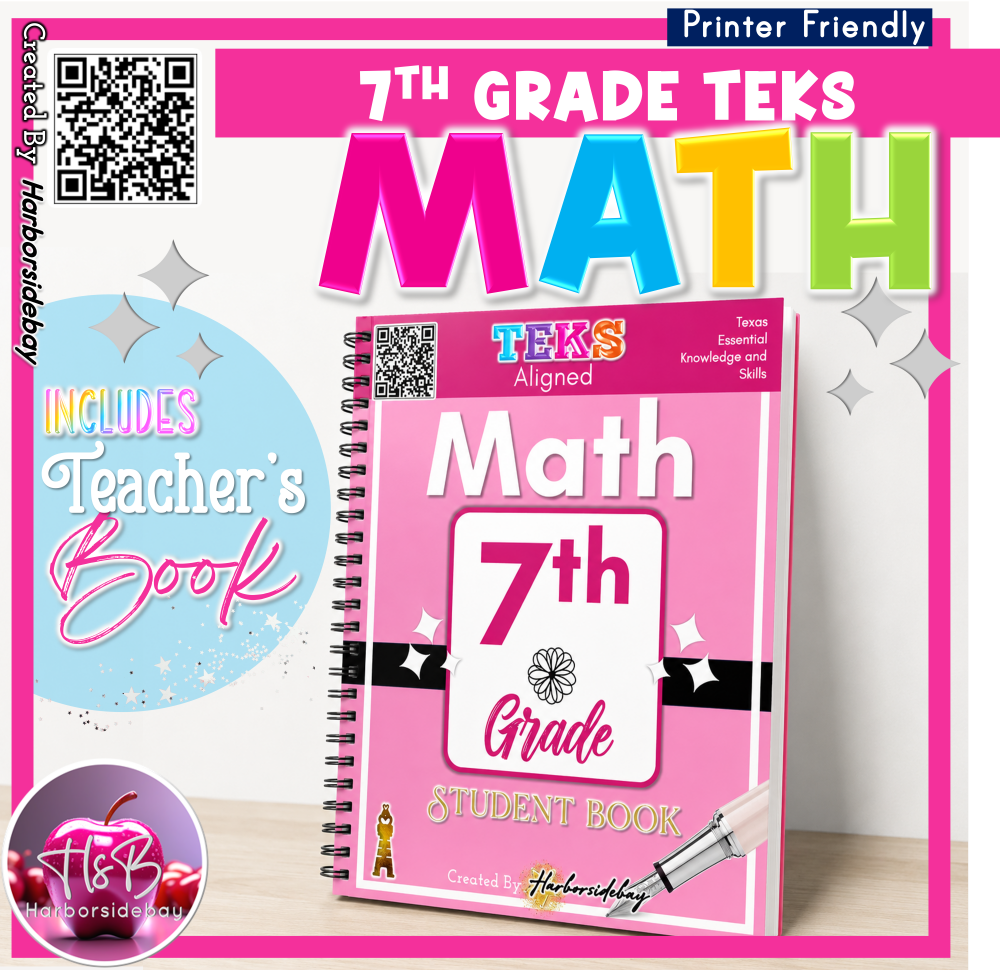
TEKS Math 7th Grade
ʕ•́ᴥ•̀ʔっ Greetings!
Great for use in lesson introduction, supplement, class assignments, practice, homework, independent / group activity and quizzes for 7th grade, TEKS aligned, math problems. Great for students who are in 7th grade, will begin 7th grade, or end 7th grade.
💻Includes🪄
🪄Student Version
🍎Teacher Version
🪄Features🪄
🌟Multiple Choice in Student's Book
🌟Teacher's Book
🌟Student and Teacher books are separated for Quick Print & Assign (No Mods req.)
📁 Total of 2 PDF files.
🍎TEKS Standards Found in this Resource🍎
💫 MA.7.1.A
Mathematical process standards. The student uses mathematical processes to acquire and demonstrate mathematical understanding. The student is expected to: apply mathematics to problems arising in everyday life, society, and the workplace;
💫 MA.7.1.B
Mathematical process standards. The student uses mathematical processes to acquire and demonstrate mathematical understanding. The student is expected to: use a problem-solving model that incorporates analyzing given information, formulating a plan or strategy, determining a solution, justifying the solution, and evaluating the problem-solving process and the reasonableness of the solution;
💫 MA.7.1.C
Mathematical process standards. The student uses mathematical processes to acquire and demonstrate mathematical understanding. The student is expected to: select tools, including real objects, manipulatives, paper and pencil, and technology as appropriate, and techniques, including mental math, estimation, and number sense as appropriate, to solve problems;
💫 MA.7.1.D
Mathematical process standards. The student uses mathematical processes to acquire and demonstrate mathematical understanding. The student is expected to: communicate mathematical ideas, reasoning, and their implications using multiple representations, including symbols, diagrams, graphs, and language as appropriate;
💫 MA.7.1.E
Mathematical process standards. The student uses mathematical processes to acquire and demonstrate mathematical understanding. The student is expected to: create and use representations to organize, record, and communicate mathematical ideas;
💫 MA.7.1.F
Mathematical process standards. The student uses mathematical processes to acquire and demonstrate mathematical understanding. The student is expected to: analyze mathematical relationships to connect and communicate mathematical ideas; and
💫 MA.7.1.G
Mathematical process standards. The student uses mathematical processes to acquire and demonstrate mathematical understanding. The student is expected to: display, explain, and justify mathematical ideas and arguments using precise mathematical language in written or oral communication.
💫 MA.7.2.A
Number and operations. The student applies mathematical process standards to represent and use rational numbers in a variety of forms. The student is expected to: extend previous knowledge of sets and subsets using a visual representation to describe relationships between sets of rational numbers.
💫 MA.7.3.A
Number and operations. The student applies mathematical process standards to add, subtract, multiply, and divide while solving problems and justifying solutions. The student is expected to: add, subtract, multiply, and divide rational numbers fluently; and
💫 MA.7.3.B
Number and operations. The student applies mathematical process standards to add, subtract, multiply, and divide while solving problems and justifying solutions. The student is expected to: apply and extend previous understandings of operations to solve problems using addition, subtraction, multiplication, and division of rational numbers.
💫 MA.7.4.A
Proportionality. The student applies mathematical process standards to represent and solve problems involving proportional relationships. The student is expected to: represent constant rates of change in mathematical and real-world problems given pictorial, tabular, verbal, numeric, graphical, and algebraic representations, including 𝑑 = 𝑟𝑡;
💫 MA.7.4.B
Proportionality. The student applies mathematical process standards to represent and solve problems involving proportional relationships. The student is expected to: calculate unit rates from rates in mathematical and real-world problems;
💫 MA.7.4.C
Proportionality. The student applies mathematical process standards to represent and solve problems involving proportional relationships. The student is expected to: determine the constant of proportionality (𝑘 = 𝑦/𝑥) within mathematical and real-world problems;
💫 MA.7.4.D
Proportionality. The student applies mathematical process standards to represent and solve problems involving proportional relationships. The student is expected to: solve problems involving ratios, rates, and percents, including multi-step problems involving percent increase and percent decrease, and financial literacy problems; and
💫 MA.7.4.E
Proportionality. The student applies mathematical process standards to represent and solve problems involving proportional relationships. The student is expected to: convert between measurement systems, including the use of proportions and the use of unit rates.
💫 MA.7.5.A
Proportionality. The student applies mathematical process standards to use geometry to describe or solve problems involving proportional relationships. The student is expected to: generalize the critical attributes of similarity, including ratios within and between similar shapes;
💫 MA.7.5.B
Proportionality. The student applies mathematical process standards to use geometry to describe or solve problems involving proportional relationships. The student is expected to: describe π as the ratio of the circumference of a circle to its diameter; and
💫 MA.7.5.C
Proportionality. The student applies mathematical process standards to use geometry to describe or solve problems involving proportional relationships. The student is expected to: solve mathematical and real-world problems involving similar shape and scale drawings.
💫 MA.7.6.A
Proportionality. The student applies mathematical process standards to use probability and statistics to describe or solve problems involving proportional relationships. The student is expected to: represent sample spaces for simple and compound events using lists and tree diagrams;
💫 MA.7.6.B
Proportionality. The student applies mathematical process standards to use probability and statistics to describe or solve problems involving proportional relationships. The student is expected to: select and use different simulations to represent simple and compound events with and without technology;
💫 MA.7.6.C
Proportionality. The student applies mathematical process standards to use probability and statistics to describe or solve problems involving proportional relationships. The student is expected to: make predictions and determine solutions using experimental data for simple and compound events;
💫 MA.7.6.D
Proportionality. The student applies mathematical process standards to use probability and statistics to describe or solve problems involving proportional relationships. The student is expected to: make predictions and determine solutions using theoretical probability for simple and compound events;
💫 MA.7.6.E
Proportionality. The student applies mathematical process standards to use probability and statistics to describe or solve problems involving proportional relationships. The student is expected to: find the probabilities of a simple event and its complement and describe the relationship between the two;
💫 MA.7.6.F
Proportionality. The student applies mathematical process standards to use probability and statistics to describe or solve problems involving proportional relationships. The student is expected to: use data from a random sample to make inferences about a population;
💫 MA.7.6.G
Proportionality. The student applies mathematical process standards to use probability and statistics to describe or solve problems involving proportional relationships. The student is expected to: solve problems using data represented in bar graphs, dot plots, and circle graphs, including part-to-whole and part-to-part comparisons and equivalents;
💫 MA.7.6.H
Proportionality. The student applies mathematical process standards to use probability and statistics to describe or solve problems involving proportional relationships. The student is expected to: solve problems using qualitative and quantitative predictions and comparisons from simple experiments; and
💫 MA.7.6.I
Proportionality. The student applies mathematical process standards to use probability and statistics to describe or solve problems involving proportional relationships. The student is expected to: determine experimental and theoretical probabilities related to simple and compound events using data and sample spaces.
💫 MA.7.7.A
Expressions, equations, and relationships. The student applies mathematical process standards to represent linear relationships using multiple representations. The student is expected to: represent linear relationships using verbal descriptions, tables, graphs, and equations that simplify to the form 𝑦 = 𝑚𝑥 + 𝑏.
💫 MA.7.8.A
Expressions, equations, and relationships. The student applies mathematical process standards to develop geometric relationships with volume. The student is expected to: model the relationship between the volume of a rectangular prism and a rectangular pyramid having both congruent bases and heights and connect that relationship to the formulas;
💫 MA.7.8.B
Expressions, equations, and relationships. The student applies mathematical process standards to develop geometric relationships with volume. The student is expected to: explain verbally and symbolically the relationship between the volume of a triangular prism and a triangular pyramid having both congruent bases and heights and connect that relationship to the formulas; and
💫 MA.7.8.C
Expressions, equations, and relationships. The student applies mathematical process standards to develop geometric relationships with volume. The student is expected to: use models to determine the approximate formulas for the circumference and area of a circle and connect the models to the actual formulas.
💫 MA.7.9.A
Expressions, equations, and relationships. The student applies mathematical process standards to solve geometric problems. The student is expected to: solve problems involving the volume of rectangular prisms, triangular prisms, rectangular pyramids, and triangular pyramids;
💫 MA.7.9.B
Expressions, equations, and relationships. The student applies mathematical process standards to solve geometric problems. The student is expected to: determine the circumference and area of circles;
💫 MA.7.9.C
Expressions, equations, and relationships. The student applies mathematical process standards to solve geometric problems. The student is expected to: determine the area of composite figures containing combinations of rectangles, squares, parallelograms, trapezoids, triangles, semicircles, and quarter circles; and
💫 MA.7.9.D
Expressions, equations, and relationships. The student applies mathematical process standards to solve geometric problems. The student is expected to: solve problems involving the lateral and total surface area of a rectangular prism, rectangular pyramid, triangular prism, and triangular pyramid by determining the area of the shape's net.
💫 MA.7.10.A
Expressions, equations, and relationships. The student applies mathematical process standards to use one-variable equations and inequalities to represent situations. The student is expected to: write one-variable, two-step equations and inequalities to represent constraints or conditions within problems;
💫 MA.7.10.B
Expressions, equations, and relationships. The student applies mathematical process standards to use one-variable equations and inequalities to represent situations. The student is expected to: represent solutions for one-variable, two-step equations and inequalities on number lines; and
💫MA.7.10.C
Expressions, equations, and relationships. The student applies mathematical process standards to use one-variable equations and inequalities to represent situations. The student is expected to: write a corresponding real-world problem given a one-variable, two-step equation or inequality.
💫MA.7.11.A
Expressions, equations, and relationships. The student applies mathematical process standards to solve one-variable equations and inequalities. The student is expected to: model and solve one-variable, two-step equations and inequalities;
💫 MA.7.11.B
Expressions, equations, and relationships. The student applies mathematical process standards to solve one-variable equations and inequalities. The student is expected to: determine if the given value(s) make(s) one-variable, two-step equations and inequalities true; and
💫 MA.7.11.C
Expressions, equations, and relationships. The student applies mathematical process standards to solve one-variable equations and inequalities. The student is expected to: write and solve equations using geometry concepts, including the sum of the angles in a triangle, and angle relationships.
💫 MA.7.12.A
Measurement and data. The student applies mathematical process standards to use statistical representations to analyze data. The student is expected to: compare two groups of numeric data using comparative dot plots or box plots by comparing their shapes, centers, and spreads;
💫 MA.7.12.B
Measurement and data. The student applies mathematical process standards to use statistical representations to analyze data. The student is expected to: use data from a random sample to make inferences about a population; and
💫 MA.7.12.C
Measurement and data. The student applies mathematical process standards to use statistical representations to analyze data. The student is expected to: compare two populations based on data in random samples from these populations, including informal comparative inferences about differences between the two populations.
💫 MA.7.13.A
Personal financial literacy. The student applies mathematical process standards to develop an economic way of thinking and problem solving useful in one's life as a knowledgeable consumer and investor. The student is expected to: calculate the sales tax for a given purchase and calculate income tax for earned wages;
💫 MA.7.13.B
Personal financial literacy. The student applies mathematical process standards to develop an economic way of thinking and problem solving useful in one's life as a knowledgeable consumer and investor. The student is expected to: identify the components of a personal budget, including income; planned savings for college, retirement, and emergencies; taxes; and fixed and variable expenses, and calculate what percentage each category comprises of the total budget;
💫 MA.7.13.C
Personal financial literacy. The student applies mathematical process standards to develop an economic way of thinking and problem solving useful in one's life as a knowledgeable consumer and investor. The student is expected to: create and organize a financial assets and liabilities record and construct a net worth statement;
💫 MA.7.13.D
Personal financial literacy. The student applies mathematical process standards to develop an economic way of thinking and problem solving useful in one's life as a knowledgeable consumer and investor. The student is expected to: use a family budget estimator to determine the minimum household budget and average hourly wage needed for a family to meet its basic needs in the student's city or another large city nearby;
💫 MA.7.13.E
Personal financial literacy. The student applies mathematical process standards to develop an economic way of thinking and problem solving useful in one's life as a knowledgeable consumer and investor. The student is expected to: calculate and compare simple interest and compound interest earnings; and
💫 MA.7.13.F
Personal financial literacy. The student applies mathematical process standards to develop an economic way of thinking and problem solving useful in one's life as a knowledgeable consumer and investor. The student is expected to: analyze and compare monetary incentives, including sales, rebates, and coupons.