
Pilates Geometry: 10 Shapes That Help You See Movement Differently
Pilates Geometry
10 Shapes That Help You See Movement Differently
A Visual Guide to Recognizing, Understanding, and Teaching Pilates Movement
See the Shape. Understand the Relationship. Experience the Movement. Apply the Learning.
What if you could look at a familiar Pilates exercise and see movement in an entirely new way?
Pilates Geometry introduces a practical visual framework that helps Pilates instructors and students recognize how the body organizes itself through lines, angles, curves, and movement pathways.
Instead of focusing only on individual muscles or body parts, this illustrated guide helps you see the relationships between body segments, recognize how those relationships change during movement, and use your observations to make more thoughtful teaching decisions.
No mathematics background is required. Just curiosity, observation, and a willingness to see movement differently.
What You'll Learn
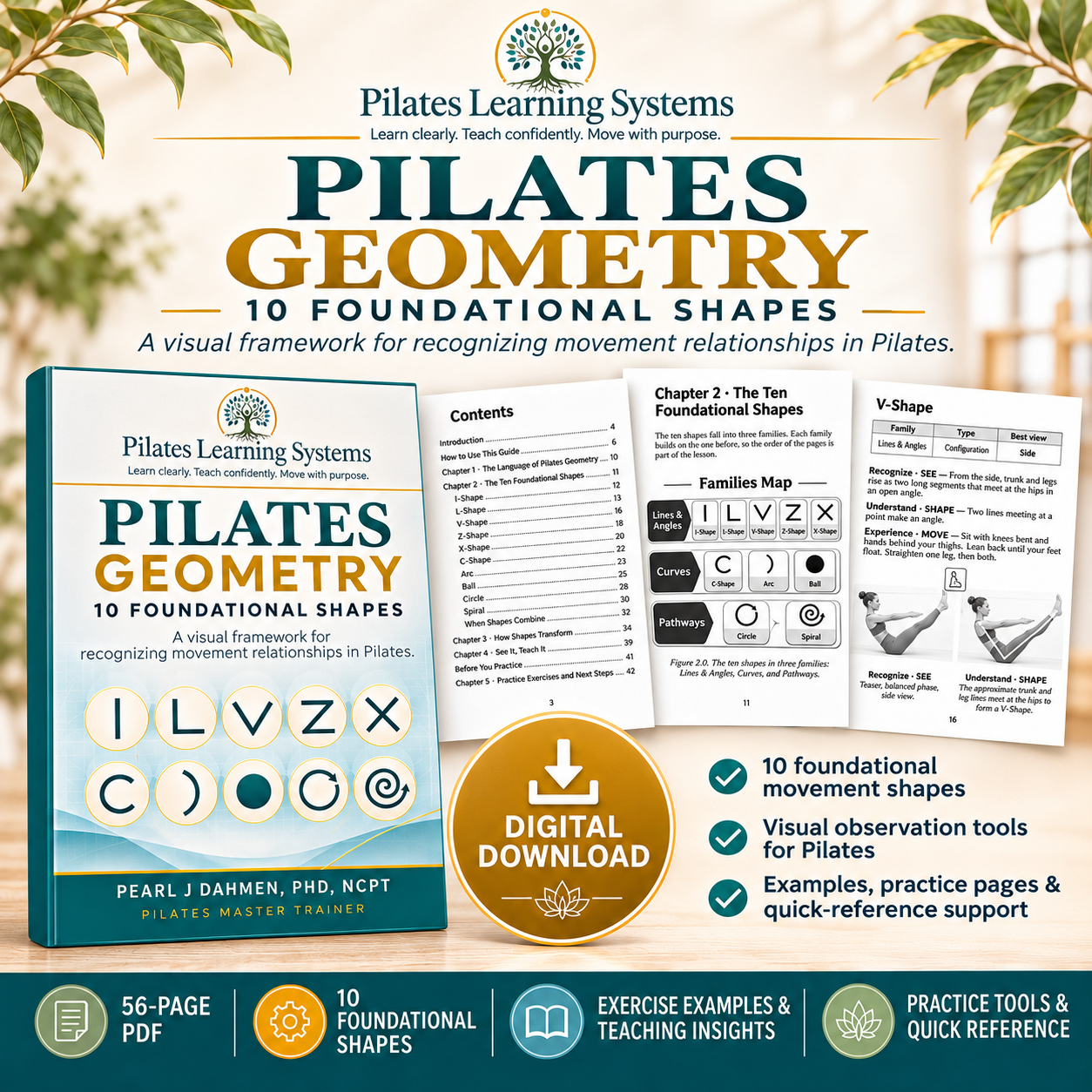
The 10 Foundational Shapes
Discover ten visual references organized into three families:
- Lines & Angles: I-Shape, L-Shape, V-Shape, Z-Shape, and X-Shape
- Curves: C-Shape, Arc, and Ball
- Pathways: Circle and Spiral
Each shape is illustrated through familiar Pilates exercises, helping you recognize geometric relationships in actual movement.
The Seven Movement-Observation Elements
Explore lines, angles, curves, pathways, rotation, planes and views, and balance and support. Learn how these elements provide a practical vocabulary for describing what you observe.
A Five-Step Method for Observing Movement
Apply a structured approach to Pilates movement:
- SEE — Recognize the body position and support.
- SHAPE — Identify the primary geometric relationship.
- MOVE — Notice what changes and what remains relatively stable.
- ANALYZE — Describe what you actually observe.
- APPLY — Connect your observation to an appropriate teaching choice.
Optional reflection questions encourage you to deepen your understanding.
What's Inside
- Illustrated explanations of all 10 foundational shapes
- Grayscale Pilates exercise illustrations with geometric overlays
- Examples showing how viewing angles change what you observe
- Movement transformations using Roll Up, Teaser, and One Leg Circle
- Practical teaching insights, cues, and movement variations
- Three guided practice activities with an answer key
- Quick-reference chart of shapes and movement relationships
- Glossary of movement-observation terminology
- Frequently asked questions about applying Pilates Geometry
Who This Guide Is For
Pilates Instructors in Training: Build observation skills and develop a clearer visual understanding of familiar exercises.
New Pilates Instructors: Strengthen your ability to recognize movement relationships, communicate observations, and make purposeful teaching choices.
Experienced Pilates Instructors: Explore another perspective on familiar repertoire and refine how you observe and interpret movement.
Dedicated Pilates Students: Develop greater awareness of how your body organizes itself during exercises.
Why Pilates Geometry Is Different
Pilates Geometry is not a collection of ideal positions or a system for judging whether movement is correct.
It is a way to ask better questions about what you see.
Two students may perform the same exercise with different-looking shapes, and both may be moving effectively. The goal is not to create a perfect line, curve, or angle. It is to understand how the observed relationships support the intention of the exercise.
This guide complements Pilates principles, anatomy, biomechanics, and established teaching practices without replacing them.
Product Details
- Format: Digital PDF download
- Length: 56 pages
- Illustrations: Grayscale movement illustrations and geometric overlays
- Use: Personal study, instructor education, lesson preparation, and individual Pilates instruction
- Delivery: Digital product; no physical book will be shipped
The PDF can be saved to your device or printed for personal reference.
About the Author
Pearl J Dahmen, PhD, NCPT, is a Pilates Master Trainer, educator, and founder of Pilates Learning Systems. With a PhD in Adult Education and extensive experience in teaching and professional training, she develops practical educational resources that help Pilates instructors learn clearly, teach confidently, and move with purpose.
Discover a new way to see Pilates movement.
Download Pilates Geometry and begin recognizing the lines, angles, curves, and pathways that bring movement into focus.
Learn clearly. Teach confidently. Move with purpose.
Published by Pilates Learning Systems | The Holistic Quest LLC
© 2026 The Holistic Quest LLC. All rights reserved.