

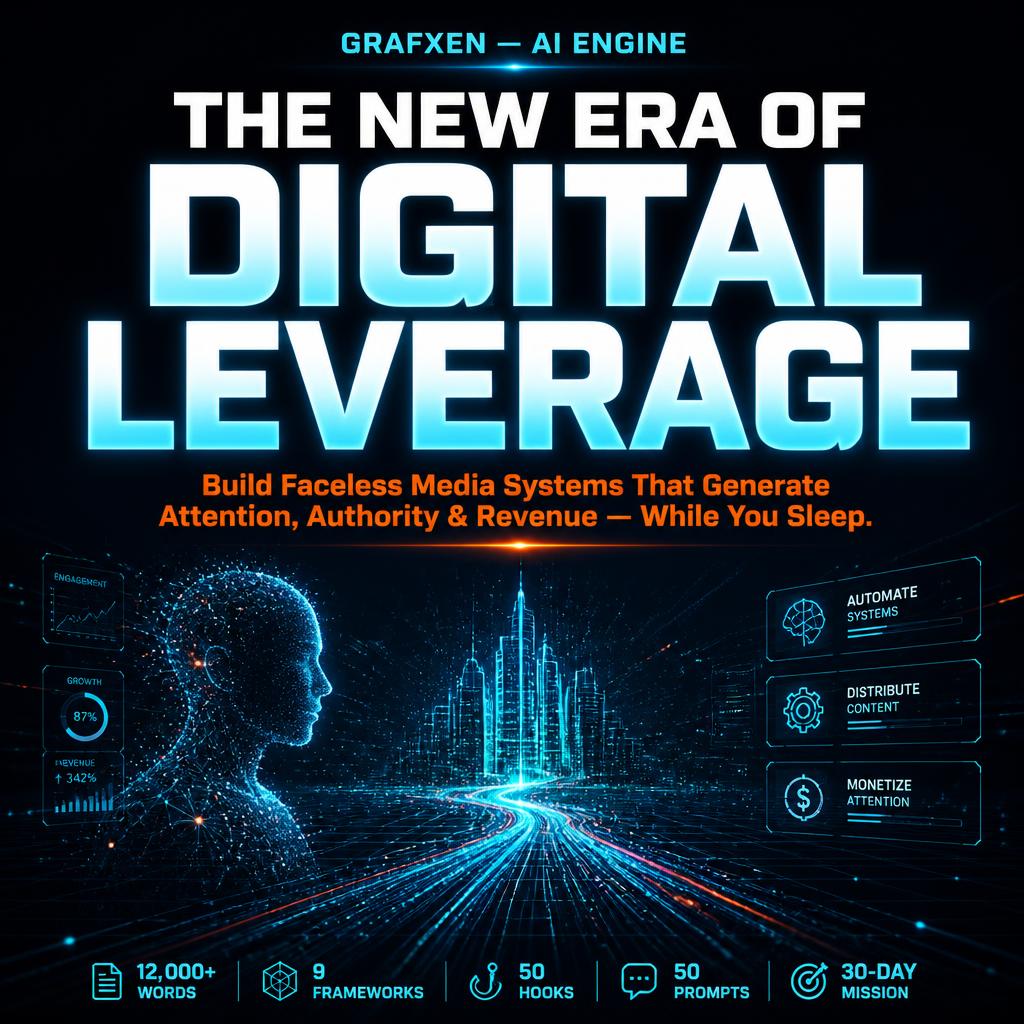


THE NEW ERA OF DIGITAL LEVERAGE
THE NEW ERA OF DIGITAL LEVERAGE
A Practical Guide to Faceless Content, AI-Assisted Workflows, and Digital Business Models
The digital world offers more ways than ever to create, publish, and distribute content. But creating content is not the same as building a structured digital operation.
The real challenge is understanding how the different parts fit together: finding relevant topics, developing engaging scripts, producing visual content, organizing publishing workflows, reaching an audience, and exploring suitable ways to monetize your work.
The New Era of Digital Leverage explores this process through the concept of faceless media and AI-assisted content production.
Rather than focusing on isolated tools or quick-money promises, this guide introduces a systems-oriented approach to digital content: how to organize the work, connect the stages, and make more deliberate decisions about what you create and why.
WHAT YOU WILL EXPLORE
1. The Faceless Advantage
Understand the faceless content model and explore formats that use narration, visuals, text, stock footage, and screen recordings instead of requiring an on-camera presenter.
2. Signal Extraction System
Explore ways to research audience interests and identify potential content topics using resources such as Google Trends, YouTube Search, Reddit, and TikTok Creative Center.
3. Script Engineering Framework
Discover how to structure video scripts around hooks, audience interest, value delivery, and clear calls to action.
4. Voice and Visual Production
Explore approaches to narration and visual content, including text-to-speech, voice tools, stock footage, generated visuals, and screen recordings.
5. CapCut Assembly Line
Understand the stages of a repeatable video-editing workflow, from assembling visual elements to preparing content for publication.
6. Distribution Engine
Examine how content can be adapted for platforms such as TikTok, YouTube Shorts, Instagram Reels, Facebook, LinkedIn, and X.
7. Automation and Scaling System
Explore templates, content batching, standardization, and AI-assisted automation as ways to organize repetitive production tasks.
8. Monetization Architecture
Learn about different digital business models, including affiliate marketing, digital products, services, productized systems, memberships, and software.
9. Operating Principles
Consider the broader principles of digital leverage: reusable assets, structured systems, informed decisions, ownership, and long-term thinking.
EXPLORE DIFFERENT DIGITAL BUSINESS MODELS
The guide also introduces ways content activity may connect to a business:
- Affiliate Marketing: Present relevant third-party products and services through affiliate arrangements.
- Digital Products: Develop resources such as ebooks, guides, and templates.
- Micro-Services: Offer focused services related to content creation and production.
- Productized Systems: Package repeatable processes into clearly defined service offers.
- Memberships and SaaS: Explore recurring-access models based on communities, resources, or software.
These are business models to evaluate and understand, not guaranteed sources of income.
A STRUCTURED 30-DAY ACTION FRAMEWORK
The guide outlines a four-stage implementation approach:
- Week 1: Organize your tools, research a content direction, and prepare an initial production workflow.
- Week 2: Establish a publishing routine and work toward greater consistency.
- Week 3: Review available performance data and identify opportunities to improve your content.
- Week 4: Examine potential offers and consider which monetization models may suit your project.
The framework provides structure for taking action. Your pace and results will depend on your experience, resources, time, and implementation.
WHO IS THIS GUIDE FOR?
This guide is intended for:
- Creators interested in faceless video content.
- Entrepreneurs exploring digital business models.
- Freelancers developing content-related services.
- Digital product creators and affiliate marketers.
- People interested in AI-assisted content production.
- Anyone who wants to approach digital publishing more systematically.
You do not need to appear on camera to explore the faceless content model. You do, however, need to make decisions about your audience, content quality, production process, and business direction.
FROM INDIVIDUAL CONTENT TO CONNECTED SYSTEMS
A successful digital operation is not created simply by publishing more videos or using more AI tools.
It requires research, planning, production, distribution, evaluation, and a clear understanding of the purpose behind each activity.
AI can assist with selected tasks, but it does not replace strategy, original thinking, editorial judgment, quality control, or the work required to build a business.
The New Era of Digital Leverage is about understanding these connections and exploring how to put them into practice.
Build systems. Create with purpose. Think beyond individual posts.
ABOUT THE AUTHOR
Daniel Graf is an Austrian independent author and technology enthusiast focused on making technology practical and turning ideas into action.
Through GRAFXEN, he explores practical applications of AI, automation, digital systems, and emerging technologies.
DANIEL GRAF – GRAFXEN
Making technology practical. Turning ideas into action.
IMPORTANT INFORMATION
This guide is educational material. It does not promise or guarantee views, followers, customers, business growth, or income. Results vary according to content quality, audience demand, competition, platform policies, implementation, and other factors. References to third-party platforms and tools are for informational purposes; their availability and features may change.