






My Problem, My Plan
Give your kid a way to solve their own problems. Not just this one. Every one after it too.
Kids hit problems all day. A bad grade. A friend who suddenly went quiet. A morning that falls apart before the bus even shows up.
Most of the time, we do one of two things. We fix it for them, or we tell them to calm down. Both come from a good place. Neither one teaches them how to handle the next problem on their own.
This worksheet does something different.
It hands kids a simple, repeatable way to slow down, figure out what is actually wrong, dig past the obvious to find the real cause, and build a small plan they chose themselves. It is the same structured thinking that engineers and problem solvers use at work, stripped all the way down to language a nine-year-old can actually use.
No jargon. No training needed. Just print it and go.
What is inside
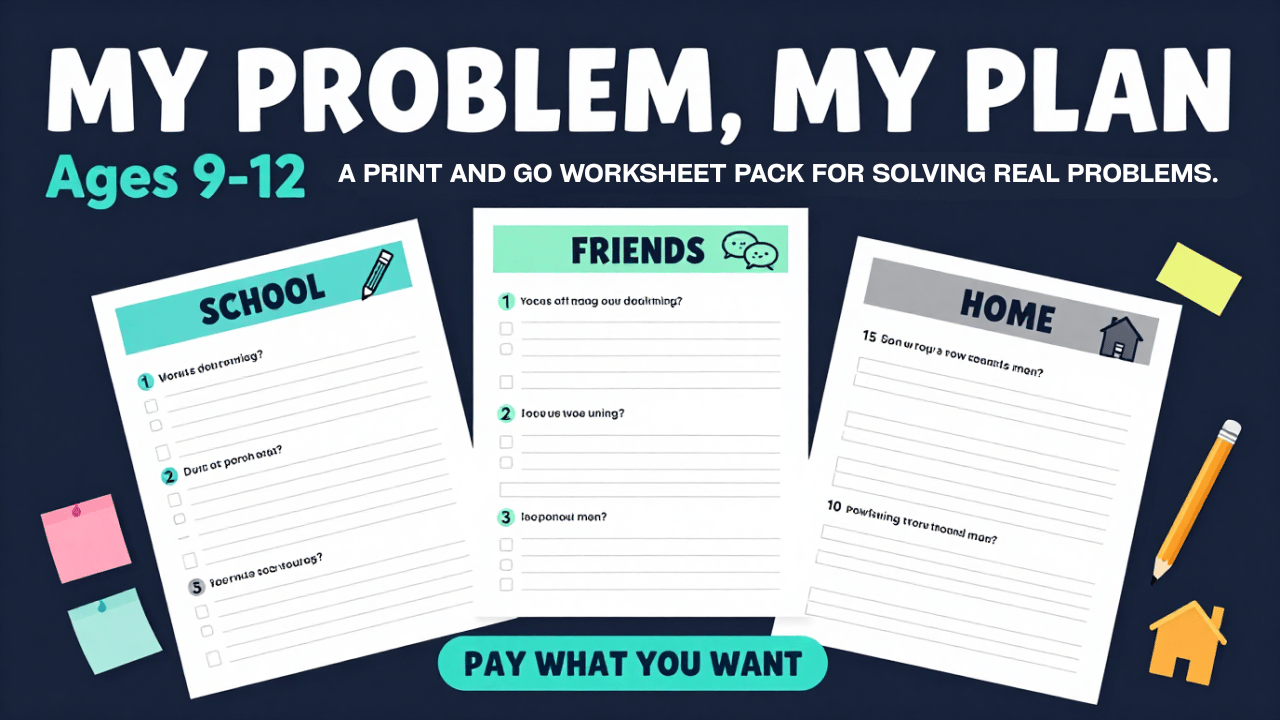
Three themed versions, because problems do not all look the same:
- School Edition for bad grades, confusing projects, and trouble focusing
- Friends Edition for disagreements, feeling left out, or just not clicking with someone
- Home Edition for chores, screen time battles, and morning chaos
Each version walks a child through the same six steps: name the problem, dig deeper with a "why" chain, brainstorm a few solutions, pick the best one, build a real plan with actual next steps, then look back at what worked.
You also get a Parent and Teacher Guide that explains the thinking behind every step, shows you how to use the worksheet without taking over, gives teachers three ways to run it in a classroom, and tells you exactly what to do when a kid's plan does not work the first time. Because it often will not, and that turns out to be the most useful part.
Why it works
The magic is not the worksheet. It is the habit it builds.
Kids learn to separate the problem from the panic. They learn the first answer is rarely the real one. They follow through on plans they picked themselves far more than on instructions handed to them. And they learn to look back at a flop as information, not failure.
That last one alone changes how a child handles setbacks for years.
Print as many as you need. This is yours to use again and again, at the kitchen table or in the classroom.
Pay what you want, including nothing at all. If it helps your kid, that is the whole point. If you want to throw a few euros/dollars our way to keep these coming, we appreciate it more than you know.
Lean thinking. Real life.