
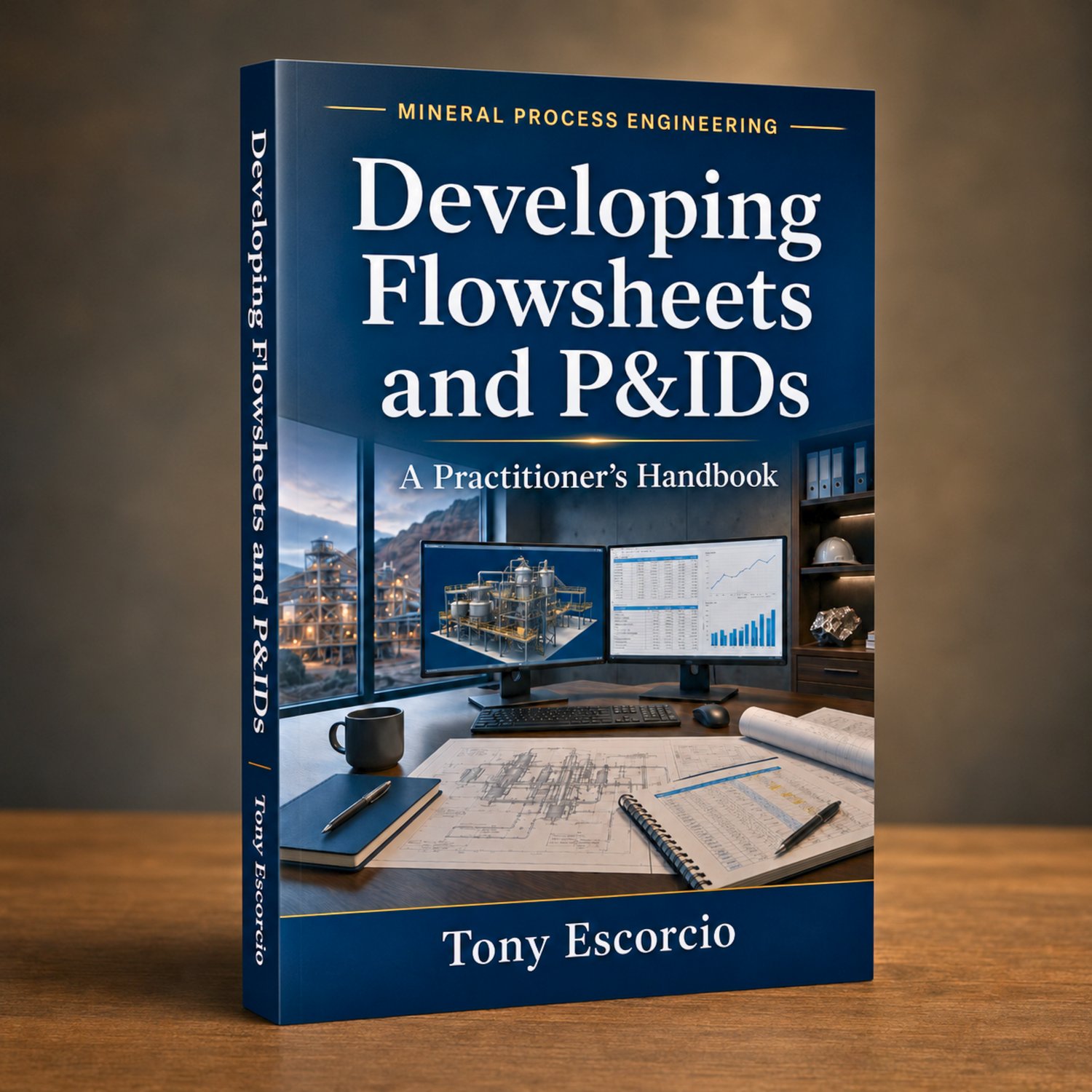
Developing Flowsheets and P&ID's
Developing Flowsheets and P&IDs: A Practitioner’s Handbook is a practical guide to one of the mineral process engineer’s most important responsibilities: transforming a process concept into a clear, coordinated and dependable engineering drawing set.
Rather than presenting drawing conventions as isolated rules, Tony Escorcio follows a single, internally consistent 476.2 t/h gold-processing plant from its first block-flow concept through to construction-issue P&IDs, engineering registers, HAZOP review and project handover. Every convention is applied to the same case study, allowing readers to see how the drawings develop and how decisions made at one stage affect the next.
The handbook establishes a disciplined sequence for developing process documentation:
Block Flow Diagram → Process Flow Diagram → Mass Balance → P&ID → Engineering Registers
This progression helps prevent the common problems caused by adding detail too early, mixing drawing levels or allowing equipment, line, valve and instrument data to become disconnected.
Topics include:
- Diagram hierarchy: BFDs, PFDs and P&IDs
- Drawing standards, numbering and revision control
- Equipment, streams, utilities and major control loops
- Line numbering, valves and in-line components
- Instrumentation and ISA tagging
- Safety systems, relief devices and interlocks
- Tie-ins, battery limits and sheet connectivity
- Grinding, classification, leach, CIP, elution, electrowinning and reagent-system examples
- Equipment lists, line lists, valve schedules, instrument indexes and tie-in schedules
- HAZOP, model reviews, redlines, as-built drawings and handover
The appendices provide a master symbol legend, a worked stream table, standard drawing notes, abbreviations and practical line- and tag-numbering schemes. A companion Excel workbook supports the case study with cross-linked engineering registers.
Written for practising process engineers, metallurgists, designers, project engineers, graduates and technical personnel, this handbook turns drawing-office knowledge that is often learned informally into a structured, repeatable and practical engineering method.