

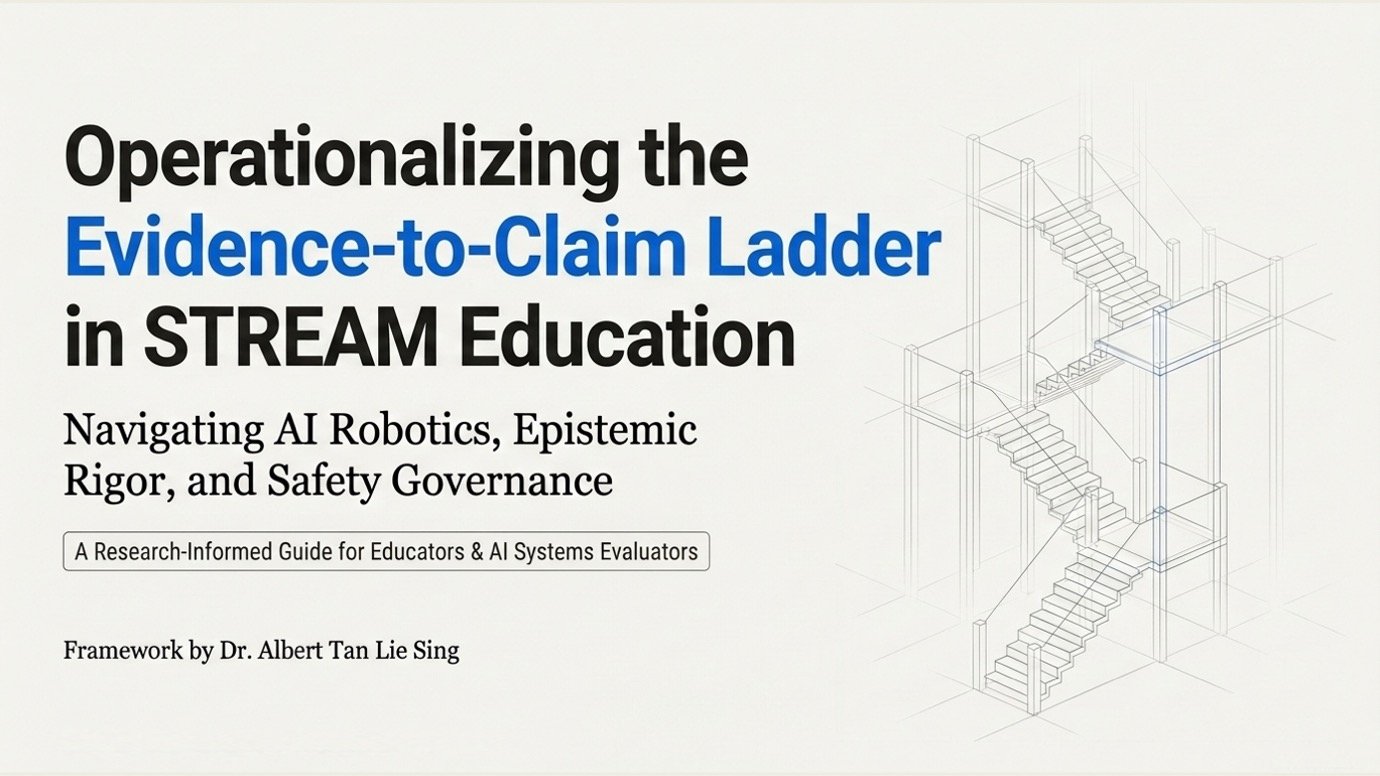
Operationalizing the Evidence-to-Claim Ladder in STREAM Education
Navigating AI Robotics, Epistemic Rigor, and Safety Governance
How much can an AI benchmark really prove? When does a correctly cited source fail to support a scientific claim? And how can educators and researchers distinguish observable performance from assumptions about understanding?
This illustrated, research-informed guide by Dr. Albert Tan Lie Sing examines the relationship between evidence, scientific claims, AI capability evaluation, and responsible governance.
Across 21 pages, readers will explore the five-layer Evidence-to-Claim Ladder, the limitations of static AI benchmarks, citation correctness versus auditability, evidence-centered assessment, controlled human–AI performance comparisons, and the structure of AI safety cases.
Designed for STREAM educators, academic researchers, instructional designers, AI robotics practitioners, and technology evaluators, this publication encourages more disciplined reasoning about what scientific evidence establishes—and what remains uncertain.
Volume I establishes the conceptual foundations. A planned companion publication, The Evidence-to-Claim Ladder in Practice, will explore applications, experimental validation, and measurable educational and humanitarian outcomes.
21 pages | Illustrated scholarly guide | First Edition 2026
What You Will Learn
Discover how to think critically about scientific evidence, artificial intelligence, robotics, and educational claims.
Through this illustrated, research-informed guide, you will learn to:
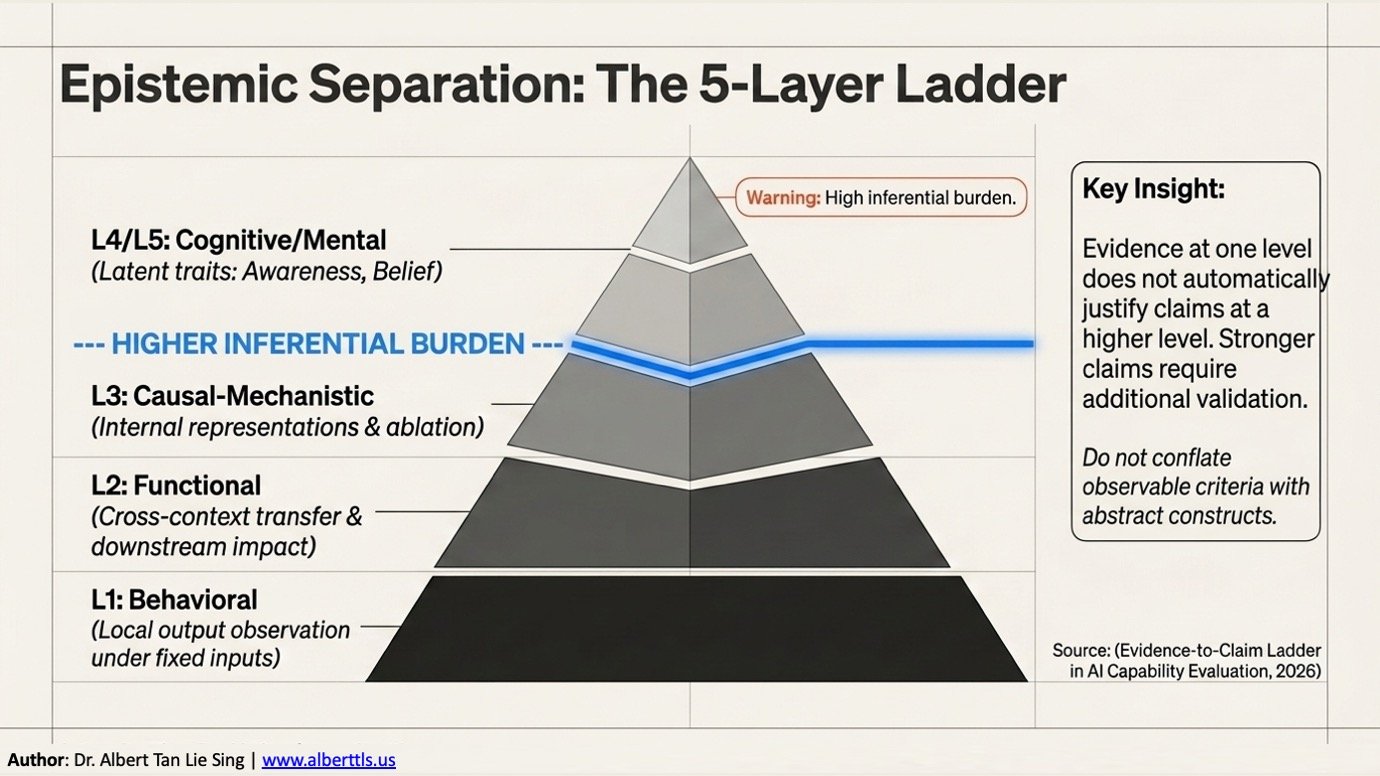
- Distinguish evidence from assumptions: Understand why correct performance does not automatically prove intelligence, understanding, or safety.
- Apply the Evidence-to-Claim Ladder: Explore five levels of evidence and the limits of the conclusions each level can support.
- Question AI benchmarks: Recognize why successful test results may not predict reliable real-world behavior.
- Evaluate scientific references: Distinguish citation correctness from genuine evidentiary support, traceability, and research integrity.
- Assess AI capabilities more carefully: Understand the importance of testing alternative explanations, memorization, and shortcuts.
- Interpret human–AI performance: Learn how controlled comparisons can identify performance differences without exaggerating AI capabilities.
- Understand AI safety governance: Explore evidence-based safety cases, human accountability, and responsible deployment decisions.
- Strengthen evidence-based educational reasoning: Discover how careful assessment and critical thinking can inform responsible STREAM education.
By the end of this eBook, you will have a clearer understanding of how to question evidence, recognize unsupported conclusions, and approach AI capability and safety claims with greater scientific rigor.
Volume I introduces the conceptual foundations. The planned Volume II, The Evidence-to-Claim Ladder in Practice, will explore practical applications, assessment methods, and empirical validation.