

The masculine sky-god is a recent invention. The goddess never left.
We are told, implicitly if not explicitly, that humanity’s oldest spiritual impulse was toward the sky — toward a father, a king, a judge above the clouds. This is not history. It is inheritance. The oldest spiritual impulse we can trace points somewhere else entirely: downward, inward, into the dark and fertile earth. And the figure at its center was always female.
The Invention We Forgot Was an Invention
The Abrahamic God, in geological time, is a newborn. The oldest texts of the Hebrew Bible date to roughly the 10th century BCE. The patriarchal sky-god traditions that now underpin the spiritual lives of half the world’s population are, at most, a few thousand years old. Set that against a species that has been anatomically modern for around 300,000 years, and producing sophisticated symbolic culture for at least 100,000 of those. The masculine monotheistic moment, however dominant it feels from inside it, represents perhaps two percent of the time we have been human.
For the other ninety-eight percent, the evidence tells a different story. Not uniformly, not without complexity, but with a consistency that resists dismissal: the animating spiritual presence of early human consciousness was overwhelmingly feminine. She was the earth that swallowed the dead and pushed up new growth. She was the cave that initiated the living. She was the moon that counted time. She was not worshipped at a remove, from pews, through intermediaries. She was the world itself, and to live was to live inside her.
Red Ochre and the First Sacred Act
Before language as we know it. Before agriculture, writing, cities, or empire. Before the great Axial Age philosophies, before any named god, before almost anything we conventionally call civilization — there was ochre.
Red ochre, iron oxide ground to a powder, appears in the archaeological record as early as 300,000 years ago in Africa and at Neanderthal sites across Europe. It was used on the dead. It was used in caves. It was, as far as we can determine, the first substance ever treated as sacred. And the colour it produces is the colour of blood — menstrual blood, birth blood, the blood that marks the threshold between death and life.
🧱 Early ochre use in Africa (300,000+ years)

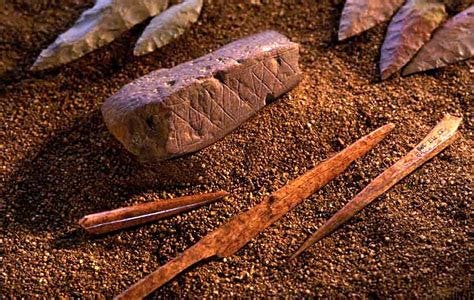
- Red ochre fragments from Middle Stone Age Africa show deliberate grinding and use as pigment. These finds appear in African sites as early as 500,000–300,000 years ago, according to large-scale analyses of ochre use across the continent.
- Blombos Cave (South Africa) includes engraved ochre pieces and ochre-processing kits, demonstrating symbolic and possibly ritual use.
🧬 Neanderthal ochre use (Europe, 250,000+ years ago)
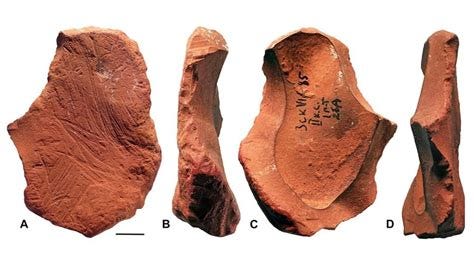
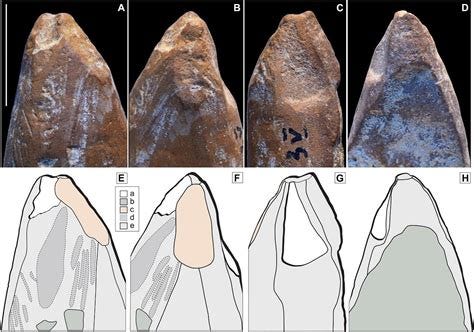
Neanderthals used red ochre at least 200,000–250,000 years ago, based on hematite concentrates recovered at Maastricht‑Belvédère (Netherlands).
- The images above show Neanderthal ochre “crayons” and modified ochre fragments, demonstrating intentional shaping for symbolic or practical use.
🕳️ Ochre in caves (symbolic and artistic use)
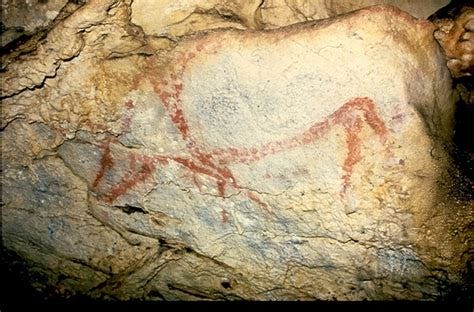
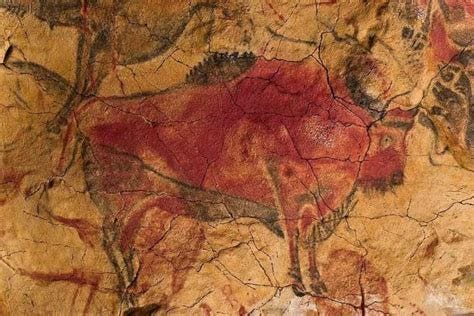
Red ochre is the earliest known pigment used in cave art, including animal figures and abstract markings.
- Neanderthal cave paintings (e.g., Altamira, Spain) include red ochre bison and other motifs.
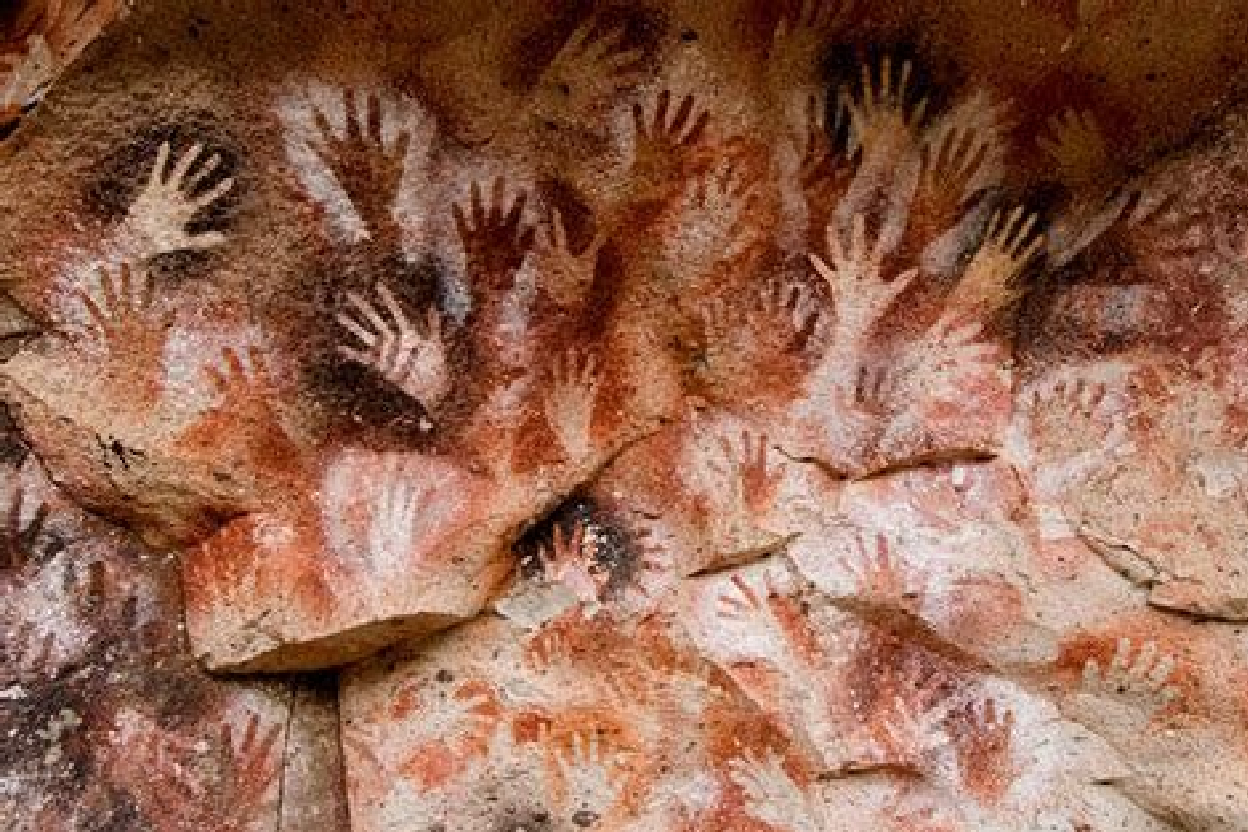
- Ochre hand stencils and linear marks appear across Paleolithic caves worldwide.
⚰️ Ochre in burials (the dead marked with red)
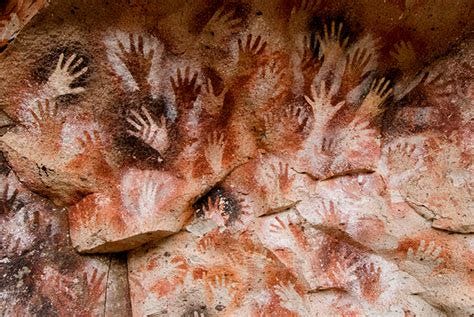
- While the image above shows ochre handprints, it represents the same pigment used in burial contexts across Africa, Europe, and the Near East.
- Archaeological literature documents red ochre sprinkled over bodies in early Homo sapiens and Neanderthal burials, interpreted as symbolic or ritual behavior.
🔴 The colour of blood (symbolic associations)
Although symbolism cannot be photographed, the archaeological record shows:
- Deliberate grinding of hematite to produce vivid red powder.
- Transport of ochre over long distances, implying special value.
- Habitual ritual use emerging around 160,000 years ago, with ochre present in one‑third of African Middle Stone Age sites—strongly suggesting symbolic meaning.
These patterns support the scholarly interpretation that red ochre’s association with blood, life, death, and transformation is ancient and widespread.
The scholar Marija Gimbutas, whose life’s work synthesised the symbolic patterns of Old European prehistoric cultures, argued that this association — red, woman, blood, regeneration — was not coincidental or decorative. It was the structural logic of the earliest known spiritual worldview: that life comes from woman, returns to the earth (herself a woman), and emerges again. The ochre-stained burials of Neanderthals are not primitive superstition. They are the first recorded theological statement, and it concerns the mother.
“The Goddess is the primary deity of Old Europe... the Great Mother who creates and destroys, who is birth, death, and regeneration in one.”— Marija Gimbutas, The Language of the Goddess, 1989
She Is Carved in Stone
Around 38,000 years ago, in the Swabian Alps of what is now Germany, someone carved a small figure from mammoth ivory. She fits in a hand. Her breasts are heavy, her hips wide, her face absent — not overlooked, but deliberately, meaningfully blank. She is not a portrait. She is a principle. The Venus of Hohle Fels is the oldest known figurative sculpture in the world, and she is female.
She is not alone. The Venus of Willendorf, carved around 28,000 BCE. The Venus of Laussel, a bas-relief of a woman holding a bison horn marked with thirteen notches — the lunar months — carved into limestone in the Dordogne. The Venus of Dolní Věstonice, fired from clay around 26,000 BCE in Moravia, making her also the oldest known ceramic object in the world. Hundreds of these figures have been found across a geographic arc from the Pyrenees to Siberia, spanning tens of thousands of years. No comparable corpus of masculine figurines exists from this period. None.
The interpretive instinct has often been to reduce them — fertility fetishes, pornographic objects, idealized bodies. These readings reveal more about the interpreters than the objects. A more serious engagement with their context, their distribution, their careful manufacture, and their recurrence across vast spans of time and space suggests something else: that these objects are votive, that they mark a sacred presence, and that presence is a woman.
The Cave as Her Body
The painted caves of the Upper Palaeolithic — Lascaux, Altamira, Chauvet, El Castillo — have been interpreted primarily as hunting magic, as proto-narrative, as shamanic vision. These readings are not wrong, but they are incomplete. The cave itself is part of the message.
The neuropsychologist David Lewis-Williams has argued extensively that the descent into a deep cave, for a Palaeolithic human, was understood as a descent into another world — a membrane between the living and the sacred. But the membrane was not neutral. The cave’s entrance, dark and narrow; the womb-like chambers within; the resounding silence that swallows sound and self — the structural resonance with female anatomy was not lost on the people who crawled through these spaces with fat-burning lamps and ochre-covered hands. Many of the earliest engravings found in these caves are vulvic. Not incidentally. The cave is her body. To enter the cave is to re-enter the source.
The burials that took place in and around these sites — Neanderthal and early sapiens alike — follow the same logic. The dead return to her. The bones go back into the earth’s body. The red ochre marks the transition. There is grief here, but not only grief. There is confidence: she received the dead once, and she will give life again.
What We Lost, and When
The shift is not sudden, and it is not universal. But it is traceable. With the emergence of settled agriculture, beginning around 10,000 BCE, a slow transformation occurs. Land becomes property. Lineage becomes inheritance. Paternity — previously irrelevant in a world of communal child-rearing and fluid kinship — becomes suddenly consequential. Who a man’s children are matters, because land is now passed through bloodlines. Women’s sexuality, once a sacred and autonomous force, becomes something to be controlled and managed. The great earth goddess does not disappear immediately. She survives, fragmented: as Inanna, as Ishtar, as Asherah (who appears in early Hebrew texts as Yahweh’s own consort, later excised). She endures as the Black Madonna, as Mary, as every stubborn local goddess that the monotheisms absorbed rather than extinguished.
But she has been diminished, deliberately and repeatedly, over millennia. Her temples were built over. Her sacred groves were cut down. Her myths were rewritten to make her a consort, a mother to a male hero, a monster to be defeated. The erasure was not total — nothing so ancient and so structural can be entirely removed — but it was sustained, and we live in its aftermath.
She Did Not Go Anywhere
The impulse persists. It does not need permission or doctrine. It surfaces in every generation: in the women who bring flowers to Mary knowing they are bringing them to something older than Mary; in the seasonal rituals of European folk tradition that no amount of Christianisation could fully unseat; in the felt sense, for which there is no proper theological language in the dominant traditions, that the earth is alive, that it is watching, and that it is not a he.
The masculine sky-god, with his transcendence and his judgement and his distance from matter, is a relatively recent solution to the terror of consciousness. Before him, for most of human time, the solution was different: you are not separate from the sacred. You are inside it. It breathes when you breathe. It bleeds when you bleed. It will receive your bones when you are done with them, and from those bones it will make something new.
This is not naivety. This is not the thought of people who did not know better. The Venus of Hohle Fels is 38,000 years old. She was carved by someone with the same cognitive architecture you carry. She was not a step on the way to something more sophisticated. She was an answer — articulate, carefully made, passed down across generations — to the question of what it means to be alive in a world you did not make.
The question hasn’t changed. Neither has she.
Works cited & further reading
Marija Gimbutas, 1989 — The Language of the Goddess
Marija Gimbutas, 1991 — The Civilization of the Goddess
David Lewis-Williams, 2002 — The Mind in the Cave
Mircea Eliade, 1976 — A History of Religious Ideas, Vol. I
Nicholas Conard, 2009 — A female figurine from the basal Aurignacian of Hohle Fels Cave, Nature
Dusan Boric & others — Ochre and mortuary practices in the Palaeolithic, Journal of World Prehistory
Tikva Frymer-Kensky, 1992 — In the Wake of the Goddesses
Riane Eisler, 1987 — The Chalice and the Blade