

Throughout human history, symbols for knowledge have served as profound bridges between the seen and unseen realms. These sacred emblems, many rooted in goddess traditions and women's spiritual practices, carry encoded wisdom that speaks directly to the soul. When we explore these ancient symbols through a feminine lens, we discover that knowledge itself was once understood as a sacred gift from the Divine Feminine, not merely an intellectual pursuit but a holistic understanding encompassing intuition, body wisdom, and connection to the Earth.
The Serpent as Sacred Wisdom Keeper
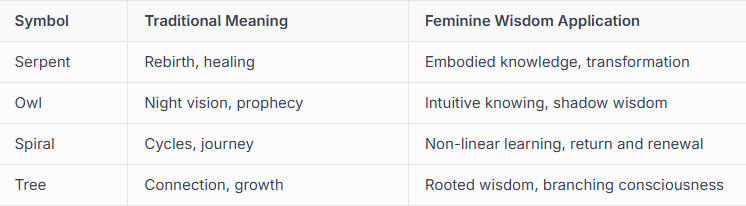
The serpent stands as one of the most ancient and misunderstood symbols for knowledge in human civilisation. Long before patriarchal religions recast the serpent as a symbol of evil, this creature represented regeneration, healing, and profound wisdom in goddess-centred cultures.
Marija Gimbutas's groundbreaking archaeological research revealed that serpent imagery appeared extensively in Old European goddess temples, dating back thousands of years. The serpent's ability to shed its skin represented transformation and renewal - the very essence of knowledge as an evolving, cyclical force rather than static information.
Key aspects of serpent wisdom include:
- Connection to earth energies and chthonic knowledge
- Cyclic renewal and the shedding of outdated beliefs
- Kundalini energy and embodied spiritual awakening
- Healing arts and medicinal knowledge
In ancient Crete, the Snake Goddess figurines depicted priestesses holding serpents aloft, channelling divine wisdom through their bodies. This imagery suggests that knowledge was understood as something experienced physically and spiritually, not merely contemplated intellectually.

Reclaiming Serpent Wisdom Today
For modern seekers on the path of feminine spirituality, the serpent symbol invites us to trust our instinctual knowing. The serpent moves close to the ground, intimately connected with Earth's vibrations. This teaches us that true knowledge comes from staying grounded whilst simultaneously reaching towards higher consciousness.
Monica Sjöö and Barbara Mor documented in The Great Cosmic Mother how serpent symbolism appears across cultures as a feminine principle. The snake's sinuous movement mirrors water, blood flow, and the spiral dance of life itself. When we engage with this symbol, we're tapping into primordial understanding that predates written language.
The Owl: Guardian of Nocturnal Knowledge
Among symbols for knowledge, the owl occupies a unique position as the creature who sees what remains hidden in darkness. Ancient goddess traditions honoured the owl as sacred to Athena, Lilith, and other feminine deities associated with wisdom, foresight, and the mysteries of night.
The owl's connection to feminine knowledge differs markedly from solar, masculine paradigms of enlightenment. Where patriarchal traditions often frame wisdom as bringing things "into the light," owl wisdom acknowledges that some truths live in shadow, in the liminal spaces, in what Carole P. Christ describes as the divine darkness of the feminine sacred.
Embracing Shadow Wisdom
The owl teaches us that not all knowledge comes through brightness and clarity. Some understanding arrives through:
- Dreams and the unconscious realm
- Intuitive flashes that bypass rational thought
- Silence and receptive listening
- Honouring what society has pushed into shadow
Germaine Greer's work on women's ways of knowing emphasises how feminine epistemology often operates through modes dismissed by patriarchal academia - intuition, emotional intelligence, embodied experience, and cyclical rather than linear thinking. The owl, active when the sun-oriented world sleeps, perfectly embodies this alternative approach to wisdom.
The Spiral: Non-Linear Paths to Understanding
The spiral appears repeatedly in ancient goddess sites across Europe, from Newgrange in Ireland to Malta's temple complexes. As one of the most prevalent symbols for knowledge in feminine spiritual traditions, the spiral represents a fundamentally different understanding of how we acquire wisdom.
Marija Gimbutas identified the spiral as a primary motif in Old European goddess culture, appearing on pottery, temple walls, and sacred objects. Unlike the linear progression favoured in masculine educational models, the spiral suggests that knowledge unfolds in cycles. We return to the same lessons at different levels of understanding, each revolution bringing deeper integration.
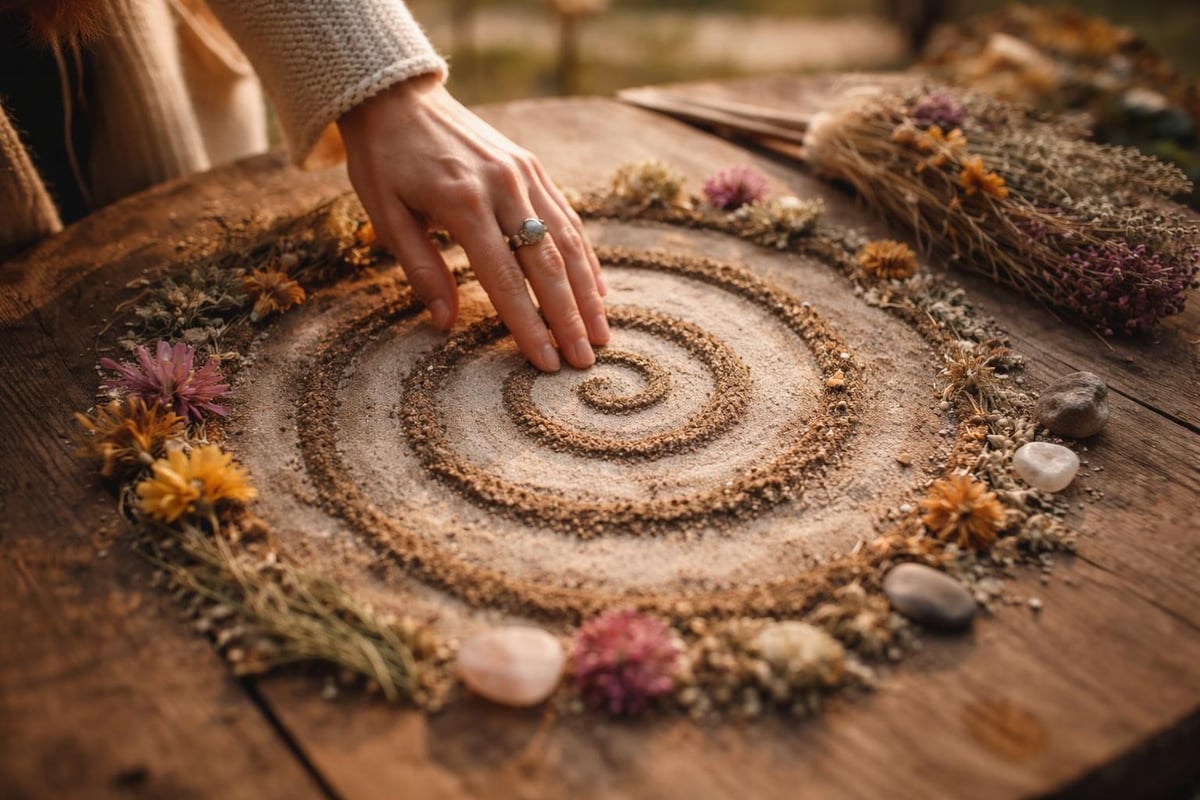 The spiral teaches us:
- Knowledge deepens through return and reflection
- Wisdom isn't a destination but an ongoing journey
- Each cycle reveals new dimensions of familiar truths
- Growth moves simultaneously inward and outward
Living Spiral Wisdom
For those walking a path of feminine spirituality, the spiral offers permission to release linear expectations of progress. You haven't "failed" when you encounter familiar challenges or revisit old wounds. Instead, you're moving along the spiral, approaching these experiences with accumulated wisdom.
This understanding proves particularly liberating for women who've been conditioned to view learning as a competitive, hierarchical process with clear endpoints. The spiral reminds us that wisdom accumulates in layers, like the rings of ancient trees, each marking a season of growth.
The Tree of Life: Rooted and Reaching
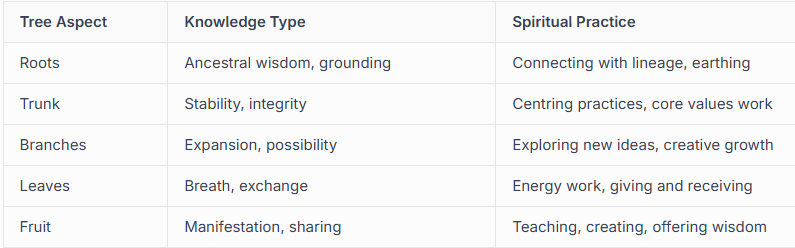
Trees have long served as symbols for knowledge across cultures, representing the connection between earth and sky, underworld and upper world, roots and branches. In feminine spiritual traditions, the tree embodies a particular kind of wisdom - knowledge that remains rooted in body, place, and ancestral memory whilst simultaneously reaching towards cosmic consciousness.
The World Tree appears in Norse mythology as Yggdrasil, but older goddess traditions also honoured sacred groves and individual trees as dwelling places of divine wisdom. Oak groves served as temple spaces for ancient priestesses. Carole P. Christ writes about how goddess spirituality recognises the sacred in nature itself, not as a resource to exploit but as a source of profound teaching.
Tree Wisdom in Daily Practice
Working with the tree as a symbol for knowledge in your spiritual practice might involve spending time with actual trees, noticing their seasonal wisdom. Trees teach patience - an oak doesn't rush its growth. They demonstrate balance - roots must deepen as branches extend. They embody generosity - offering shade, oxygen, and habitat without expectation of return.
Trees also illustrate how knowledge serves life. Unlike wisdom hoarded in ivory towers, tree wisdom is practical, nurturing, and freely shared. This aligns with the ethos found in resources at Goddess Knowledge, where ancient women's wisdom is made accessible for modern spiritual evolution.
The Book and Written Word as Feminine Symbol
Whilst often associated with patriarchal institutions, the book itself carries rich symbolism for knowledge within feminine spirituality when we reclaim it. In goddess traditions, sacred texts and grimoires passed wisdom between women, creating lineages of understanding that patriarchal authorities sought to suppress.
 The burning of libraries, destruction of goddess temples, and persecution of wise women throughout history attempted to erase feminine ways of knowing. Yet women continued encoding wisdom in fairy tales, folk traditions, herbal lore, and secret teachings passed mother to daughter.
Monica Sjöö documented how women's knowledge - particularly regarding birth, healing, and death - was systematically devalued and destroyed. Today, reclaiming the book as a symbol for knowledge means recognising that feminine wisdom deserves to be recorded, preserved, and transmitted with the same reverence given to patriarchal texts.
Creating Your Personal Grimoire
Many women on spiritual paths today maintain journals, grimoires, or Books of Shadows. These personal texts become living symbols for knowledge, documenting:
- Dreams and their meanings
- Ritual experiences and insights
- Herbal remedies and moon wisdom
- Personal reflections and growth patterns
- Goddess invocations and prayers
This practice honours the understanding that your own experience constitutes valid knowledge. You needn't rely solely on external authorities - your lived wisdom, intuitions, and spiritual encounters deserve documentation.
The Cauldron: Transformation and Integration
The cauldron appears across Celtic and European goddess traditions as a powerful symbol for knowledge, representing the alchemical process of transformation that turns experience into wisdom. Unlike symbols suggesting knowledge arrives fully formed, the cauldron acknowledges that understanding requires time, heat, and mysterious processes of change.
In goddess mythology, cauldrons provide inexhaustible nourishment, brew potions of wisdom, and facilitate rebirth. The Cauldron of Cerridwen from Welsh tradition creates the elixir of knowledge through prolonged transformation - a year and a day of constant attention.
Cauldron wisdom teaches:
- Knowledge requires tending and patience
- Transformation happens in darkness and heat
- Different ingredients combine to create new understanding
- Feminine knowledge nourishes and sustains
Germaine Greer's analysis of women's creative processes aligns with cauldron symbolism. Women often synthesise diverse experiences, emotions, relationships, and observations into integrated understanding. This differs from compartmentalised, abstract knowledge production, instead resembling the cauldron's transformative mixing.
Working with Cauldron Energy
Even without a physical cauldron, you can engage this symbol for knowledge by recognising your own being as a transformative vessel. What experiences are you currently processing? What elements of your life need time to simmer together before revealing their wisdom?
The cauldron reminds us that some knowledge cannot be rushed. Healing, integration, and deep understanding emerge according to their own timing, not forced schedules.
The Moon: Cyclical Knowledge and Mystery
The moon stands as perhaps the most universally recognised feminine symbol, and its connection to knowledge runs deep in goddess traditions. The moon teaches through cycles, revealing different faces whilst remaining fundamentally whole - a profound lesson about the nature of wisdom itself.
Marija Gimbutas's research identified lunar imagery throughout Old European goddess culture. The moon's phases represented the triple goddess - maiden, mother, and crone - each holding different forms of knowledge. This challenges linear models suggesting wisdom accumulates steadily with age. Instead, the moon teaches that different life phases and even different moments offer unique access to understanding.
Moon Phases and Knowing
- New Moon: Intuitive knowledge, listening to inner voice
- Waxing Moon: Gathering information, building understanding
- Full Moon: Illumination, seeing connections clearly
- Waning Moon: Release of outdated beliefs, integration
- Dark Moon: Deep mystery, knowledge beyond words
The moon also governs women's menstrual cycles, tides, and plant growth. This connects symbols for knowledge directly to embodied, earthly experience rather than abstract intellectual pursuit. Carole P. Christ emphasises how goddess spirituality validates bodily knowing and natural cycles as legitimate sources of wisdom.
Weaving It All Together
These symbols for knowledge from goddess traditions share common threads. They honour:
- Cyclical rather than linear progression
- Embodied and intuitive knowing alongside intellectual understanding
- Connection to nature, seasons, and earth wisdom
- Transformation and integration over mere information accumulation
- Mystery and shadow as valid realms of knowing
For contemporary women seeking spiritual depth, these ancient symbols offer alternatives to patriarchal knowledge systems that often diminish feminine ways of understanding. When you work with these symbols through meditation, ritual, or contemplation, you're not merely learning about them - you're activating dormant knowing within your own being.
The serpent, owl, spiral, tree, book, cauldron, and moon each provide entry points into vast repositories of women's wisdom. They remind us that knowledge isn't something extracted from the world through domination but something we participate in through relationship, reverence, and receptivity.
As you explore these symbols for knowledge, notice which ones resonate most strongly. Your attraction isn't random - it reflects wisdom your soul seeks to reclaim. Perhaps the serpent calls you towards embodied transformation, or the spiral validates your non-linear journey. Trust these resonances. They're guideposts on your path of sovereignty.
Understanding these ancient symbols for knowledge opens doorways to feminine wisdom that can transform how you navigate your spiritual evolution and daily life. When you ground these symbols in practice through ritual, reflection, and embodied experience, they become living forces rather than mere intellectual concepts. Goddess Knowledge offers transformative resources that help you activate this ancient wisdom, providing rituals and teachings that support your journey of reclaiming the Divine Feminine within and crafting your own sovereign path.