
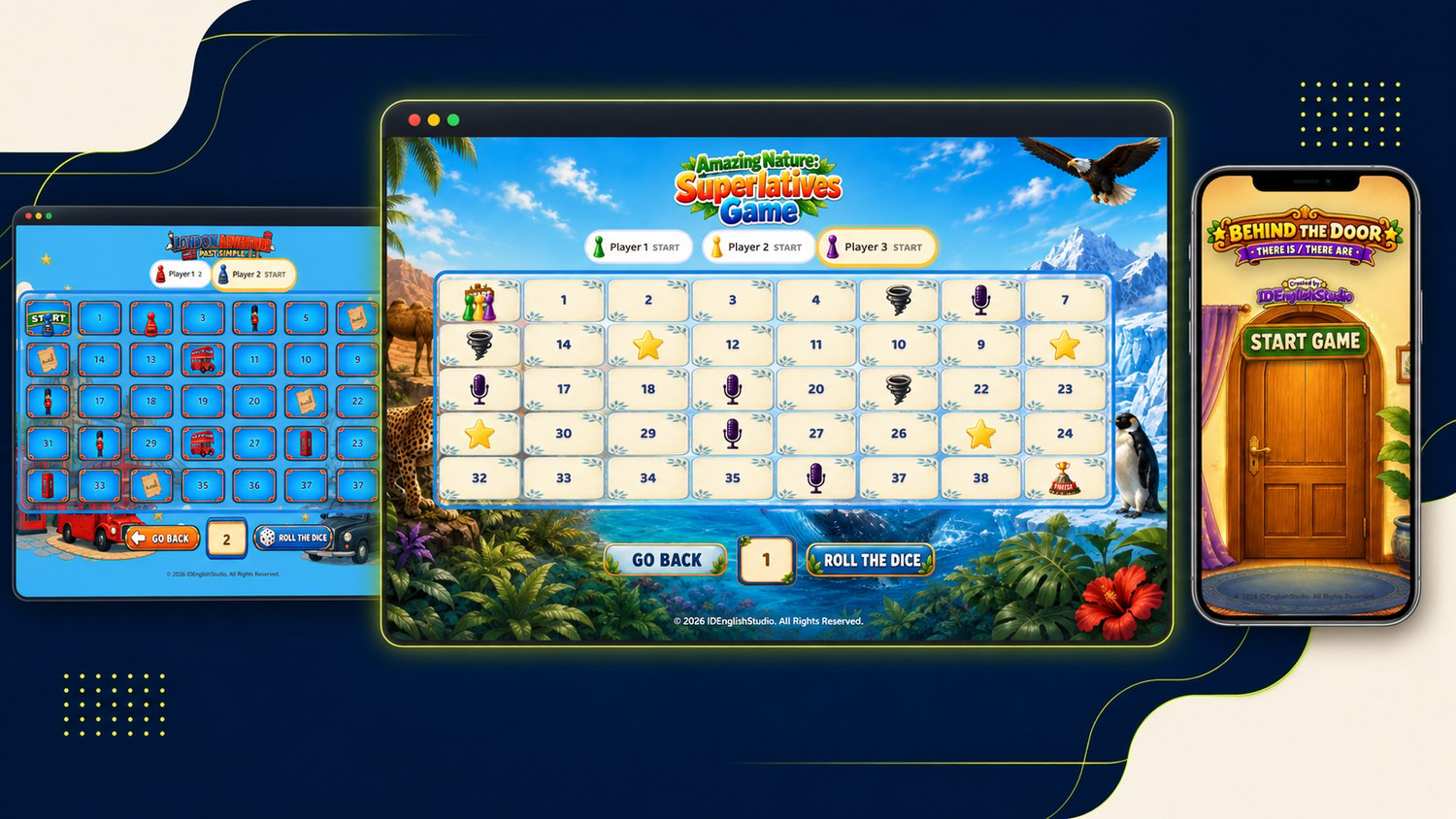
What creating interactive ESL games actually looks like
AI is usually presented as a shortcut: write a prompt and receive a finished resource. My experience is different. A single game can still take days. The biggest benefit is not speed - it is being able to create exactly what I need for a particular lesson.
AI helps from the very beginning
When I start a new game, I choose the grammar point, vocabulary, level and game logic. I discuss possible tasks with AI, but I rarely use everything exactly as it appears. Some questions are too easy, some sound unnatural, and others do not suit my students. I rewrite, simplify and replace them until the content works as a lesson.
AI also helps me create the board, cards, characters and other visual elements. This brings another round of corrections: a wrong word, an unnecessary detail, an inconsistent style or the wrong proportions. One image may need to be generated several times before I can use it.
Then the printable games became interactive
My games first existed as printable PDFs. Later, I decided to turn them into HTML games with a digital die, moving pieces, task cards and answer checking. I am gradually converting the collection, and roughly half of the games now have an interactive version.
The HTML games share one technical engine, but they are not the same template with different titles. Each game receives a new board, tasks, cards, buttons, characters and visual world. The engine is repeated; the game itself is rebuilt.
Where does the time go?
Mostly into checking. I review the grammar and vocabulary, inspect every image, count the spaces on the board, check that each task appears in the correct place, test the buttons and make sure the layout works on different screens. AI can make very confident mistakes, so this stage cannot be skipped.
So why do I keep using AI?
Because it gives me control. Downloading a ready-made activity might be faster, but then I have to adapt my lesson to someone else's vocabulary, examples and level of difficulty. With AI, I can build the material around my lesson instead.
AI speeds up individual steps, but it does not remove the work. For me, its real value is choice: I can make the game look, feel and teach exactly the way I want.
Want to see how these ideas work in practice? Explore my interactive ESL games, each created around a specific grammar point, vocabulary set and visual world. They work offline and can be opened on any device.
Explore the interactive ESL games →
AI does not give me a finished game with one click. It gives me more ways to create the game I actually want.
Comments ()