

Coloring is often dismissed as a childhood pastime—something meant to keep kids busy while adults handle more “important” responsibilities. That assumption is common, but it overlooks the bigger picture. Coloring is not just a nostalgic activity. It is a scientifically supported, highly accessible tool for improving mental clarity, emotional balance, and creative expression across all stages of life.
Many people rediscover coloring the same way—unexpectedly. A stressful day, a quiet moment, a random set of colored pencils. Then something shifts. The mind slows down. The body relaxes. Thoughts stop racing. What seems simple on the surface begins to reveal its depth. Research supports this experience. A study published in Art Therapy found that coloring structured patterns can significantly reduce anxiety levels, offering benefits similar to meditation.
That is the key: coloring is not passive. It actively engages the brain in ways that promote both focus and calm.
More Than a Hobby: What Happens in the Brain
When you color, multiple areas of the brain are activated at once. The prefrontal cortex, responsible for decision-making, helps you choose colors and patterns. At the same time, the amygdala—associated with stress and emotional response—begins to quiet down. This creates a rare combination: alertness without tension.
In a world dominated by constant stimulation, this balance is powerful.
Coloring gives the brain something structured to focus on without overwhelming it. There is no pressure to perform, no requirement to be “good.” The process itself becomes the reward.
1. A Natural Way to Reduce Stress and Anxiety
One of the most immediate benefits of coloring is its calming effect. As you focus on filling in shapes and patterns, your attention shifts away from stressors. This redirection reduces mental clutter and helps lower cortisol, the body’s primary stress hormone.
The repetitive motion of coloring also plays a role. Similar to deep breathing or walking, it creates a rhythm that signals the body to relax. For adults dealing with work pressure, family responsibilities, or digital overload, coloring offers a simple, effective way to decompress.
2. Strengthening Focus and Attention
Coloring requires sustained attention. You must stay within lines, make choices, and follow through on a task. This trains the brain to concentrate for longer periods.
For children, this builds foundational skills for learning—especially in reading and writing. For adults, it sharpens mental clarity in a world filled with distractions. It becomes a practical exercise in focus, disguised as something enjoyable.
3. Unlocking Creativity Without Pressure
Many people believe they are “not creative.” Coloring challenges that believe in a low-risk way. You are not starting from a blank page. Instead, you are working within a structure, which actually makes creativity easier to access.
Choosing colors, experimenting with shading, and exploring combinations all activate creative pathways in the brain. Over time, this spills into other areas—problem-solving, decision-making, and even communication.
It is creativity without intimidation.
4. Improving Motor Skills and Coordination
Coloring is not just mental—it is physical. Holding and controlling a pencil strengthens fine motor skills and hand-eye coordination.
For young children, this is critical. It prepares them for writing and other detailed tasks. For older adults, it helps maintain dexterity and coordination, which are essential for independence.
This makes coloring one of the rare activities that benefits both early development and aging populations in the same way.
5. Boosting Mood Through Completion
There is a unique satisfaction that comes from finishing a coloring page. Psychologists refer to this as the “completion effect.” When you complete a task, the brain releases dopamine—a chemical linked to motivation and reward.
In a world where many tasks feel endless, this matters.
Coloring provides a clear beginning and end. You start with a blank page and end with something tangible, something finished. That sense of completion reinforces positive feelings and encourages you to return to the activity again.
A Practice for Every Stage of Life
What makes coloring truly powerful is its universality.
Children use it to develop coordination and imagination. Teenagers and adults use it to manage stress and reconnect with creativity. Seniors use it to maintain cognitive function and find comfort in a familiar, gentle activity.
Few activities bridge generations this effectively.
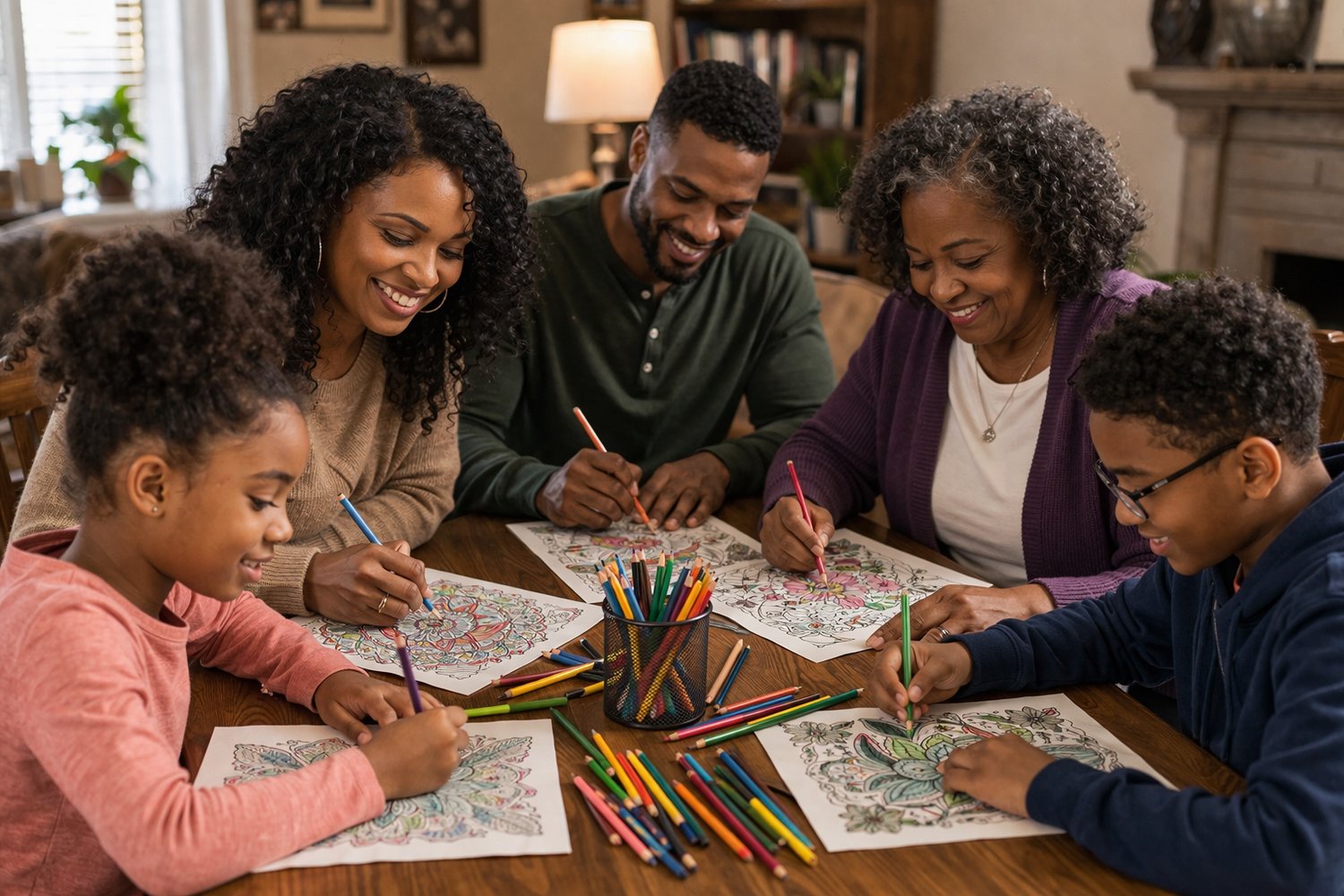
Coloring can also become a shared experience. Families can sit together, each working on their own page while still connecting. Classrooms can use it as a learning tool. Individuals can use it as a quiet, personal ritual.
Getting Started: Keep It Simple
One of the greatest strengths of coloring is how easy it is to begin. You do not need expensive materials or specialized skills.
Start with a coloring book that interests you—nature scenes, abstract patterns, or themed illustrations. Use colored pencils, markers, or even crayons. Create a calm environment—music, tea, or silence—and allow yourself to focus fully on the page.
Over time, you can experiment with techniques like shading, blending, or layering. But none of that is required. The benefit comes from the act itself.
Final Thought: Simple, But Not Small
Coloring may look simple, but its impact is not.
In a fast-paced, high-pressure world, it offers something rare: a way to slow down without disengaging, to focus without stress, and to create without expectation.
It is not just for kids. It is for anyone who needs a moment of calm, a spark of creativity, or a reminder that small, intentional actions can have a lasting effect.
And sometimes, that is exactly what people need most.
Comments ()