
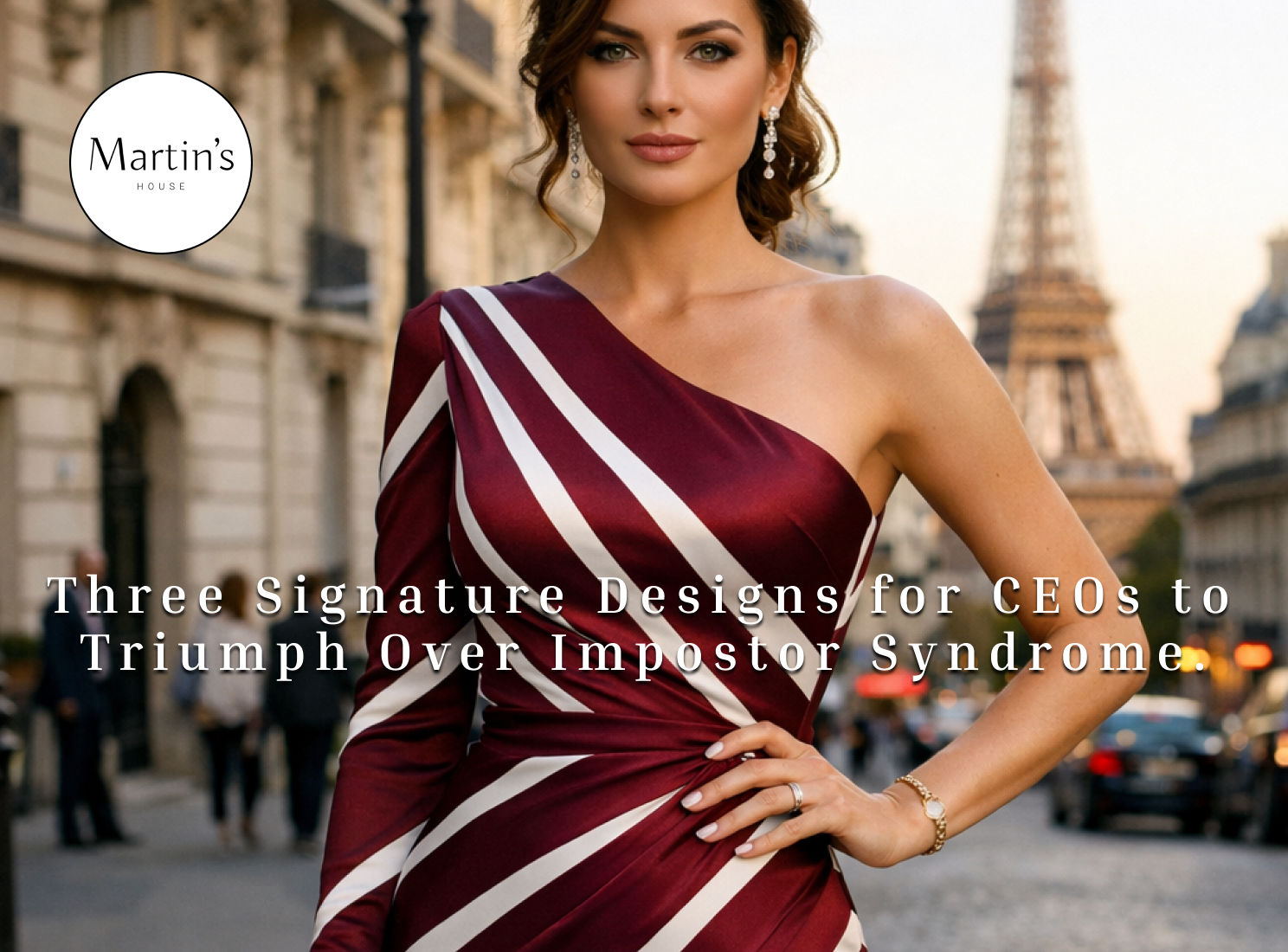
A Mini Fashion Editorial for Female CEOs Who Own the World.
Let’s cut through the noise: if you’re a female CEO reading this story, you’ve probably stood in front of a mirror at 6 AM, staring at a rack of expensive clothes and thinking, “Who am I kidding?” Impostor syndrome doesn’t care if you’ve closed million-dollar deals or built empires from scratch. It creeps in when you least expect it - in boardrooms where your voice is the only feminine one, in investor meetings where you’re questioned twice as hard, in moments when you’re celebrated for “beating the odds”, and all you can think is, “They’ll find out I’m just faking it.” But here’s the secret they don’t teach you in business school: your outfit is more than fabric and thread. It’s your armour. It’s your declaration. It’s the silent language that speaks before you even open your mouth. When you dress like you own the world - because you do - you rewrite the narrative your imposter syndrome is trying to tell. You don’t just look the part; you become it.
You walk into a place that was not designed with you in mind. The table is large, and silence is sharp. Eyes measure you before words do. Your mind races - not because you lack intelligence, experience, or vision, but because something quieter whispers: Do I belong here? That whisper has a name. Impostor Syndrome. At The Martin’s House, we know something most leadership manuals refuse to admit: impostor syndrome is not only psychological. It is embodied. It lives in posture, in hesitation, in how a woman enters a room - and crucially, in how she dresses herself to face the world. Clothing is not decoration. It is architecture. What you wear frames how you occupy space, how you are perceived, and - most importantly - how you perceive yourself. For women CEOs across cultures, beliefs, and histories, dressing is not a matter of vanity. It is a strategy. It is survival. It is sovereignty.
This editorial is for every Christian, Arab, Hebrew, Asian, and Black female CEO who’s ever felt like an impostor in her own corner office. We’ve curated three signature designs for each culture and belief system - each with a colour of strength that honours your identity while shouting your power from the rooftops. No overthinking, no compromising. Just you, amplified, and at the heart of it all? Martin’s House - a sanctuary where struggling CEOs find their voice, their style, and their unshakable confidence. Because when you feel amazing in your skin (and your clothes), impostor syndrome doesn’t stand a chance.
THE MARTIN’S HOUSE: WHERE STYLE MEETS TRANSFORMATION.
Before we dive into the designs, let’s talk about the place that makes it all possible. Martin’s House isn’t a boutique. It’s not a consulting firm. It’s a movement disguised as a studio, tucked away in a sun-drenched corner of London’s Mayfair, founded by former fashion editor-turned-empowerment coach, Sophia Martin. For ten years, she’s been helping female CEOs bridge the gap between who they are and who the world sees - and she’s done it through one simple, powerful tool: clothing. “Every woman who walks through our doors comes with the same story,” Sophia says, her voice as bold as the geometric prints that line her walls. “They’re brilliant. They’re successful. But they don’t feel it. Imposter syndrome wraps itself around their shoulders like a heavy coat, and they can’t seem to take it off. We don’t just design clothes - we design freedom. We help them find colours and silhouettes that honour their culture, their faith, and their genius. Because when you wear your truth, you can’t be an imposter.”
Martin’s House works with a team of designers from every corner of the globe, ensuring that each signature design is rooted in authenticity, not appropriation. Every piece is crafted to make you feel like you’re stepping into your power - whether you’re leading a board meeting, speaking at a conference, or closing a deal over dinner. It’s where Emily Foster found her way back to herself, and where countless other CEOs have discovered that style isn’t just about looking good - it’s about feeling unbeatable.
Why Fashion Matters in the War Against Impostor Syndrome.
Impostor syndrome tells women to shrink. Fashion, when done with intention, tells women to stand. Research confirms what intuition already knows: when a woman feels aligned in her appearance, her confidence, decision-making, and authority increase. This is not about trends. This is about aligning one's inner identity with their outer expression. At The Martin’s House, we design CEO Signature Businesswear with one mission:
To help women lead without fragmentation.
You do not need to dress like someone else to succeed. You need to dress like yourself at your highest level. Below, we present three CEO Signature Designs, adapted across cultures and beliefs, to help women CEOs overcome impostor syndrome - not by pretending, but by claiming their place.
DESIGN I: THE FOUNDATION.
Authority Begins at the Core
This design is about grounding. It stabilises the nervous system - it tells the body, I am safe. I am capable. I am here.
1- The Silhouette
- Structured tailoring
- Clean lines
- Natural fabrics
- Balanced proportions
This is the outfit you wear when you need to feel anchored.
2- Cultural Interpretations.
Christian Female CEOs
- Colours: Ivory, deep blue, soft gold
- Pieces: Tailored trousers, silk blouse, refined blazer
- Symbolism: Integrity, freedom, innovation
Christian women often carry a leadership style rooted in freedom, vision, and responsibility. The Foundation Design gives them clarity and calm authority - never aggressive, never apologetic.
Arab Female CEOs
- Colours: Sand, emerald, midnight black
- Pieces: Long tailored coat, fluid trousers, high-neck silk top
- Symbolism: Dignity, restraint, quiet power
For Arab and Muslim women, authority is expressed through composure. This design respects modesty while reinforcing presence. Nothing is loud. Everything is intentional.
Comments ()