
There was a time when leadership demanded uniformity. A single silhouette. A single language of power. A single way to look, think, speak, and lead. That time is over.
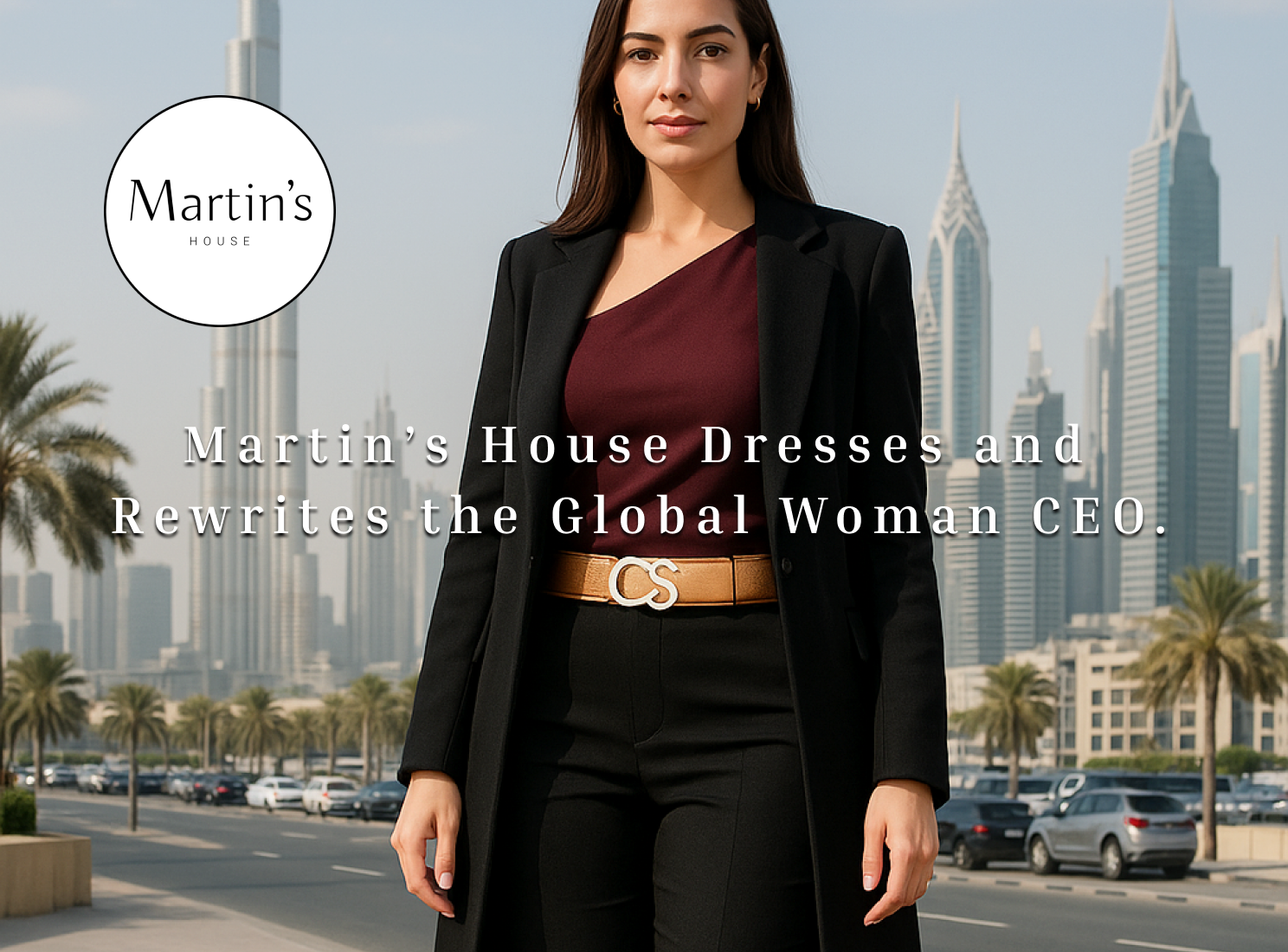
Martin’s House was not created to polish women into sameness. Its purpose was to restore them to themselves, with their authority, elegance and identity intact. This is not fashion as costume. This is not leadership as performance. This is not empowerment that asks women to abandon their culture, faith, or inner language to succeed. “The Martin’s House” dresses and rewrites the global woman CEO – without erasing who she is. And that changes everything.
A New House for a New Kind of Power.
Martin’s House is not simply a brand. It is a House in the couture sense: a place of vision, lineage, and design philosophy. It is also something more radical. It is a cross-cultural editorial and fashion house built for women who lead businesses in a world that still misunderstands them. Christian CEOs navigating freedom and calling. Arab and Muslim CEOs negotiating visibility, tradition, and authority. Jewish women leaders carry wisdom, legacy, and expectation. Asian CEOs are balancing restraint, excellence, and quiet dominance.
Women managers across cultures who dream of leadership – but quietly doubt their own abilities. Martin’s House does not flatten these differences. It honours them. Because identity is not a liability, it is the foundation of power.
1- Fashion as Language: Speaking to Women Before They Speak.
Before a woman CEO speaks, her presence already has. Clothing is not superficial - it’s communicative. It tells the room who she is – before she introduces herself. For decades, fashion asked women to translate themselves into a masculine code of authority. Sharp suits. Neutral palettes. Erased curves. Muted femininity. Martin’s House rejects this entirely. Our fashion philosophy is simple and uncompromising: A woman should never have to erase her culture, her beliefs, or her femininity to lead. Instead, we design CEO Signature Businesswear that speaks every cultural language – without diluting strength.
• Tailored trousers that honour movement and dignity
• Coats that command space without aggression
• Silk blouses that carry softness without fragility
• Dresses that signal authority without apology
Every piece is designed with one question in mind: Who is the woman behind the brand – and how does she want to stand in the world?

The Global CEO Is Not One Woman.
The mistake most leadership brands make is assuming there is one archetype of success. There isn’t.
1- The Christian Woman CEO.
Often driven by freedom, innovation, and calling, she faces a unique tension:
• ambition versus humility
• leadership versus service
• confidence versus spiritual doubt
Her imposter syndrome often sounds like: “Am I allowed to want more? Is my success pride?”
Martin’s House dresses her in confidence that feels aligned – not conflicted. Clothing that affirms her authority without severing her faith.
2- The Arab and Muslim Woman CEO.
Her challenge is different – and often heavier. She navigates:
• visibility within conservative frameworks
• leadership in environments that question her authority
• innovation under restriction
• ambition under scrutiny
Her imposter syndrome is rarely loud. It is quiet and exhausting: “Am I allowed to take space? Can I lead without dishonouring my culture?”
Martin’s House designs with dignity, mystery, and authority, proving that power does not require exposure – and leadership does not require assimilation.
3- The Jewish Woman CEO.
Often raised with legacy, expectation, and intellect, she carries:
• responsibility to tradition
• pressure to perform
• fear of failure as betrayal
Her imposter syndrome sounds like: “If I fail, I dishonour more than myself.”
Martin’s House meets her with precision, structure, and intellectual elegance – a fashion that reflects wisdom, lineage, and modern command.
4- The Asian Woman CEO.
She often leads quietly – but intensely.
• excellence over visibility
• restraint over display
• discipline over noise
Her imposter syndrome whispers: “If I speak too boldly, will I disrupt harmony?”
Martin’s House designs minimalism with intention – pieces that communicate authority through restraint, not silence.
Imposter Syndrome: The Silent Global Enemy.
Across cultures, languages, and belief systems, Imposter Syndrome is a universal phenomenon. It does not discriminate. It adapts. For some women, it sounds like self-doubt, for others, it disguises itself as overwork, perfectionism, or invisibility, but the outcome is the same:
• delayed leadership
• diminished vision
• abandoned dreams
Imposter Syndrome convinces capable women that they are temporary guests in rooms they were born to build. It is dangerous for business managers who are women and stay just below the CEO level. They are close enough to see power, but are unsure whether they are allowed to claim it.
1- Rewriting the Inner Narrative: Identity Before Strategy.
Martin’s House does not start with tactics. It begins with identity. When we talk about leadership frameworks, growth plans, or visibility strategies, we ask: Who are you when no one is watching? Who have you been told you must be to succeed? It is not a lack of skill that prevents most women leaders from succeeding; it is an internal contradiction.
Martin’s House exists to resolve that contradiction – not by changing the woman, but by realigning her with herself.
The Martin’s House Coaching Program: Identity-Led Leadership.
To support women at every level – from business managers to CEOs – The Martin’s House introduces a Signature Identity & Leadership Coaching Framework, adapted across cultures...
Comments ()